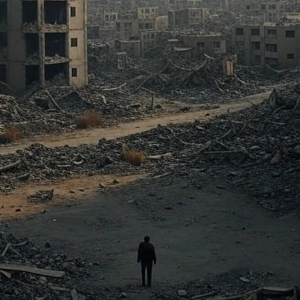
The narrative of Iran’s Islamic Revolutionary Guard Corps (IRGC) as a formidable military force has been peddled for years, amplified by propaganda and echoed by sympathetic global media. Yet, recent Israeli and US strikes have exposed this narrative as flimsy, collapsing under scrutiny. The IRGC’s decimation in these operations reveals a truth long masked by bravado: Iran’s military capabilities, like those of other overhyped regimes in the region, are far less potent than claimed.
History provides clear parallels, from Iraq’s collapse in 1991 to Syria’s implosion and the Arab coalition’s humiliation in 1967. When examined, the pattern is unmistakable—boastful regimes, often backed by Russia, consistently fail to deliver on their rhetoric. The narrative of the IRGC’s military strength and the threats from Iran, Russia, China, and North Korea, often referred to as the “Axis Powers,” could very well simply be hollow posturing.
The Middle East offers a graveyard of militaries whose reputations were inflated beyond reality, only to be exposed in combat. In 1991, Iraq’s army was touted as the world’s third most powerful, hardened by its war with Iran and armed with Soviet weaponry. Yet, in the Gulf War, a US-led coalition crushed Saddam Hussein’s forces in under a month. Operation Desert Storm reduced Iraq’s vaunted tanks and air defenses to rubble, with coalition forces suffering minimal losses. The lesson was stark: a large army, even backed by a superpower like the Soviet Union, is no match for superior technology, strategy, and coordination.
Similarly, Syria’s military was once heralded as a regional powerhouse, equipped with Russian missiles and a disciplined officer corps. Yet, during its civil war, Assad’s forces buckled against ragtag militias and rebel groups. Despite numerical superiority and Russian support, the Syrian army failed to secure its territory, relying on Iranian proxies and Russian airstrikes to survive. The myth of Syrian strength vanished as its defenses collapsed against non-state actors, revealing the fragility beneath the propaganda.
A bit further back in contemporary history, the 1967 Six-Day War provides another stark example. Egypt, Syria, and Jordan, backed by Soviet arms and advisors, launched an attack on Israel, confident in their combined might. They boasted of driving Israel into the sea, but Israel’s preemptive strikes destroyed their air forces in hours, and within six days, the Arab coalition was routed. This war remains a case study in how bloated reputations, fueled by political posturing, crumble when tested by a disciplined adversary.
A recurring theme in these failures is Russian support, which has proven more liability than asset. Iraq, Syria, and the 1967 Arab coalition all relied on Soviet or Russian weaponry and training, yet each was outclassed by Western militaries. This pattern continues today. Russia’s war in Ukraine has shattered the myth of its own military prowess. Once feared as a near-peer adversary to NATO, Russia’s forces have been hampered by logistical failures, outdated equipment, and low morale. Ukraine, with Western backing, has exposed Russia’s weaknesses, from its overhyped T-90 tanks to its faltering air force. If Russia, a supposed superpower, struggles against a smaller neighbor, what does this say about its allies like Iran?
The IRGC, like its predecessors, depends on Russian technology and strategic support. Yet, recent Israeli and US strikes have shown the IRGC’s inability to counter advanced Western systems. Precision airstrikes have dismantled IRGC bases, missile stockpiles, and command structures with surgical efficiency, while Iran’s air defenses—often Russian-supplied—failed to respond effectively. The IRGC’s drone and missile programs, while capable of asymmetric harassment, have proven no match for Israel’s Iron Dome or US air superiority. This is not the hallmark of a potent military but one overhyped by its own propaganda.
Iran’s allies in the so-called Axis Powers—Russia, China, and North Korea—face similar scrutiny. China’s military, particularly its navy, presents a formidable threat due to its sheer size, boasting more ships than the US Navy. However, its weaponry remains inferior, with Western analysts noting that Chinese naval technology, such as its missile systems and electronic warfare capabilities, lags a generation behind US assets like the Aegis combat system and nuclear submarines. Despite Beijing’s aggressive posturing in the South China Sea, its untested forces rely on numerical strength rather than qualitative superiority.
North Korea, meanwhile, depends on outdated Soviet-era equipment and a malnourished, undertrained military. Its nuclear arsenal, while a threat, is more about deterrence than practical warfighting capability. The regime’s bellicose rhetoric masks a military that would struggle against modern forces, as evidenced by its reliance on cyber warfare and asymmetric tactics rather than conventional strength.
So, the question remains: are the threats from Iran, Russia, China, and North Korea mere bravado? History suggests they are. The IRGC’s recent losses underscore a recurring theme—regimes that project strength through propaganda often falter when confronted. Iran’s missile barrages and proxy networks may intimidate neighbors, but they crumble against adversaries with superior technology and intelligence. Russia’s quagmire in Ukraine, China’s reliance on quantity over quality, and North Korea’s hollow posturing all point to a gap between rhetoric and reality.
This is not to dismiss these nations as harmless. Asymmetric tactics, cyberattacks, and proxy wars can cause disruption. But the narrative of the IRGC—or its Axis allies—as unstoppable juggernauts and equals to the West is a fantasy. The US and Israel, with their technological edge and battle-tested doctrines, have repeatedly exposed the hollowness of such claims, the IRGC’s decimation just the latest chapter in a long history of overhyped militaries collapsing under pressure.
The narrative of Iran’s IRGC as a potent military force is a carefully crafted illusion, one that recent strikes have shattered. Like Iraq in 1991, Syria in its civil war, and the Arab coalition in 1967, Iran’s capabilities have been exposed as vastly overrated. Russian support, a common denominator in these failures, has proven unreliable, and the broader Axis of Iran, Russia, China, and North Korea increasingly appears to be a coalition of bluster rather than strength. And while China’s military size poses a challenge, its inferior weaponry limits its threat.
The lesson is clear: propaganda cannot substitute for capability. As long as Western militaries maintain their technological and strategic edge, the chest-thumping of these regimes will remain just that—noise, not power.
Then, when we return, our segment on America’s Third Watch, broadcast nationally from our flagship station WGUL AM860 & FM93.7 in Tampa, Florida.
In Closing…
As we wrap up today’s episode, don’t forget to subscribe and share, and let’s remember this: truth and honest discussion are the foundational bedrock of freedom.
In the United States and across the globe, open dialogue—rooted in facts, not fear—guards against tyranny, preserving our liberties. When we challenge ideas, seek fact-based evidence, and listen with open minds, we strengthen the bonds of our free society. Censorship and half-truths erode trust, but candid conversations build resilience.
So, keep questioning, keep speaking, and keep seeking the truth. It’s not just a right—it’s a responsibility. Until next time, stay curious, stay bold, and let’s keep the flame of freedom burning bright.
Until next time…
Get full access to Underground USA at
www.undergroundusa.com/subscribe