I share reflections on last night's Harris-Trump Debate in the first two minutes of this podcast.
In the rest of the podcast, I review Yuval Noah Harari's newest book.
Harari is one of my top three favorite authors. I also love Bill Bryson and Walter Isaacson.
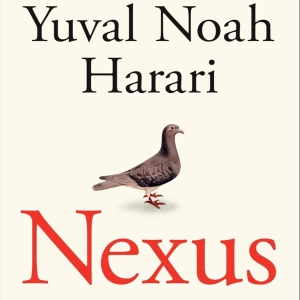
Therefore, I was thrilled that a few months ago, I got an advanced copy of Nexus: A Brief History of Information Networks from the Stone Age to AI, which launches today, September 10, 2024.
It's a 515-page book but is filled with headers over its 11 chapters, making it modular and readable.
I also reviewed his previous book, 21 Lessons for the 21st Century.
I loved Nexus, although Homo Deus is still my favorite Harari book.
Nexus explores the evolution of information networks from prehistoric times to the present, focusing mainly on the impact of artificial intelligence (AI) on society.
Outline
There are 3 parts:
Part 1: Human Networks focuses on history and how information went from clay tablets to silicon.
Part 2: The Inorganic Network focuses on the internet age and the birth of AI. It discusses how computers differ from printing presses and how the information networks are relentless and fallible.
Part 3: Computer Politics focuses on how AI will enter every aspect of our lives, governments, and businesses. He discusses democracies, totalitarianism, and the Silicon Curtain (how China and the West have different internets and AIs).
Overview and Themes
In Nexus, Harari argues that human history has been profoundly shaped by our ability to create and share narratives, which he identifies as the foundation of our social structures.
He posits that information networks—from oral traditions to the internet—serve as the "glue" that holds societies together.
The book emphasizes the dual nature of information: while it can foster cooperation and understanding, it can also propagate falsehoods and manipulation, particularly in the age of AI.
Nexus is more urgent and personal than Harari's previous works. It tackles contemporary issues related to AI, warning about its potential to manipulate human behavior without direct control.
Harari connects historical developments, such as the rise of farming and cities, to the evolution of information networks.
Nexus mixes historical analysis and philosophical reflection with Harari's trademark ability to provoke thought about the implications of modern technology.
His exploration of how AI could reshape human existence is captivating and unsettling, prompting you to reconsider your relationship with technology.
One fascinating observation is that governments used to spend 80% of their budgets on the military. Today, they spend about 10% on the military and more on healthcare.
Critique
Harari makes the same error that many nonfiction books do: they spend 95% of the book complaining and 5% of the time discussing the solution.
Conclusion
Happily, Harari isn't bleak or hopeless. He isn't overly pessimistic about our future. He believes we're at a critical crossroads, akin to when Christian scholars decided what books would make it into the Bible. What we do today will have an impact forever.
Totalitarianism loves AI's ability to survey and process data to keep the population in check.
However, totalitarianism hates that AI is a black box that is unpredictable and hard to control. Totalitarianism may become dependent on AI to make wise decisions, and it may falter, especially if the AI doesn't do what's best for the totalitarian leader.
Harari believes that democracy will triumph over totalitarianism because democracy is self-correcting and open to criticism. It's constantly adjusting to the wisdom of the crowds, whereas totalitarianism is rigid.
Ultimately, he believes that strong, wise institutions will help us incorporate the best of AI while avoiding its follies and dangers.
Nexus contributes to the discourse on AI and its societal implications. While it may not achieve the same universal acclaim as Harari's earlier works, like Sapiens or Homo Deus, it offers a compelling examination of how information networks have evolved and the urgent questions they raise for the future.
Readers looking for a blend of history, philosophy, and contemporary relevance will find much to ponder in Harari's latest offering.
After my verdict, I have included some excerpts from the book so you can get a feel for what it covers.
VERDICT: 9 out of 10 stars.
Excerpts
To conclude, the new computer network will not necessarily be either bad or good. All we know for sure is that it will be alien and it will be fallible. We therefore need to build institutions that will be able to check not just familiar human weaknesses like greed and hatred but also radically alien errors. There is no technological solution to this problem. It is, rather, a political challenge. Do we have the political will to deal with it? Modern humanity has created two main types of political systems: large-scale democracy and large-scale totalitarianism.
==========
Another common but mistaken assumption is that creativity is unique to humans so it would be difficult to automate any job that requires creativity.
==========
third mistaken assumption is that computers couldn’t replace humans in jobs requiring emotional intelligence, from therapists to teachers.
==========
If it means the ability to correctly identify emotions and react to them in an optimal way, then computers may well outperform humans even in emotional intelligence. Emotions too are patterns.
==========
Actually, computers may outperform humans in recognizing human emotions, precisely because they have no emotions of their own. We yearn to be understood, but other humans often fail to understand how we feel, because they are too preoccupied with their own feelings. In contrast, computers will have an exquisitely fine-tuned understanding of how we feel, because they will learn to recognize the patterns of our feelings, while they have no distracting feelings of their own.
==========
Actually, computers may outperform humans in recognizing human emotions, precisely because they have no emotions of their own. We yearn to be understood, but other humans often fail to understand how we feel, because they are too preoccupied with their own feelings. In contrast, computers will have an exquisitely fine-tuned understanding of how we feel, because they will learn to recognize the patterns of our feelings, while they have no distracting feelings of their own. A 2023 study found that the ChatGPT chatbot, for example, outperforms the average human in the emotional awareness it displays toward specific scenarios.
==========
If three years of high unemployment could bring Hitler to power, what might never-ending turmoil in the job market do to democracy?
==========
The most important human skill for surviving the twenty-first century is likely to be flexibility, and democracies are more flexible than totalitarian regimes.
==========
The rise of unfathomable alien intelligence undermines democracy. If more and more decisions about people’s lives are made in a black box, so voters cannot understand and challenge them, democracy ceases to function.
==========
Power lies at the nexus where the information channels merge.
==========
For most of recorded history, the military was the number one item on the budget of every empire, sultanate, kingdom, and republic.
==========
For many people in the 2010s, the fact that the health-care budget was bigger than the military budget was unremarkable. But it was the result of a major change in human behavior, and one that would have sounded impossible to most previous generations.
==========
It places a heavy responsibility on all of us to make good choices. It implies that if human civilization is consumed by conflict, we cannot blame it on any law of nature or any alien technology.
==========
It places a heavy responsibility on all of us to make good choices. It implies that if human civilization is consumed by conflict, we cannot blame it on any law of nature or any alien technology. It also implies that if we make the effort, we can create a better world.
==========
It places a heavy responsibility on all of us to make good choices. It implies that if human civilization is consumed by conflict, we cannot blame it on any law of nature or any alien technology. It also implies that if we make the effort, we can create a better world. This isn’t naïveté; it’s realism.
==========
The invention of AI is potentially more momentous than the invention of the telegraph, the printing press, or even writing, because AI is the first tool that is capable of making decisions and generating ideas by itself.
==========
The good news is that if we eschew complacency and despair, we are capable of creating balanced information networks that will keep their own power in check. Doing so is not a matter of inventing another miracle technology or landing upon some brilliant idea that has somehow escaped all previous generations. Rather, to create wiser networks, we must abandon both the naive and the populist views of information, put aside our fantasies of infallibility, and commit ourselves to the hard and rather mundane work of building institutions with strong self-correcting mechanisms. That is perhaps the most important takeaway this book has to offer.
==========
This wisdom is much older than human history. It is elemental, the foundation of organic life. The first organisms weren’t created by some infallible genius or god. They emerged through an intricate process of trial and error. Over four billion years, ever more complex mechanisms of mutation and self-correction led to the evolution of trees, dinosaurs, jungles, and eventually humans. Now we have summoned an alien inorganic intelligence that could escape our control and put in danger not just our own species but countless other life-forms. The decisions we all make in the coming years will determine whether summoning this alien intelligence proves to be a terminal error or the beginning of a hopeful new chapter in the evolution of life.
Get full access to Francis Tapon at
ftapon.substack.com/subscribe