On the 100th anniversary of George Mallory and Sandy Irvine's death on Mount Everest, I interviewed Dr. Robert Edwards, author of Mallory, Irvine, and Everest: The Last Step But One, which reexamined their mysterious story in extreme detail.
Watch my original interview with Dr. Edwards, my most popular interview in 2024. It provides an excellent background for today's interview.
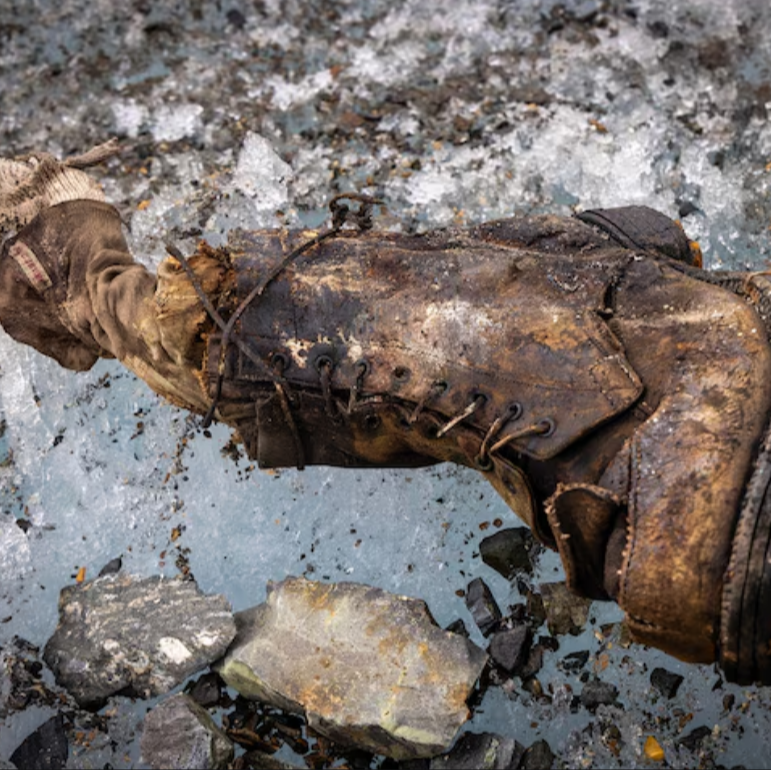
Today, Dr. Edwards returns to the WanderLearn Show to discuss Jimmy Chin's surprising October 2024 announcement that he found Andrew Comyn Irvine's foot! Andrew Irvine's nickname was Sandy.
Watch the VideoPhoto by National Geographic
Image copyright: National Geographic
National Geographic sponsored the expedition and announced the momentous news. The rest of Sandy's body has not been found yet.
Sandy died 100 years ago. In 1960, Chinese climber Wang Fuzhou claimed he spotted a dead European climber who had to be Sandy Irvine. Assuming that sighting was accurate, nobody has seen Irvine since then ... until now.
Famed mountaineer and photographer Jimmy Chin found Sandy's foot inside the 100-year-old boot.
Robert Edwards wrote his initial impressions of Sandy's discovery on Goodreads.
In this interview, we delve into greater detail, including the map Dr. Edwards made:
In the podcast, I struggled to understand why Dr. Edwards thought Sandy's foot may have been found either in pin v1 or v2.
After the interview, I reflected more carefully and realized that the Central Rongbuk Glacier is sliding west (right in the image). I initially assumed it was sliding north (down the image).
Excerpt of Dr. Edwards's Goodreads post
I can think of at least two scenarios which are consistent with the new discovery:
• On June 8, 1924, Irvine fell from somewhere on the North Face of Everest to the head of the Central Rongbuk Glacier. If so, it seems to me that, given the topography of Mount Everest, the start of that fall had to be either within, or to the west of, the Norton Couloir. In that case, Irvine fell at least 500 meters to the west of where Mallory's body was found.
• On June 8, 1924, Irvine became immobilised or died in the place where on May 24 or 25, 1960, the Chinese mountaineer Wang Fu-zhou would see the body of “a European in braces” [for North Americans: suspenders]. The Chinese route was along the Northeast Ridge. According to reports of a speech in Leningrad in 1965, Wang saw the body at 8,600 meters (28,215 feet): that is, between the Second Step and the Third Step. If so, the body could only be that of Irvine; and he had died on the descent. In this scenario, at some unknowable date after 1960, natural events carried Irvine's body down the mountain to the head of the glacier.
In both scenarios, the implacable creep of the ice carried part of Irvine's remains to the place where Jimmy Chin found them in September 2024.
The first scenario excludes the second: for if in 1924 Irvine fell to the glacier, Wang Fu-zhou in 1960 could not have seen a body of any kind at 8,600 meters. No doubt, other scenarios are conceivable.
What next?
Undoubtedly, the China-Tibet Mountaineering Association will conduct an expedition to find the rest of Irvine’s body and any artifacts associated with it; or will permit National Geographic to undertake such an endeavour. The search could possibly be made before the winter; otherwise, the next window will probably be the spring of 2025. Irvine’s body and artifacts will surely be found.
The Chinese authorities also have the opportunity to examine Irvine’s boot for rock particles, which might reveal where he had been before he died. (As far as I can determine, Mallory’s boots were never tested in this way.)
In either event, we may then know more about the last climb of Mallory and Irvine.
Dr. Edwards added in an email to me:
In case I didn't explain clearly the difference between the two pins in the Google Earth image: pin v1 is based on ice velocity of 10 meters/year; pin v2 is based on ice velocity of 27 meters/year (based on a range of Chinese estimates for the East Rongbuk Glaicier).
In both cases, the pin assumes movement of the remains over 100 years, i.e. assuming that Irvine fell all the way to the glacier in 1924. So Pin v1 is 1,000 meters downstream; pin v2 is 2,700 meters downstream.
If Irvine's remains fell after 1960 (which, given Wang's sighting, I'm inclined to think more probable), both pins would be much closer to the head of the glacier. Pin v1 would be at most 640 meters downstream; pin v2 would be at most 1,728 meters downstream.
Both pins hug the western rim of the glacier, since I'm inclined to think that objects starting near the rim will remain near the rim. (A glaciologist would know.)
More info
You can post comments, ask questions, and sign up for my newsletter at http://wanderlearn.com.
If you like this podcast, subscribe and share!
On social media, my username is always FTapon. Connect with me on:
My Patrons sponsored this show!
Claim your monthly reward by becoming a patron at http://Patreon.com/FTapon
Rewards start at just $2/month!
Affiliate links
Get 25% off when you sign up to Trusted Housesitters, a site that helps you find sitters or homes to sit in.
Start your podcast with my company, Podbean, and get one month free!
In the USA, I recommend trading crypto with Kraken.
Outside the USA, trade crypto with Binance and get 5% off your trading fees!
For backpacking gear, buy from Gossamer Gear.
Get full access to Francis Tapon at
ftapon.substack.com/subscribe