#3 What was the Earth like 500 million years ago ? | Documentary History of the Earth
Author: Orbinea Studio
July 15, 2023
Duration: 14:47
🌍 Where do we come from?
How was the world around us formed?
Powerful engines of reflection, these questions answer a visceral need to know our origins, our belonging and to understand this world around us.
Our planet, the Earth, is a planet similar to the others. Like the others, it is unique. The planets share a part of their history but have then evolved differently developing their own individualities. The Earth is the only planet known to harbor life. Among all the organisms that have succeeded each other, one of them has demonstrated a strong capacity to master its environment and adapt it to its needs: Man.
Man hates ignorance. He therefore started to study these questions very early on in order to understand the Earth. But can we really claim to know the Earth when so many interpretations and uncertainties come into play? Man studies the subject, first through philosophy, then through geology. The study of the lithosphere reveals an astonishing amount of information allowing us to go back to its formation. Today, a history of the Earth since its birth is written, but the scenario is not fixed and will continue to evolve with the discoveries. Its appearance has not always been that of the beautiful, calm and peaceful blue planet. Its birth and its "early childhood" took place in chaos, an unprecedented hell in which unimaginable heat reigns.
How did it evolve to become the Earth as we know it today?
What did the Earth look like 500 million years ago?
🔥 As a reminder, videos are published on SUNDAYS at 6:00 PM.
-------------------------
💥 What did the Earth look like 500 million years ago? :
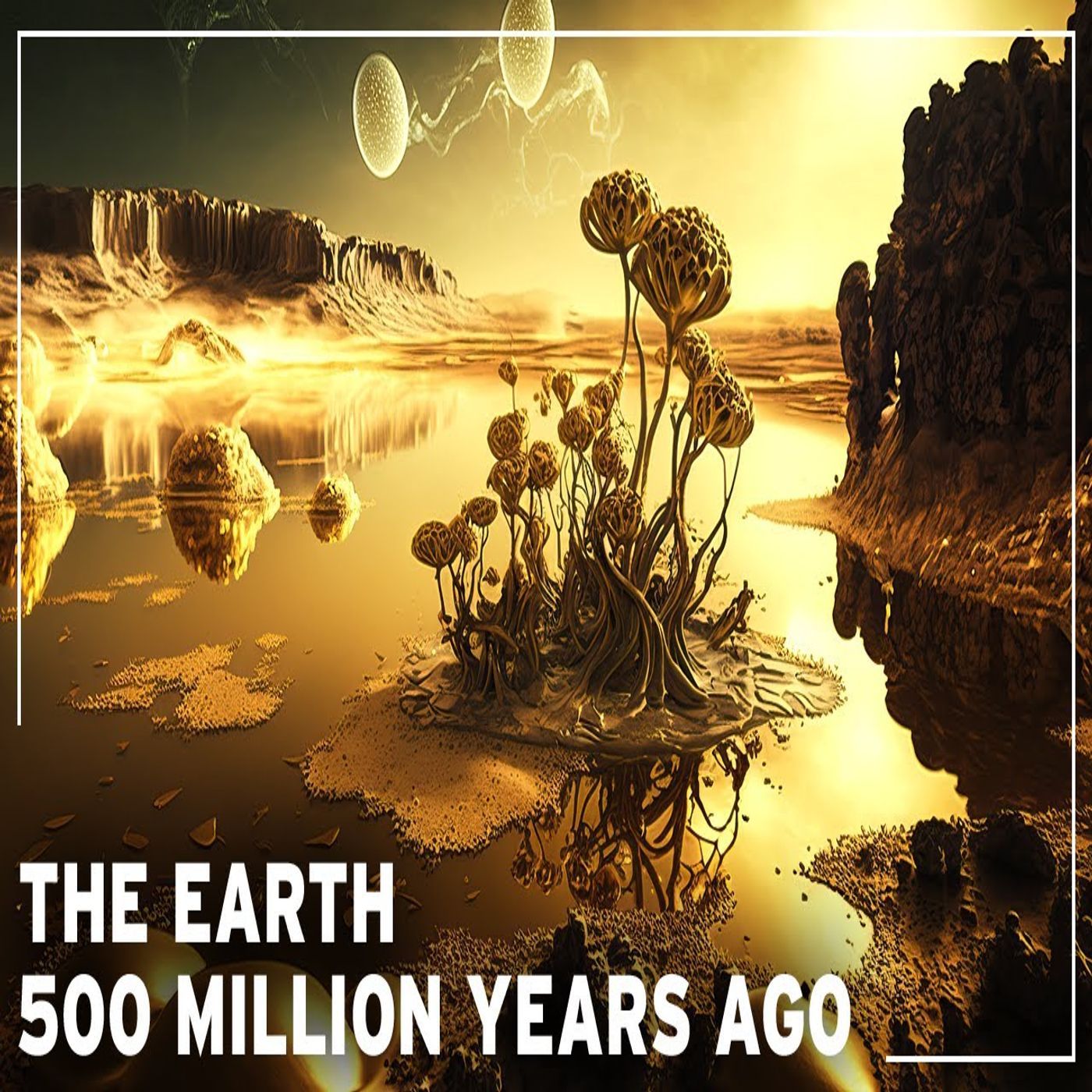
- The Earth offered a desolate landscape until then. Lava flows from volcanoes rolled down its sides. Now immobile, they still crackle but slowly freeze. Lakes of yellow, blue or grey mud are bubbling. The heat coming from the bowels of the Earth bursts on the surface of these muds in thick bubbles. When the first volcanoes appear on the surface of the Earth, they contract in extraordinarily violent eruptions before cooling down and building gigantic mountains made of ash and lava. Over the years, these rocks evolve into mud and clay under the action of wind and rain. The debris is carried away by torrents and carried to the sea, then accumulates and forms shales and sandstones. At the same time, the continents, continuously in motion, are moving. When they meet, the surrounding sediments are dragged along and compressed to form new mountain ranges. As geological cycles progress, volcanoes erupt, then die out and life proliferates on the sea floor. As for the dry land, it remained sterile. Until the day when...
Four large continents remain: Laurentia, Baltica, Siberia and Gondwana. They are drifting. Facing Laurentia, the margin of Gondwana begins to crumble into several small continents, the first individualized is Avalonia. Its distance diminishes the Iapetus Ocean and opens the Rheic Ocean. This is the beginning of the Caledonian orogeny.
-------------------------
🎬 On the program today:
- 00:00 - Introduction
- 01:45 - The Earth 500 million years ago
- 03:48 - The first colonies on land
- 08:26 - The face of the Earth 460 million years ago
- 16:23 - The first great crisis of life: the Ordovician-Silurian extinction
- 24:55 - The appearance of insects 425 million years ago
- 26:48 - End of the Caledonian orogeny
- 27:16 - Innovations in the plant world
- 30:59 - The continent of the Old Red Sandstone
- 31:44 - A new environment and new species
- 36:06 - Devonian glaciations and second mass extinction
- 43:28 - Aquatic animals develop legs: appearance of tetrapods
- 47:40 - The landscape of the Earth
- 49:17 - The Hercynian orogeny and the beginning of the formation of Pangea
- 49:53 - New plants
- 51:22 - Development of the...