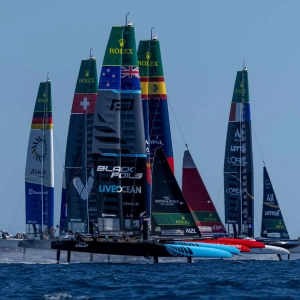
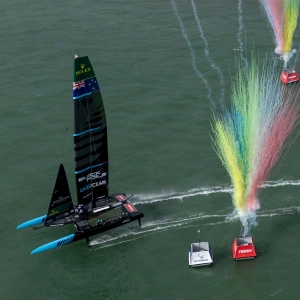
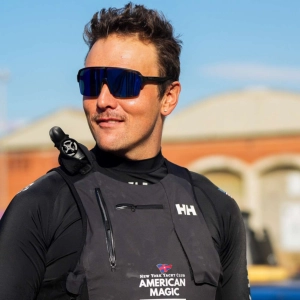
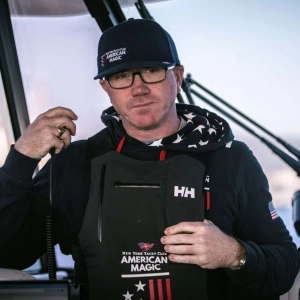
In the latest Yacht Racing Life Podcast, host Justin Chisholm and regular guest Magnus Wheatley dissect the SailGP regatta held in Saint-Tropez, a weekend dominated by tricky conditions, new technical challenges, and some standout performances.
The French event saw Mistral winds wiped out Friday’s practice and cancel Sunday’s racing, leaving Saturday’s four races to decide the outcome.
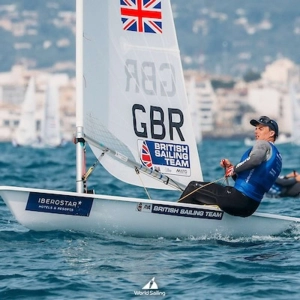
The British team emerged victorious, not through dazzling dominance but through consistency and resilience. Wheatley hails strategist Hannah Mills as the MVP, noting her sharp, concise communication with helm Dylan Fletcher. Together, they turned potential setbacks into solid results, epitomising the Olympic mindset of avoiding disasters and maximising opportunities. Their ability to read a critical wind shift in the final race secured the event win and valuable season points, keeping them firmly in the hunt for SailGP’s multimillion-dollar prize purse.
Saint-Tropez featured small rigs and new high-speed rudders, whose thinner profiles and longer chords seemed to leave many crews struggling. Boat handling across the fleet looked ragged, with several teams hobby-horsing and nose-diving. Wheatley bluntly describes the overall standard as “bang average,” surprising for this stage of the season. Some teams, like Germany, showed logical progress, while others stagnated mid-fleet.
The Italians drew particular attention after snatching a race win with a bold tack into a private shift. While Chisholm sees this as a potential breakthrough moment, Wheatley is sceptical, pointing out their inconsistent results and rigid tactical playbook. By contrast, he praises the Australians, New Zealanders, and British for their willingness to improvise and push limits, epitomised by Tom Slingsby sailing perilously close to the rules.
One flashpoint was a mark-rounding incident between Australia and New Zealand. Debate centred on whether an overlap existed, with Wheatley emphasising the limitations of broadcast graphics compared to the precise data available to on-water umpires like Craig Mitchell. Both agreed the system is fair overall, though the margins—sometimes as fine as 20 centimetres—highlight how close to the edge these races are.
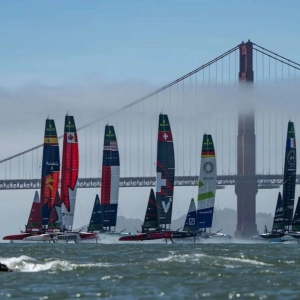
Starting tactics were another theme. Several chaotic starts, particularly from Canada, the USA, and France, demonstrated the risks of overcrowded lines. Wheatley suggested SailGP’s stadium format, with only a handful of viable starting spots, creates a two-tier fleet dynamic. With 14 teams expected next season, he advocates splitting the fleet to ensure fairer, closer racing.
Beyond performance, the conversation touched on SailGP’s equipment and future. The Southampton tech team earned praise for their rapid repairs, but Wheatley questioned whether the F50 platform remains fit for purpose. He floated the idea of smaller boats or even a wholesale redesign, noting that several designers had told him the current configuration would not be chosen if starting fresh. With Larry Ellison’s huge resources, new boats are theoretically possible, though Russell Coutts currently favours incremental upgrades.
Looking ahead, both pundits anticipate different dynamics in Geneva, where light-wind foils will debut, enabling racing in as little as seven or eight knots. Wheatley sees opportunities for Italy, Britain, and Canada to capitalise, while also keeping an eye on underperformers like Switzerland and the USA, and on Germany’s encouraging rise.
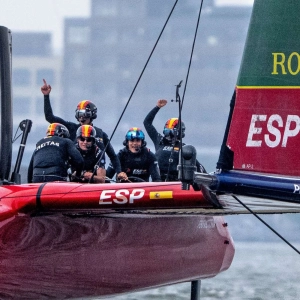
The episode closes with reflections on team dynamics. Wheatley contrasts Canada’s fraught atmosphere with the British team’s harmony, emphasising the crucial role of communication and coaching. He credits coach Rob Wilson’s tactical calls as another factor in the British success. Ultimately, both commentators believe the season finale will boil down to the established trio of Australia, New Zealand, and Britain, with Spain an outside contender after a steady showing.
Despite criticising the spectacle as a “donkey derby” at times, Wheatley acknowledges the intensity and jeopardy that keep SailGP compelling. For Chisholm, the regatta underlined both the flaws and fascination of the format, setting up intriguing battles for the remaining events in Geneva and Cádiz.
Image © Felix Diemer for SailGP
This is a public episode. If you'd like to discuss this with other subscribers or get access to bonus episodes, visit
www.yachtracinglife.com/subscribe