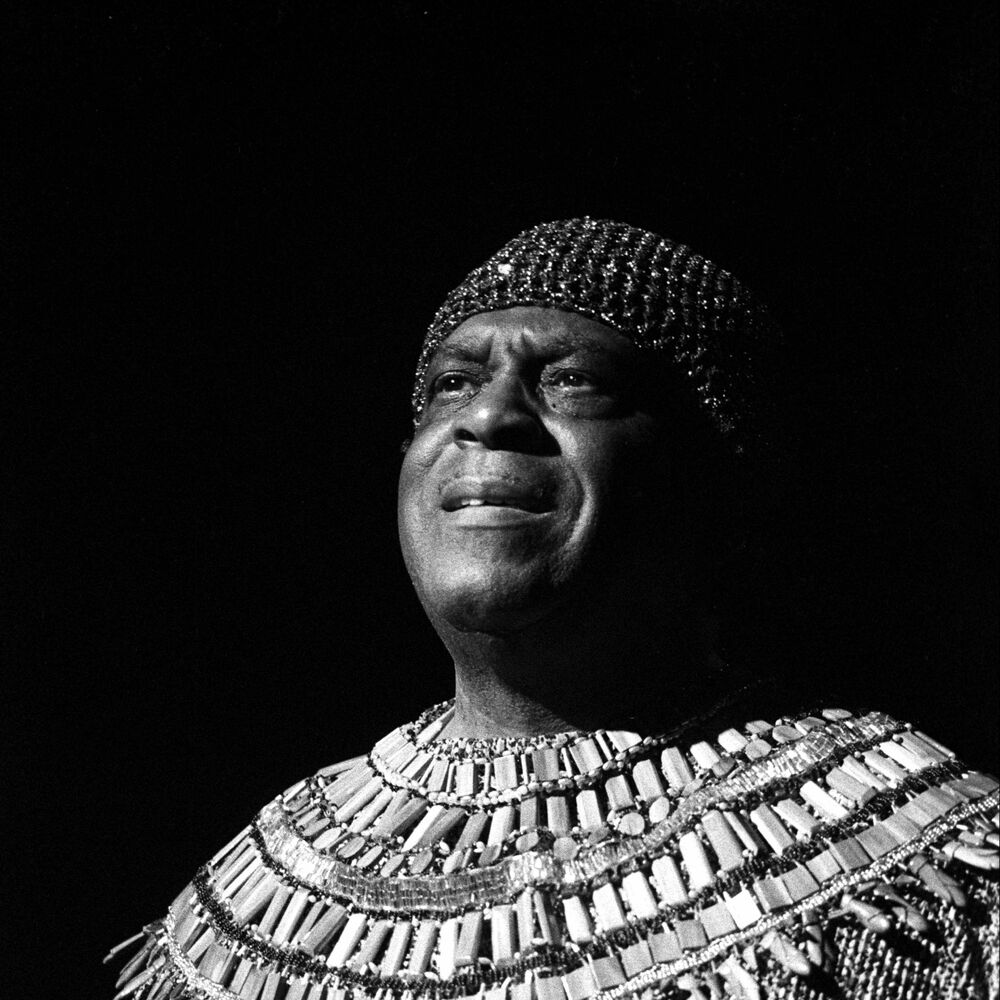
Sun Ra
 United States
Listen Sun Ra on radio stations:
Sun Ra: The Cosmic Pioneer of Avant-Garde Jazz
Sun Ra was an American composer, bandleader, and visionary whose radical fusion of free jazz, swing, and electronic experimentation created a new mythology in music. Hailing from Birmingham, Alabama, his prolific output of over 100 albums and his legendary, theatrical live performances with his Arkestra established a legacy that transcends conventional chart success or industry awards.
Early career
Born Herman Poole Blount in 1914, he claimed to have experienced a cosmic vision in the mid-1930s that transported him to Saturn. He began his professional career in Chicago in the 1940s and 1950s, arranging for Fletcher Henderson and playing piano under his birth name. He formed his own ensemble, first called the Space Trio, which evolved into the Myth Science Arkestra, and he legally changed his name to Le Sony'r Ra, or Sun Ra, in 1952.
His early independent recordings, like 1956's Super-Sonic Jazz on his own Saturn label, introduced his "cosmic philosophy" and eclectic sound. The Saturn label, often self-released and hand-distributed, became the primary vessel for his vast and unclassifiable catalog, making exact sales figures and chart data elusive but cementing his status as an early pioneer of artist-led independence.
Breakthrough
While mainstream commercial breakthrough was never his aim, Sun Ra and his Arkestra gained significant critical and countercultural recognition in the late 1960s and 1970s. Their relocation to New York and then Philadelphia coincided with a period of intense creativity and wider exposure. Albums like 1973's Space Is the Place on Blue Thumb Records and the film of the same name crystallized his interstellar persona for a new generation.
This era saw the Arkestra's legendary concerts, featuring elaborate costumes, dancers, and light shows, become must-see events. Recordings from this period, such as the Impulse! album The Heliocentric Worlds of Sun Ra, Volume One (1965), are now considered foundational texts of avant-garde jazz, studied and revered for their compositional daring.
Key tracks
Space Is the Place — This epic title track serves as both a manifesto and a musical journey, encapsulating his cosmic themes over a hypnotic groove.
Rocket Number Nine — An early Saturn single that exemplifies his ability to blend infectious swing with otherworldly concepts and vocal chants.
Calling Planet Earth — A dramatic, big-band styled piece showcasing the Arkestra's powerful ensemble work and theatrical delivery.
Nuclear War — A later-period, politically charged funk anthem that became an unexpected underground hit due to its raw, chanted energy.
Sun Ra's influence continued to grow through constant touring and recording until his passing in 1993, with the Arkestra continuing under the direction of saxophonist Marshall Allen. His work has been sampled by hip-hop artists, covered by rock bands, and studied by academics, solidifying his place as a uniquely American innovator. Collaborations with figures like poet Amiri Baraka and his influence on the entire Chicago AACM scene underscore his foundational role in avant-garde music.
For listeners exploring the outer limits of jazz, related artists include John Coltrane who similarly explored spiritual and free jazz dimensions. Parliament-Funkadelic shares the affinity for Afrofuturism, theatricality, and sprawling musical collectives. The Art Ensemble Of Chicago emerged from the same Chicago creative ferment with a shared ethos of musical freedom. Pharoah Sanders also channeled intense spiritual energy and expansive soundscapes in his work.
Sun Ra's vast catalog remains a staple on specialist radio programming, from free-form FM stations and college radio to dedicated online jazz streams. His music is regularly featured on shows focusing on avant-garde, experimental, and the deep history of jazz, introducing his cosmic sounds to new listeners every day.
The music of Sun Ra and his Arkestra can be heard across a variety of