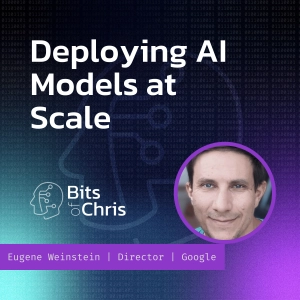
Today I sit down with Eugene Weinstein, a speech recognition researcher and Engineering Director at Google where he leads an organization that productionizes speech recognition technology across various Google products.
We discuss the evolution of speech recognition, the impact of Transformers, and the challenges of deploying models in production. This episode is packed with insight.
A few things I learned from Eugene:
* Build the model factory. Be able to pre-process your data, tune a model, and evaluate the model for accuracy and load testing as automated as possible.
* Good data is key, but it's hard to get. Eugene shared how even Google struggles with data quality issues and ways to think about handling them.
* How the Transformer architecture changed everything. Eugene breaks down why it was so impactful.
* Scaling AI is an art. The trade-offs between speed and accuracy are constant battles and often need a bit of experience to get it right.
* The benefits of cross-functional collaboration between engineers, researchers, and domain experts. Especially with finding data quality issues.
My favorite quote:
"If adding more data hurts your model performance, it's a red flag. But how do you catch it? There's no substitute for actually looking at your data."
- Eugene
Key Lessons
* The importance of data quality and preprocessing in AI model development, including the need for manual inspection and automated checks.
* The challenges and strategies for productionizing AI research, including optimizing for speed vs. accuracy and managing hardware resources efficiently.
* The value of cross-functional collaboration between data engineers, researchers, and domain experts to improve AI model development and deployment.
* The evolution of speech recognition technology and how recent advancements like transformer architectures have impacted the field.
* The process of scaling AI models from research to production, including the importance of robust evaluation and testing frameworks.
Links
* https://huggingface.co/
* https://github.com/run-llama/llama_index
* https://www.langchain.com/
* https://ai.google.dev/gemma
* https://deepmind.google/technologies/gemini/project-astra/
Connect with Eugene
* https://www.linkedin.com/in/weinsteineugene/
* https://research.google/people/eugeneweinstein/
Timeline
[00:00:00] Introduction of Eugene, his background at MIT and Google
[00:01:26] Eugene's early work in speech recognition and computer vision
[00:02:58] Discussion of Google's scale and the evolution of machine learning techniques
[00:04:38] The impact of neural networks and deep learning on speech recognition
[00:07:53] Explanation of transformer architecture and its significance
[00:09:00] Convergence of different AI modalities and increased accessibility of AI technologies
[00:14:55] The process of taking AI research to production at Google's scale
[00:19:03] Importance of data quality and preprocessing in AI model development
[00:21:54] Discussion on the value of domain expertise and cross-functional collaboration
[00:25:36] Signals for identifying data quality issues and the need for data checks
[00:31:17] Challenges in model deployment, including speed vs. accuracy trade-offs
[00:34:51] Optimizing hardware utilization for AI model inference
[00:37:56] Decision-making process for model selection and deployment
[00:39:47] Explanation of the model tuning process and parameter optimization
[00:42:01] Importance of software engineering discipline in productionizing research code
[00:43:56] Building an efficient pipeline for testing, training, tuning, and evaluating models
This is a public episode. If you would like to discuss this with other subscribers or get access to bonus episodes, visit
bitsofchris.com