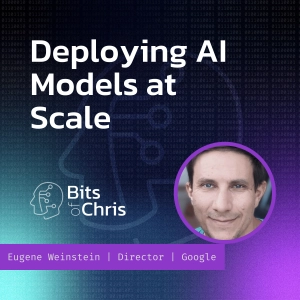
Deploying AI Models at Scale | Eugene Weinstein, Engineering Director @ Google

Deploying AI Models at Scale | Eugene Weinstein, Engineering Director @ Google

Author: Second Brains and Soft Skills for Staff Engineers. Augment, Stay Human. September 10, 2024 Duration: 46:53

Today I sit down with Eugene Weinstein, a speech recognition researcher and Engineering Director at Google where he leads an organization that productionizes speech recognition technology across various Google products.

We discuss the evolution of speech recognition, the impact of Transformers, and the challenges of deploying models in production. This episode is packed with insight.

A few things I learned from Eugene:

* Build the model factory. Be able to pre-process your data, tune a model, and evaluate the model for accuracy and load testing as automated as possible.

* Good data is key, but it's hard to get. Eugene shared how even Google struggles with data quality issues and ways to think about handling them.

* How the Transformer architecture changed everything. Eugene breaks down why it was so impactful.

* Scaling AI is an art. The trade-offs between speed and accuracy are constant battles and often need a bit of experience to get it right.

* The benefits of cross-functional collaboration between engineers, researchers, and domain experts. Especially with finding data quality issues.

My favorite quote:

"If adding more data hurts your model performance, it's a red flag. But how do you catch it? There's no substitute for actually looking at your data."

- Eugene

Key Lessons

* The importance of data quality and preprocessing in AI model development, including the need for manual inspection and automated checks.

* The challenges and strategies for productionizing AI research, including optimizing for speed vs. accuracy and managing hardware resources efficiently.

* The value of cross-functional collaboration between data engineers, researchers, and domain experts to improve AI model development and deployment.

* The evolution of speech recognition technology and how recent advancements like transformer architectures have impacted the field.

* The process of scaling AI models from research to production, including the importance of robust evaluation and testing frameworks.

Links

* https://huggingface.co/

* https://github.com/run-llama/llama_index

* https://www.langchain.com/

* https://ai.google.dev/gemma

* https://deepmind.google/technologies/gemini/project-astra/

Connect with Eugene

* https://www.linkedin.com/in/weinsteineugene/

* https://research.google/people/eugeneweinstein/

Timeline

[00:00:00] Introduction of Eugene, his background at MIT and Google

[00:01:26] Eugene's early work in speech recognition and computer vision

[00:02:58] Discussion of Google's scale and the evolution of machine learning techniques

[00:04:38] The impact of neural networks and deep learning on speech recognition

[00:07:53] Explanation of transformer architecture and its significance

[00:09:00] Convergence of different AI modalities and increased accessibility of AI technologies

[00:14:55] The process of taking AI research to production at Google's scale

[00:19:03] Importance of data quality and preprocessing in AI model development

[00:21:54] Discussion on the value of domain expertise and cross-functional collaboration

[00:25:36] Signals for identifying data quality issues and the need for data checks

[00:31:17] Challenges in model deployment, including speed vs. accuracy trade-offs

[00:34:51] Optimizing hardware utilization for AI model inference

[00:37:56] Decision-making process for model selection and deployment

[00:39:47] Explanation of the model tuning process and parameter optimization

[00:42:01] Importance of software engineering discipline in productionizing research code

[00:43:56] Building an efficient pipeline for testing, training, tuning, and evaluating models


This is a public episode. If you would like to discuss this with other subscribers or get access to bonus episodes, visit bitsofchris.com

In a world racing to automate everything, Bits of Chris: Augment, Stay Human offers a different, more human-centered conversation. This isn't about fearing technology but about thoughtfully integrating it to enhance our own capabilities and judgment. The core idea is Open Augmented Intelligence-a vision where tools amplify human potential without locking us into opaque, closed systems. Each episode explores practical strategies for building your "second brain" and honing the soft skills crucial for leadership, particularly for staff engineers and those navigating complex technical careers. You'll hear discussions on selecting tools, managing knowledge, and making strategic decisions that align with a future where individuals control their own data and intellectual processes. Weaving together themes from technology, business, and investing, the podcast provides a grounded perspective on staying relevant and effective. It’s for anyone who believes the best future is one where we use AI to augment our humanity, not replace it, fostering transparency and personal agency in an increasingly automated landscape. Tune in for a nuanced take on building a career and a mindset that remains resilient and distinctly human.
Author: Language: English Episodes: 47

Bits of Chris: Augment, Stay Human
Podcast Episodes
#26 - Investing is Simple, the Hardest Part is You [not-audio_url] [/not-audio_url]

Duration: 9:14
Simplicity + Consistency = Compounding WealthBut it’s hard to stay consistent when you’re a human.In this episode, you’ll learn:* The simple formula to investing wealth* How to stay consistent by automating and ignoring*…
#25 - Why Full-Time Employees Should Be Part-Time Creators [not-audio_url] [/not-audio_url]

Duration: 10:59
Full-Time Employees can indirectly grow their careers and by creating content Part-Time.Even if the content has nothing to do with your industry.Part-Time creators are free to explore, learn, and enjoy without the pressu…
#24 - Moving to the Lakehouse: From Hive to Iceberg [not-audio_url] [/not-audio_url]

Duration: 10:15
Change is hard.But it’s necessary.In this Data Engineering episode, you'll learn:* Hive tracks data as folders, Iceberg tracks data as files* How this key distinction enables Iceberg with powerful metadata operations* Wh…
#23 - A Personal Story About Regret [not-audio_url] [/not-audio_url]

Duration: 5:54
Today’s episode is a personal story about the night I met my wife.It’s a story I might use in a month at a Moth storytelling event. This is the first time I told it. This is a public episode. If you would like to discuss…
#22 - How to Be OK With Being You [not-audio_url] [/not-audio_url]

Duration: 9:47
You’ll never be that ideal version of yourself.You’ll never be able to do everything you want.Our time is finite, this is a good thing.We can be free to accept ourselves today and focus on what we feel is important.In th…
#21 - How to Turn Your Phone Addiction Into a Superpower [not-audio_url] [/not-audio_url]

Duration: 9:47
You know it’s a problem.But everyone else is the same way, so you ignore it.Turn your automatic habit into something that works for you.In this episode, you’ll learn:* How our culture today makes it hard to notice the pr…
#20 - An Interview with My 5 Year Old Daughter [not-audio_url] [/not-audio_url]

Duration: 9:11
I’m joined today by my daughter Sophia.In today’s episode, you’ll hear:* 5 jokes straight from Sophia’s brain* The hardest part about Kindergarten* Who her favorite stuffed animal is* What she wants for her birthday This…
#19 - Why I'm Teaching My Kids to Fail [not-audio_url] [/not-audio_url]

Duration: 9:53
I want my kids to fail.Making mistakes, experiencing defeat - these are things I want them to embrace. To go head first into. Life is a series of challenges. You will encounter setbacks.If you’re too afraid to take risk…
#18 - Knowing When to Quit on Your Dreams [not-audio_url] [/not-audio_url]

Duration: 10:51
You should quit.The biggest mistake you can make is staying stuck in a place you don’t actually want to be.Quitting is hard because it’s a recognition that one path isn’t working.Not quitting is the slow, grind of failur…
#17 - Wealth is What You Don't See [not-audio_url] [/not-audio_url]

Duration: 10:52
Most of the broke people I know drive Range Rovers.Having a high income doesn’t make you rich.In this episode, you’ll learn:* How the gap between income and expenses is the most important part of building wealth* Why you…