Episode 173.0 – Blunt Neck Trauma

Episode 173.0 – Blunt Neck Trauma

Author: Core EM November 26, 2019 Duration: 12:28

We go into one of the more complex injuries – blunt neck trauma.

Hosts:
Audrey Bree Tse, MD
Brian Gilberti, MD

Download One Comment Tags:

Show Notes

Overview

  • Blunt neck trauma comprises 5% of all neck trauma
  • Mortality due to loss of airway more so than hemorrhage

Mechanism

  • MVCs with cervical hyperextension, flexion, rotation during rapid deceleration, direct impact  
  • Strangulation: hanging, choking, clothesline injury (see section on strangulation in this chapter)
  • Direct blows: assault, sports, falls

Initial Management/Primary Survey

  • Airway
    • Evaluate for airway distress (stridor, hoarseness, dysphonia, dyspnea) or impending airway compromise
    • Early aggressive airway control: low threshold for intubation if unconscious patient, evidence of airway compromise including voice change, dyspnea, neurological changes, or pulmonary edema
    • Assume a difficult airway 
  • Breathing
    • Supplemental oxygen
    • Assess for bilateral breath sounds 
    • Can use bedside US to evaluate for pneumothorax or hemothorax
  • Circulation
    • Assess for open wounds, bleeding, hemorrhage 
    • IV access
  • Disability
    • Maintain C-spine immobilization 
    • Calculate GCS
    • Look for seatbelt sign

Secondary Survey

  • Evaluate for specific signs of vascular, laryngotracheal, pharyngoesophageal, and cervical spinal injuries with inspection, palpation, and auscultation
  • Perform extremely thorough exam to evaluate for any concomitant injuries (e.g. stab wounds, gunshot wounds, intoxications/ ingestions, etc.)

Types of Injuries

  • Vascular injury
    • Overview
      • Carotid arteries (internal, external, common carotid) and vertebral arteries injured
      • Mortality rate ~60% for symptomatic blunt cerebral vascular injury
    • Mechanism
      • Hyperextension and lateral rotation of the neck, direct blunt force, strangulation, seat belt injuries, and chiropractic manipulation
      • Morbidity due to intimal dissections, thromboses, pseudoaneurysms, fistulas, and transections
    • Clinical Features
      • Most patients are asymptomatic and do not develop focal neurological deficits for days
      • if Horner’s syndrome, suspect disruption of thoracic sympathetic chain (wraps around carotid artery)
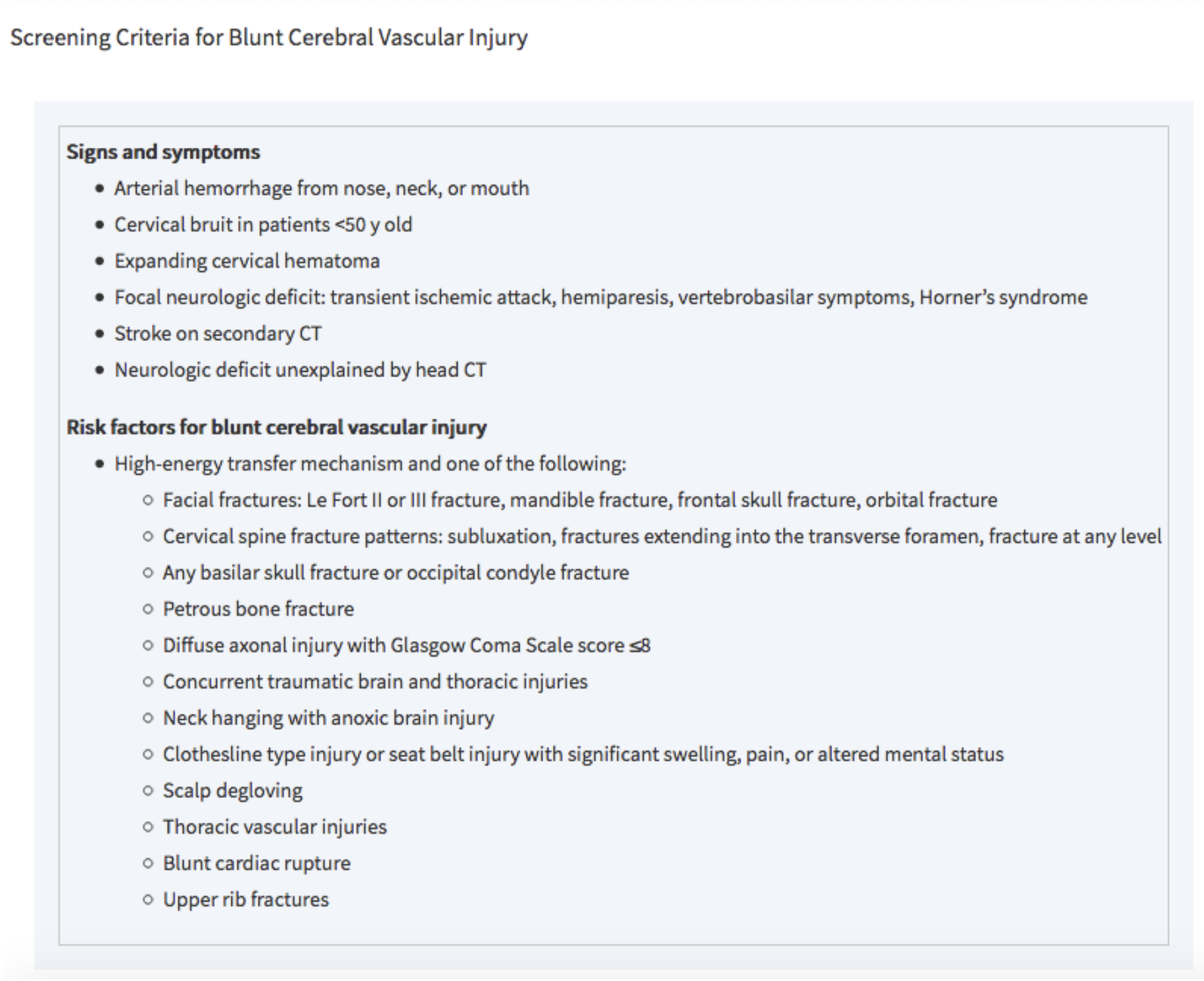
      • specific screening criteria are used to detect blunt cerebrovascular injury in asymptomatic patients (see below)

Tintinalli 2016

  • Diagnostic Testing
    • Gold standard for blunt cerebral vascular injury = MDCTA (multidetector four-vessel CT angiography)
      • <80% sensitive but 97% specific
      • Also images aerodigestive tracts and C-spine (unlike angiography)
    • Followed by Digital Subtraction Angiography (DSA) for positive results or high suspicion 
      • Angiography is invasive, expensive, resource-intensive, and carries a high contrast load
  • Management
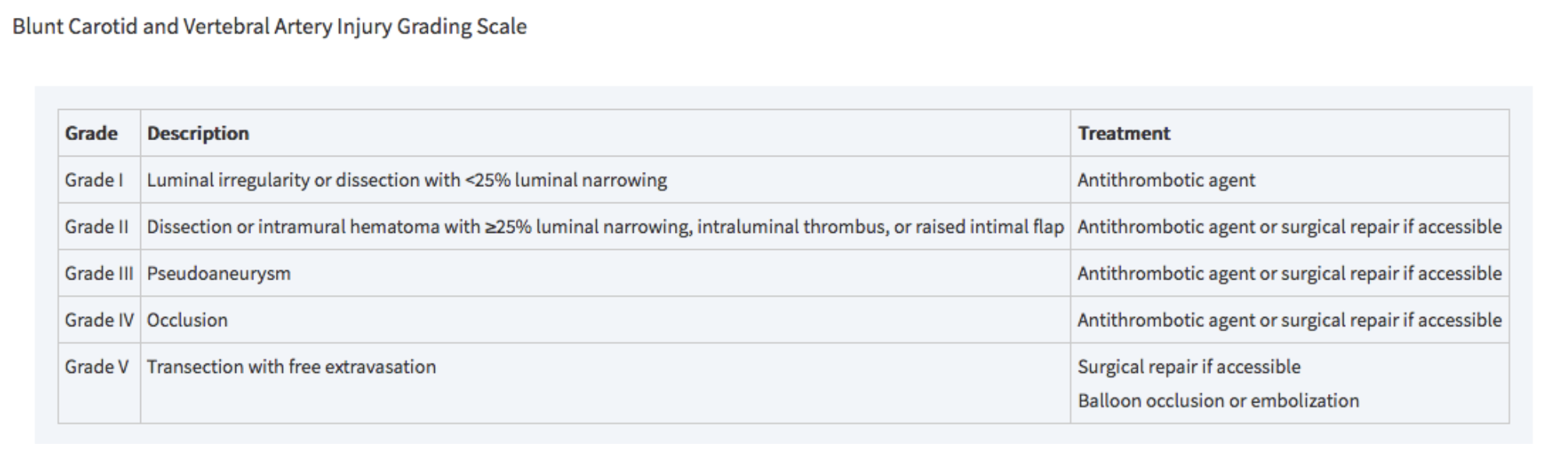
    • Antithrombotics vs. interventional repair based on BCVI grading system
    • Involve consultants early: trauma surgery, neurosurgery, vascular surgery, neurology
    • All patients with blunt cerebral vascular injury will require admission

Tintinalli 2018

  • Pharyngoesophageal injury  
      • Overview
        • Rare in blunt neck trauma
        • Includes hematomas and perforations of both pharynx and esophagus
      • Mechanism
        • Sudden acceleration or deceleration with hyperextension of the neck
        • Esophagus is thus forced against the spine
      • Clinical Features
        • Dysphagia, odynophagia, hematemesis, spitting up blood
        • Tenderness to palpation
        • SC emphysema
        • Neurological deficits (delayed presentation)
        • Infectious symptoms (delayed presentation)
      • Diagnostic Testing
        • Esophagography with water-soluble contrast (e.g. Gastrograffin)
        • If negative contrast esophagography, obtain flexible endoscopy (most sensitive)
          • Combination of contrast esophagography + esophagoscopy has sensitivity close to 100%
        • Swallow studies with water-soluble agent
        • MDCTA
        • Plain films of neck and chest 
          • Findings such as pneumomediastinum, hydrothorax, or retropharyngeal air may suggest perforation but are not sensitive
      • Management
        • All pharyngoesophageal injuries receive IV antibiotics with anaerobic coverage
        • Parenteral/ enteral nutrition
        • NGT should only be placed under endoscopic guidance to avoid further injury
        • Medical management vs. surgical repair depending on extent of injury
          • Surgical repair for esophageal perforations or pharyngeal perforations >2cm
        • Involve consultants early: trauma surgery, vascular surgery, otolaryngology, gastroenterology
        • All patients with blunt cerebral vascular injury will require admission
  • Laryngotracheal injury  
    • Overview
      • Occurs in >0.5% of blunt neck trauma
      • Includes hyoid fractures, thyroid/ cricoid cartilage damage, cricotracheal separation, vocal cord disruption, tracheal hematoma or transection
    • Mechanism
      • Assault, clothesline injuries, direct blunt force from MVCs compressing the larynx between a fixed object and the spine
    • Clinical Features
      • Patients are often asymptomatic at first and then develop airway edema and/or hematoma resulting in airway obstruction
      • Children are at higher risk for airway compromise due to less cartilage calcifications
    • Diagnostic Testing
      • Flexible fiberoptic laryngoscopy (FFL) to assess airway patency and extent of intraluminal injury
      • MDCTA
        • Obtain 1-mm cuts of larynx and perform multiplanar reconstructions 
      • Consider POCUS to detect laryngotracheal separation
    • Plain films of neck and chest
    • Poor sensitivity for penetrating neck trauma injuries
    • Can show extraluminal air, fracture or disruption of cartilaginous (e.g. larynx) structures 
    • Management
      • When securing airway, use an ETT that is one size smaller due to likelihood of airway edema
      • Conservative management (IV antibiotics, steroids, observation) vs. surgical repair
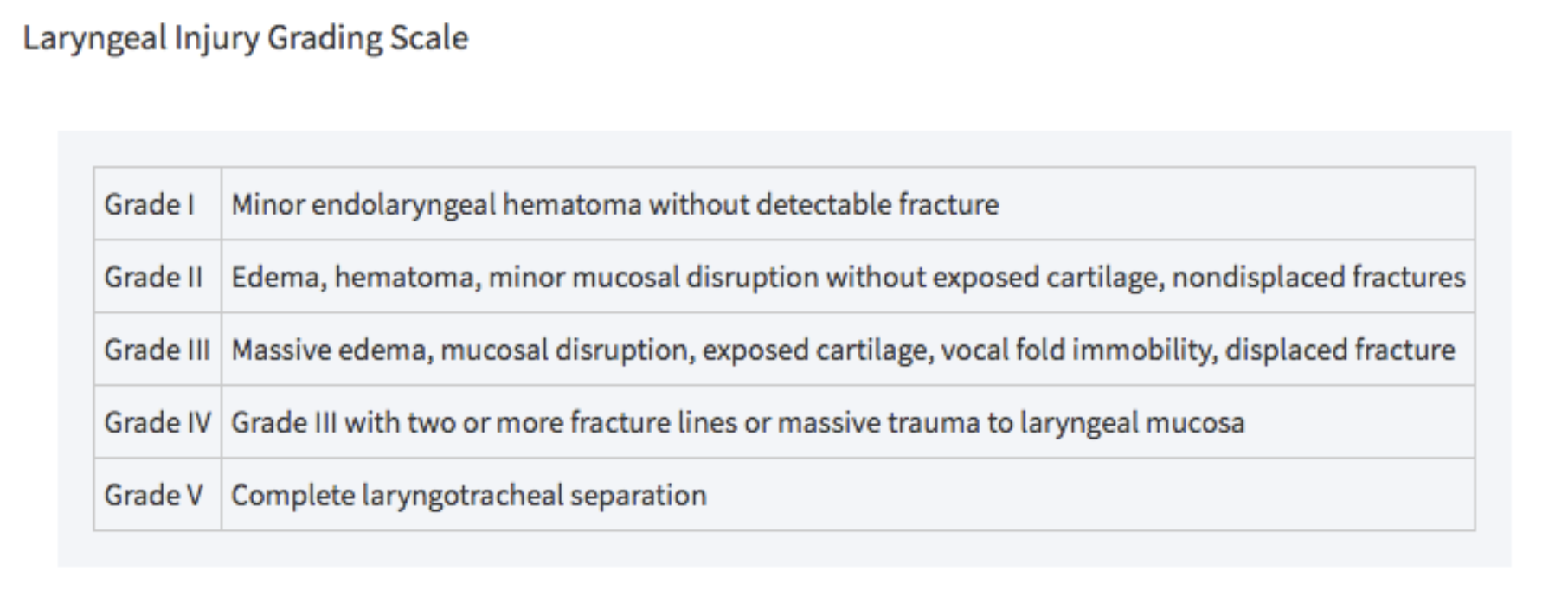
        • Grades III, IV, and V laryngotracheal injuries as defined by Schaefer and Brown’s classification system require OR

Tintinalli 2018

        • Involve consultants early: trauma surgery, neurosurgery, vascular surgery, neurology, otolaryngology 
  • Cervical spine/ spinal cord injury  
    • See chapter for spinal trauma

Disposition

  • Admit symptomatic patients to monitored setting
  • Given delayed symptoms, consider monitoring patients who are asymptomatic on arrival
    • Serial exams for worsening dyspnea, dysphonia, stridor, drooling, bruits, focal neuro deficits
    • Only discharge after ruling out airway threat, neurological deficit, vascular injury, or suicidal/ homicidal ideation
    • Monitor asymptomatic patients on home anticoagulation in ED for at least 6 hours from trauma to rule out delayed neck hematoma
  • Social work and/or psychiatry for patients in whom you suspect suicide risk or domestric violence, look for other signs of self harm

Take Home Points

  • Aggressive early airway management for unconscious patient, evidence of airway compromise including voice change, dyspnea, neurological changes, or pulmonary edema
  • Involve consultants early: trauma surgery, neurosurgery, vascular surgery, neurology, otolaryngology 
  • Victims of blunt cerebral vascular injury may present completely asymptomatic but develop delayed neurological symptoms; close observation and monitoring is recommended especially for patients on home anticoagulation
  • Remember to evaluate for concomitant injuries
  • Psychiatric evaluation for all attempted suicides

References

  • Bromberg, William. et al. Blunt Cerebrovascular Injury Practice Management Guidelines: The Eastern Association for the Surgery of Trauma. J Trauma. 68 (2): 471-7, Feb 2010. 
  • Cothren CC, Moore EE, Biffl WL, et al. Anticoagulation is the gold standard therapy for blunt carotid injuries to reduce stroke rate. Arch Surg. 2004;139:540–545; discussion 545–546.
  • Joshua AA.  Neck Trauma, Blunt, Anterior.  In: Schaider J, Barkin R, Hayden S, Wolfe R, Barkin A, Shayne P, Rosen P.  Rosen and Barkin’s 5-Minute Emergency Medicine Consult. 5th Edition. Philadelphia, PA: Wolters Kluwer; 2015; 738-739.
  • Tintinalli, J., Stapczynski, J. Stephan, editor, Ma, O. John, editor, Yealy, Donald M., editor, Meckler, Garth D., editor, & Cline, David, editor. (2018). Tintinalli’s emergency medicine : A comprehensive study guide (9th ed.).
  • Walls, R., Hockberger, Robert S., editor, & Gausche-Hill, Marianne, editor. (2018). Rosen’s emergency medicine : Concepts and clinical practice (Ninth ed.).
  • Advanced trauma life support. (2018). 10th ed. Chicago, IL: American College of Surgeons.

Special thanks to Sana Maheshwari, MD 

NYU Bellevue Emergency Medicine Residency PGY3


Read More

There’s a particular kind of pressure that comes with working in an emergency department, where decisions need to be both swift and sound. Core EM-Emergency Medicine Podcast exists in that space, offering a direct line to the essential knowledge and clinical reasoning that emergency medicine demands. Created by the team at Core EM, each episode feels less like a formal lecture and more like a focused conversation with a trusted colleague. You’ll hear discussions that break down critical topics, from managing common presentations to unraveling complex, high-acuity cases, all grounded in current evidence and practical reality. This podcast serves as a reliable resource for physicians, residents, and advanced practice providers looking to solidify their foundation or stay sharp on the latest evidence. It’s about cutting through the noise to deliver core content that’s immediately applicable at the bedside. Tune in for a clear, concise, and always relevant dive into the principles that define emergency care, designed to fit into a busy clinician’s life between shifts or during a commute.
Author: Language: en-us Episodes: 100

Core EM - Emergency Medicine Podcast
Podcast Episodes
Episode 222: Local Anesthetic Systemic Toxicity (LAST) [not-audio_url] [/not-audio_url]

Duration: 0:00
We discuss this ominous complication of providing local anesthesia. Hosts: Elaine Jonas, MD Brian Gilberti, MD https://media.blubrry.com/coreem/content.blubrry.com/coreem/LAST.mp3 Download Leave a Comment Tags: Critical…
Episode 221: High-Output Heart Failure [not-audio_url] [/not-audio_url]

Duration: 0:00
We discuss the diagnosis and treatment of one of EM's paradoxes: High-Output Heart Failure. Hosts: Nicolas Gonzalez, MD Brian Gilberti, MD https://media.blubrry.com/coreem/content.blubrry.com/coreem/HOHF.mp3 Download Lea…
Episode 220: Post-ROSC Care [not-audio_url] [/not-audio_url]

Duration: 0:00
We explore how to refine and optimize care in the vital minutes following ROSC. Hosts: Jonathan Elmer, MD, MS Brian Gilberti, MD https://media.blubrry.com/coreem/content.blubrry.com/coreem/Post-ROSC_care.mp3 Download Lea…
Episode 219: Meningitis 2.0 [not-audio_url] [/not-audio_url]

Duration: 0:00
We review diagnosing and managing bacterial meningitis in the ED. Hosts: Sarah Fetterolf, MD Avir Mitra, MD https://media.blubrry.com/coreem/content.blubrry.com/coreem/Meningitis_2_0.mp3 Download Leave a Comment Tags: CN…
Episode 218: Sympathetic Crashing Acute Pulmonary Edema (SCAPE) [not-audio_url] [/not-audio_url]

Duration: 12:45
We discuss the diagnosis and management of SCAPE in the ED. Hosts: Naz Sarpoulaki, MD, MPH Brian Gilberti, MD https://media.blubrry.com/coreem/content.blubrry.com/coreem/SCAPEv2.mp3 Download Leave a Comment Tags: Acute P…
Episode 217: Prehospital Blood Transfusion [not-audio_url] [/not-audio_url]

Duration: 0:00
We discuss the shift to prehospital blood to treat shock sooner. Hosts: Nichole Bosson, MD, MPH, FACEP Avir Mitra, MD https://media.blubrry.com/coreem/content.blubrry.com/coreem/Prehospital_Transfusion.mp3 Download Leave…
Episode 216: BRUE (Brief Resolved Unexplained Event) [not-audio_url] [/not-audio_url]

Duration: 0:00
We review BRUEs (Brief Resolved Unexplained Events). Hosts: Ellen Duncan, MD, PhD Noumi Chowdhury, MD https://media.blubrry.com/coreem/content.blubrry.com/coreem/BRUE.mp3 Download Leave a Comment Tags: Pediatrics Show No…
Episode 215: Marburg Virus and Global EM [not-audio_url] [/not-audio_url]

Duration: 0:00
Lessons from Rwanda’s Marburg Virus Outbreak and Building Resilient Systems in Global EM. Hosts: Tsion Firew, MD Brian Gilberti, MD https://media.blubrry.com/coreem/content.blubrry.com/coreem/Marburg_Virus.mp3 Download L…
Episode 214: Acute Pulmonary Embolism [not-audio_url] [/not-audio_url]

Duration: 0:00
We review the diagnosis, risk stratification, & management of acute pulmonary embolism in the ED. Hosts: Vivian Chiu, MD Brian Gilberti, MD https://media.blubrry.com/coreem/content.blubrry.com/coreem/Acute_Pulmonary_Embo…
Episode 213: Pneumothorax [not-audio_url] [/not-audio_url]

Duration: 0:00
We break down pneumothorax: risks, diagnosis, and management pearls. Hosts: Christopher Pham, MD Brian Gilberti, MD https://media.blubrry.com/coreem/content.blubrry.com/coreem/Pneumothorax.mp3 Download Leave a Comment Ta…