Episode 187: Septic Joint in Children

Episode 187: Septic Joint in Children

Author: Core EM August 1, 2023 Duration: 9:02

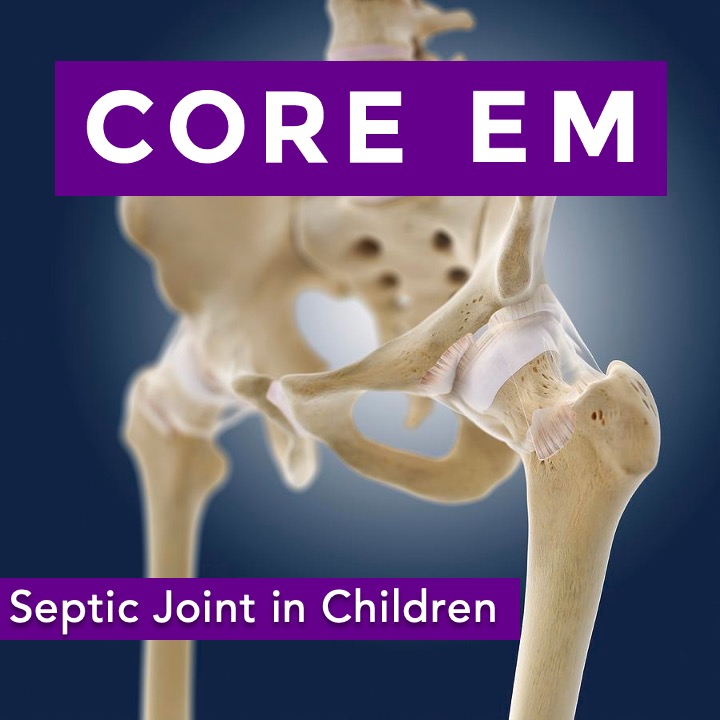
We discuss the diagnosis and management of septic arthritis in the pediatric population.

Hosts:
Brian Gilberti, MD
Ellen Duncan, MD

Download 2 Comments Tags: ,

Show Notes

  • General

    • Pain in joint for pediatric patient has a broad differential, including transient synovitis and septic arthritis

    • Transient synovitis, also known as toxic synovitis, is a common condition affecting kids aged 3-10 and often occurs after a viral infection. It is typically self-limiting and not considered a serious condition.

    • Septic arthritis is an infection in the joint space, typically affecting only one joint. It is often difficult to diagnose due to the fact that many patients, particularly under the age of 3, may not be able to localize their pain to a specific joint.

  • Workup

    • Diagnostic work-up for septic arthritis begins with blood work, which includes a complete blood count (CBC), erythrocyte sedimentation rate (ESR), C-reactive protein (CRP), and blood cultures. Lyme disease studies may also be necessary since Lyme disease can cause joint pain.

    • Patients with transient synovitis typically have mild elevation in inflammatory markers, while those with septic arthritis usually show a significant elevation.

    • Imaging studies, including X-rays, ultrasound to evaluate for a joint effusion, and MRI to assess for associated osteomyelitis, are also part of the diagnostic approach.

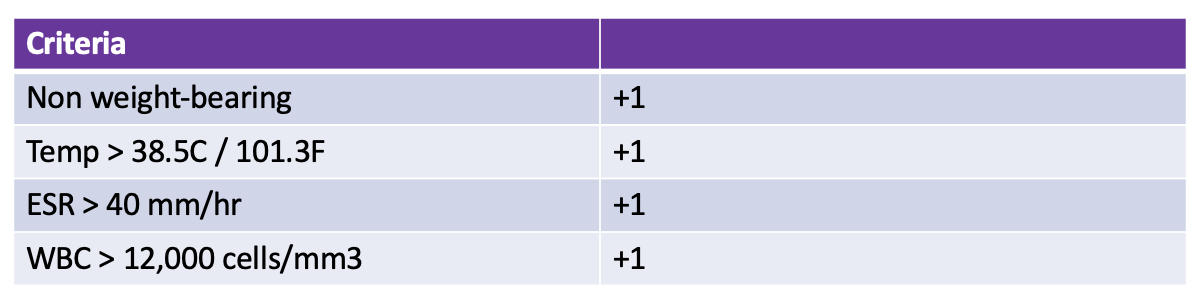
    • The Kocher criteria, developed specifically for septic arthritis of the hip, are a useful tool for clinical decision-making. The criteria include fever above 38.5 C, inability to bear weight, ESR above 40, and a white blood cell count above 12,000.

1 criterion met = 3% probability of septic arthritis

2 criteria met = 40% probability of septic arthritis

3 criteria met = 93% probability of septic arthritis

4 criteria met = 99+% probability of septic arthritis


  • If septic arthritis is suspected, orthopedics should be consulted immediately. Joint fluid aspiration is necessary for diagnosis and should not be delayed. The fluid should be sent for cell count, gram stain, glucose, culture, and PCR if available.

  • Septic arthritis is most commonly caused by bacterial infections, with Staph aureus being the most common organism. In school-age children, other bacteria such as Strep pyogenes, Strep pneumoniae, and Haemophilus influenzae should also be considered. In preschool-aged children, K. kingae is also considered. In older children and neonates, the range of potential bacteria varies.

  • Management

    • Empiric antibiotic therapy should target the most likely organisms and should not be delayed. Antibiotics may be narrowed once culture results are obtained.

    • The choice of antibiotics is dependent on the age group, with specific combinations suggested for neonates, children between 1 month and 4 years, and children aged 5 and older.

    • Cultures are only positive in 50-60% of cases. Synovial fluid PCR studies can help narrow antibiotic treatment.

  • Take Home Points

    • Limp in the pediatric population can commonly be transient synovitis but we should always consider septic arthritis

    • Some clues in the history and physical that would point you towards septic arthritis include fever, refusal to bear weight, and limited range of motion on exam

    • We are going to have to get labs, including CBC, inflammatory markers, and preoperative labs, along with an XR and possibly an ultrasound

    • Kocher criteria is one tool that can help us determine if this is a patient that requires a joint tap.

    • Arthrocentesis is the gold standard for diagnosis, but antibiotics should be started promptly if the diagnosis is suspected.

    • The choice of antibiotics is dependent upon age group.

      • Neonates get vanc/cefepime, kids 1-4 yo get vanc / ceftriaxone

      • Older than 5 yo get vancomycin

        • Add ceftriaxone to them if patient has sickle cell disease, are immunocompromised, or Lyme or STI are suspected

    • Always cross check with institutional preferences / guidelines when choosing antibiotics


Read More

There’s a particular kind of pressure that comes with working in an emergency department, where decisions need to be both swift and sound. Core EM-Emergency Medicine Podcast exists in that space, offering a direct line to the essential knowledge and clinical reasoning that emergency medicine demands. Created by the team at Core EM, each episode feels less like a formal lecture and more like a focused conversation with a trusted colleague. You’ll hear discussions that break down critical topics, from managing common presentations to unraveling complex, high-acuity cases, all grounded in current evidence and practical reality. This podcast serves as a reliable resource for physicians, residents, and advanced practice providers looking to solidify their foundation or stay sharp on the latest evidence. It’s about cutting through the noise to deliver core content that’s immediately applicable at the bedside. Tune in for a clear, concise, and always relevant dive into the principles that define emergency care, designed to fit into a busy clinician’s life between shifts or during a commute.
Author: Language: en-us Episodes: 100

Core EM - Emergency Medicine Podcast
Podcast Episodes
Episode 212: Angioedema [not-audio_url] [/not-audio_url]

Duration: 0:00
Angioedema – Recognition and Management in the ED Hosts: Maria Mulligan-Buckmiller, MD Brian Gilberti, MD https://media.blubrry.com/coreem/content.blubrry.com/coreem/Angioedema.mp3 Download Leave a Comment Tags: Airway S…
Episode 211: Granulomatosis with Polyangiitis [not-audio_url] [/not-audio_url]

Duration: 0:00
Granulomatosis with Polyangiitis (GPA) – Recognition and Management in the ED Hosts: Phoebe Draper, MD Brian Gilberti, MD https://media.blubrry.com/coreem/content.blubrry.com/coreem/GPA.mp3 Download One Comment Tags: Rhe…
Episode 210: Capacity Assessment [not-audio_url] [/not-audio_url]

Duration: 0:00
We discuss capacity assessment, patient autonomy, safety, and documentation. Hosts: Anne Levine, MD Brian Gilberti, MD https://media.blubrry.com/coreem/content.blubrry.com/coreem/Capacity_Assessment.mp3 Download One Comm…
Episode 209: Blast Crisis [not-audio_url] [/not-audio_url]

Duration: 0:00
We dive into the recognition and management of blast crisis. Hosts: Sadakat Chowdhury, MD Brian Gilberti, MD https://media.blubrry.com/coreem/content.blubrry.com/coreem/Blast_Crisis.mp3 Download 2 Comments Tags: Hematolo…
Episode 208: Geriatric Emergency Medicine [not-audio_url] [/not-audio_url]

Duration: 0:00
We explore the expanding field of Geriatric Emergency Medicine. Hosts: Ula Hwang, MD Brian Gilberti, MD https://media.blubrry.com/coreem/content.blubrry.com/coreem/Geriatric_Emergency_Medicine.mp3 Download One Comment Ta…
Episode 207: Smoke Inhalation Injury [not-audio_url] [/not-audio_url]

Duration: 0:00
We discuss the injuries sustained from smoke inhalation. Hosts: Sarah Fetterolf, MD Brian Gilberti, MD https://media.blubrry.com/coreem/content.blubrry.com/coreem/Smoke_Inhalation.mp3 Download Leave a Comment Tags: Envir…
Episode 206: Acute Back Pain [not-audio_url] [/not-audio_url]

Duration: 0:00
We discuss the evaluation of and treatment options for acute back pain. Hosts: Benjamin Friedman, MD Brian Gilberti, MD https://media.blubrry.com/coreem/content.blubrry.com/coreem/Acute_Back_Pain.mp3 Download Leave a Com…
Episode 205: Family Presence during Resuscitation [not-audio_url] [/not-audio_url]

Duration: 0:00
We discuss the impact of family presence during resuscitations. Hosts: Ellen Duncan, MD, PhD Brian Gilberti, MD https://media.blubrry.com/coreem/content.blubrry.com/coreem/Family_Presence_During_Resuscitation.mp3 Downloa…
Episode 204: Necrotizing Fasciitis [not-audio_url] [/not-audio_url]

Duration: 9:12
We discuss the recognition and treatment of necrotizing fasciitis. Hosts: Aurnee Rahman, MD Brian Gilberti, MD https://media.blubrry.com/coreem/content.blubrry.com/coreem/Necrotizing_Fasciitis.mp3 Download Leave a Commen…
Episode 203: Acetaminophen Toxicity [not-audio_url] [/not-audio_url]

Duration: 0:00
We sit down with one of our toxicologists to discuss acetaminophen toxicity. Hosts: Marlis Gnirke, MD Brian Gilberti, MD https://media.blubrry.com/coreem/content.blubrry.com/coreem/Acetaminophen_Toxicity.mp3 Download One…