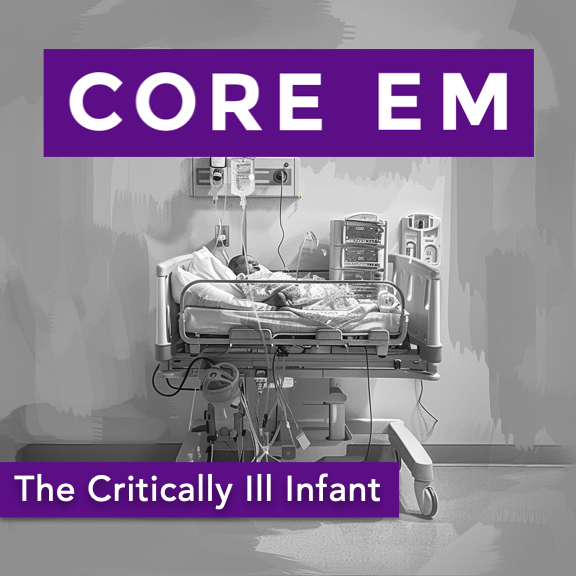
Episode 196: The Critically Ill Infant

Episode 196: The Critically Ill Infant

Author: Core EM May 1, 2024 Duration: 0:00

We discuss an approach to the critically ill infant.

Hosts:
Ellen Duncan, MD, PhD
Brian Gilberti, MD

Download Leave a Comment Tags:

Show Notes

The Critically Ill Infant: THE MISFITS

Trauma

  • ‘T’ in the mnemonic stands for trauma, which includes both accidental and intentional causes.
  • Considerations for Non-accidental Trauma:
    • Stresses the importance of considering non-accidental trauma, especially given that it may not always present with obvious external signs.
  • Anatomical Vulnerabilities:
    • Highlights specific anatomical considerations for infants who suffer from trauma:
      • Infants have proportionally larger heads, increasing their susceptibility to high cervical spine (c-spine) injuries.
      • Their liver and spleen are less protected, making abdominal injuries potentially more severe.

Heart

  • 5 T’s of Cyanotic Congenital Heart Disease: Introduces a mnemonic to help remember key right-sided ductal-dependent lesions:
    • Truncus Arteriosus: Single vessel serving as both pulmonary and systemic outflow tract.
    • Transposition of the Great Arteries: The pulmonary artery and aorta are switched, leading to improper circulation.
    • Tricuspid Atresia: Absence of the tricuspid valve, leading to inadequate development of the right ventricle and pulmonary circulation issues.
    • Tetralogy of Fallot: Comprises four defects—ventricular septal defect, pulmonary stenosis, right ventricular hypertrophy, and an overriding aorta.
    • Total Anomalous Pulmonary Venous Connection (TAPVC): Pulmonary veins do not connect to the left atrium but rather to the right heart or veins, causing oxygen-rich blood to mix with oxygen-poor blood.
  • Other Significant Conditions:
    • Ebstein’s Anomaly: Malformation of the tricuspid valve affecting right-sided heart function.
    • Pulmonary Atresia/Stenosis: Incomplete formation or narrowing of the pulmonary valve obstructs blood flow to the lungs.
  • Left-sided Ductal-Dependent Lesions:
    • Conditions such as aortic arch abnormalities (coarctation or interrupted arch), critical aortic stenosis, and hypoplastic left heart syndrome are highlighted. These generally present with less obvious cyanosis and more pallor.
  • Diagnostic and Management Considerations:
    • Routine prenatal ultrasounds detect most cases, but conditions like coarctation of the aorta and TAPVC might not be apparent until after birth when the ductus arteriosus closes.
    • Emphasizes the importance of a thorough physical exam: checking for murmurs, assessing hepatosplenomegaly, feeling for femoral pulses, measuring pre- and post-ductal saturations, and taking blood pressures in all four limbs.
  • Treatment Recommendations:
    • Early initiation of alprostadil (a prostaglandin) for patients with suspected ductal-dependent lesions to maintain ductal patency.
    • Preparedness for potential complications from alprostadil treatment, such as apnea and hypotension, which may necessitate intubation and hemodynamic support.

Endocrine

  • Focuses on acute salt-wasting crisis in undiagnosed Congenital Adrenal Hyperplasia (CAH).
  • Electrolyte imbalances: ↓Na, ↑K, ↓HCO3, ↓Glu.
  • Treatment: hydrocortisone (25mg for babies, 50mg for kids, 100mg for adults).

Metabolic

  • Electrolyte abnormalities such as hypoglycemia (values: <60 in infants, <40 in neonates).
  • Broad differential.
  • Rule of 50s for correction: D% x #ml/kg fluid = 50.

Inborn Errors of Metabolism

  • Major classes include organic acidurias (profound anion gap metabolic acidosis) and urea cycle defects (hyperammonemia)
  • Recommendation: Draw gas and ammonia level.

Sepsis

  • Emphasized as a critical condition in the differential diagnosis for ill infants, though placed later in the mnemonic for easier recall.
  • Presentation and Diagnosis:
    • Sepsis in infants often presents nonspecifically, making early detection challenging.
    • Immediate drawing of blood cultures upon suspicion of sepsis.
  • Initial Treatment:
    • Prompt initiation of antimicrobials and fluids.
    • Use of vancomycin for gram-positive and MRSA coverage, a third-generation cephalosporin or pip-tazo for broad bacterial coverage, and acyclovir for HSV. (tailor based on age and institutional guidelines)
  • Supportive Care:
    • Highlights the necessity of fluid resuscitation to stabilize the patient.

Formula

  • Formula-Related Electrolyte Imbalances:
    • Incorrect mixing of infant formula can cause hypo- or hypernatremia.
  • Consequences of Electrolyte Imbalances:
    • Both conditions can lead to severe outcomes including altered mental status, seizures, coma, and potentially death.
  • Management Strategies:
    • Treatment varies based on the sodium levels:
      • Symptomatic hyponatremia is treated with hypertonic saline.
      • Hypernatremia requires fluid resuscitation.

Intestinal Catastrophe

  • Specific Conditions:
    • Malrotation with Midgut Volvulus: Twisting of the intestines that can obstruct blood flow.
    • Necrotizing Enterocolitis (NEC): Can occur in both full-term and preterm infants, involves inflammation and bacterial infection that can destroy bowel tissue.
    • Hirschsprung-associated Enterocolitis: Complication of Hirschsprung’s disease involving blockage and infection.
    • Intussusception: Older infants might only show altered mental status instead of the typical intermittent pain and lethargy.
  • Symptoms:
    • Common symptoms include bilious emesis (green vomit) or hematemesis (vomiting blood).
  • Emergency Response:
    • Urges early mobilization of pediatric surgery and radiology teams upon suspicion of these conditions.

Toxins

  • Includes intentional or unintentional ingestion.
  • One pill killers include: calcium channel blockers (CCB), tricyclic antidepressants (TCA), opiates, sulfonylureas, Class 1 antiarrhythmics, antimalarials, camphor, oil of wintergreen.

Seizures

  • The second ‘S’ in the mnemonic refers to seizures, which can be triggered by various conditions such as hypoglycemia, sepsis, inborn errors of metabolism, and trauma.
  • First-Line Treatment:
    • Actively seizing patients should initially be treated with benzodiazepines.
  • Second-Line Medications:
    • Includes fosphenytoin, phenobarbital, levetiracetam (Keppra), and valproic acid.
  • Management of Reversible Causes:
    • Urges prompt treatment of any identifiable causes like hypoglycemia or electrolyte imbalances.
  • Special Consideration:
    • Notes the possibility of pyridoxine-dependent epilepsy in neonates, recommending pyridoxine (vitamin B6) for intractable seizures unresponsive to multiple antiepileptic drugs (AEDs).


Read More

There’s a particular kind of pressure that comes with working in an emergency department, where decisions need to be both swift and sound. Core EM-Emergency Medicine Podcast exists in that space, offering a direct line to the essential knowledge and clinical reasoning that emergency medicine demands. Created by the team at Core EM, each episode feels less like a formal lecture and more like a focused conversation with a trusted colleague. You’ll hear discussions that break down critical topics, from managing common presentations to unraveling complex, high-acuity cases, all grounded in current evidence and practical reality. This podcast serves as a reliable resource for physicians, residents, and advanced practice providers looking to solidify their foundation or stay sharp on the latest evidence. It’s about cutting through the noise to deliver core content that’s immediately applicable at the bedside. Tune in for a clear, concise, and always relevant dive into the principles that define emergency care, designed to fit into a busy clinician’s life between shifts or during a commute.
Author: Language: en-us Episodes: 100

Core EM - Emergency Medicine Podcast
Podcast Episodes
Episode 222: Local Anesthetic Systemic Toxicity (LAST) [not-audio_url] [/not-audio_url]

Duration: 0:00
We discuss this ominous complication of providing local anesthesia. Hosts: Elaine Jonas, MD Brian Gilberti, MD https://media.blubrry.com/coreem/content.blubrry.com/coreem/LAST.mp3 Download Leave a Comment Tags: Critical…
Episode 221: High-Output Heart Failure [not-audio_url] [/not-audio_url]

Duration: 0:00
We discuss the diagnosis and treatment of one of EM's paradoxes: High-Output Heart Failure. Hosts: Nicolas Gonzalez, MD Brian Gilberti, MD https://media.blubrry.com/coreem/content.blubrry.com/coreem/HOHF.mp3 Download Lea…
Episode 220: Post-ROSC Care [not-audio_url] [/not-audio_url]

Duration: 0:00
We explore how to refine and optimize care in the vital minutes following ROSC. Hosts: Jonathan Elmer, MD, MS Brian Gilberti, MD https://media.blubrry.com/coreem/content.blubrry.com/coreem/Post-ROSC_care.mp3 Download Lea…
Episode 219: Meningitis 2.0 [not-audio_url] [/not-audio_url]

Duration: 0:00
We review diagnosing and managing bacterial meningitis in the ED. Hosts: Sarah Fetterolf, MD Avir Mitra, MD https://media.blubrry.com/coreem/content.blubrry.com/coreem/Meningitis_2_0.mp3 Download Leave a Comment Tags: CN…
Episode 218: Sympathetic Crashing Acute Pulmonary Edema (SCAPE) [not-audio_url] [/not-audio_url]

Duration: 12:45
We discuss the diagnosis and management of SCAPE in the ED. Hosts: Naz Sarpoulaki, MD, MPH Brian Gilberti, MD https://media.blubrry.com/coreem/content.blubrry.com/coreem/SCAPEv2.mp3 Download Leave a Comment Tags: Acute P…
Episode 217: Prehospital Blood Transfusion [not-audio_url] [/not-audio_url]

Duration: 0:00
We discuss the shift to prehospital blood to treat shock sooner. Hosts: Nichole Bosson, MD, MPH, FACEP Avir Mitra, MD https://media.blubrry.com/coreem/content.blubrry.com/coreem/Prehospital_Transfusion.mp3 Download Leave…
Episode 216: BRUE (Brief Resolved Unexplained Event) [not-audio_url] [/not-audio_url]

Duration: 0:00
We review BRUEs (Brief Resolved Unexplained Events). Hosts: Ellen Duncan, MD, PhD Noumi Chowdhury, MD https://media.blubrry.com/coreem/content.blubrry.com/coreem/BRUE.mp3 Download Leave a Comment Tags: Pediatrics Show No…
Episode 215: Marburg Virus and Global EM [not-audio_url] [/not-audio_url]

Duration: 0:00
Lessons from Rwanda’s Marburg Virus Outbreak and Building Resilient Systems in Global EM. Hosts: Tsion Firew, MD Brian Gilberti, MD https://media.blubrry.com/coreem/content.blubrry.com/coreem/Marburg_Virus.mp3 Download L…
Episode 214: Acute Pulmonary Embolism [not-audio_url] [/not-audio_url]

Duration: 0:00
We review the diagnosis, risk stratification, & management of acute pulmonary embolism in the ED. Hosts: Vivian Chiu, MD Brian Gilberti, MD https://media.blubrry.com/coreem/content.blubrry.com/coreem/Acute_Pulmonary_Embo…
Episode 213: Pneumothorax [not-audio_url] [/not-audio_url]

Duration: 0:00
We break down pneumothorax: risks, diagnosis, and management pearls. Hosts: Christopher Pham, MD Brian Gilberti, MD https://media.blubrry.com/coreem/content.blubrry.com/coreem/Pneumothorax.mp3 Download Leave a Comment Ta…