Episode 212: Angioedema

Episode 212: Angioedema

Author: Core EM August 2, 2025 Duration: 0:00

Angioedema – Recognition and Management in the ED

Hosts:
Maria Mulligan-Buckmiller, MD
Brian Gilberti, MD

Download Leave a Comment Tags:

Show Notes

Definition & Pathophysiology

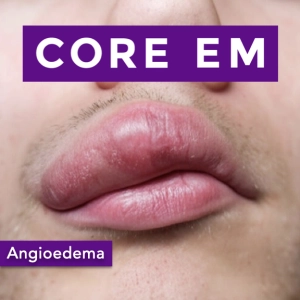
Angioedema = localized swelling of mucous membranes and subcutaneous tissues due to increased vascular permeability.

Triggers increased vascular permeability → fluid shifts into tissues.


Etiologies

  • Histamine-mediated (anaphylaxis)
    • Associated with urticaria/hives, pruritus, and redness.
    • Triggered by allergens (foods, insect stings, medications).
    • Rapid onset (minutes to hours).
  • Bradykinin-mediated
    • Hereditary angioedema (HAE): C1 esterase inhibitor deficiency (autosomal dominant).
    • Acquired angioedema: Associated with B-cell lymphoma, autoimmune disease, MGUS.
    • Medication-induced: Most commonly ACE inhibitors; rarely ARBs.
    • Typically lacks urticaria and itching.
    • Gradual onset, can last days if untreated.
  • Idiopathic angioedema
    • Unknown cause; diagnosis of exclusion.

Clinical Presentations

  • Swelling
    • Asymmetric, non-pitting, usually non-painful.
    • May involve lips, tongue, face, extremities, GI tract.
  • Respiratory compromise
    • Upper airway swelling → stridor, dyspnea, sensation of throat closure.
    • Airway obstruction is the most feared complication.
  • Abdominal manifestations
    • Bowel wall angioedema can mimic acute abdomen:
      • Nausea, vomiting, diarrhea, severe pain, increased intra-abdominal pressure, possible ischemia.

Key Differentiating Features

  • Histamine-mediated: rapid onset, hives/itching, resolves quickly with epinephrine, antihistamines, and steroids.
  • Bradykinin-mediated: slower onset, lacks urticaria, prolonged duration, less responsive to standard anaphylaxis medications.

Diagnostic Approach in the ED

  • Focus on airway (ABCs) and clinical assessment.
  • Labs (e.g., C4 level) useful for downstream diagnosis (esp. HAE) but not for acute management.
  • Imaging: only if symptoms suggest abdominal involvement or to rule out other causes.

Treatment Strategies

  • Airway protection is always priority:
    • Early consideration of intubation if worsening obstruction or inability to manage secretions.
  • Histamine-mediated (anaphylaxis):
    • Epinephrine (IM), antihistamines, corticosteroids.
  • Bradykinin-mediated:
    • Epinephrine may be tried if unclear etiology (no significant harm, lifesaving if histamine-mediated).
    • Targeted therapies:
      • Icatibant: bradykinin receptor antagonist.
      • Ecallantide: kallikrein inhibitor (less available).
      • C1 esterase inhibitor concentrate: replenishes deficient protein.
      • Fresh frozen plasma (FFP): contains C1 esterase inhibitor.
      • Tranexamic acid (TXA): off-label, less evidence, considered if no other options.

Complications to Watch For

  • Airway compromise: rapid deterioration possible.
  • Abdominal compartment syndrome from bowel edema (rare, surgical emergency).

Take-Home Points

  • Secure the airway if in doubt.
  • Differentiate histamine-mediated vs bradykinin-mediated by presence/absence of hives/itching and speed of onset.
  • Use epinephrine promptly if suspecting histamine-mediated angioedema or if uncertain.
  • Consider bradykinin-targeted therapies for confirmed hereditary, acquired, or ACE-inhibitor–related angioedema.
  • Recognize ACE inhibitors as the most frequent medication trigger; ARBs rarely cause it.
  • Labs and imaging generally don’t change initial ED management but aid diagnosis for follow-up care.

Read More

There’s a particular kind of pressure that comes with working in an emergency department, where decisions need to be both swift and sound. Core EM-Emergency Medicine Podcast exists in that space, offering a direct line to the essential knowledge and clinical reasoning that emergency medicine demands. Created by the team at Core EM, each episode feels less like a formal lecture and more like a focused conversation with a trusted colleague. You’ll hear discussions that break down critical topics, from managing common presentations to unraveling complex, high-acuity cases, all grounded in current evidence and practical reality. This podcast serves as a reliable resource for physicians, residents, and advanced practice providers looking to solidify their foundation or stay sharp on the latest evidence. It’s about cutting through the noise to deliver core content that’s immediately applicable at the bedside. Tune in for a clear, concise, and always relevant dive into the principles that define emergency care, designed to fit into a busy clinician’s life between shifts or during a commute.
Author: Language: en-us Episodes: 100

Core EM - Emergency Medicine Podcast
Podcast Episodes
Episode 211: Granulomatosis with Polyangiitis [not-audio_url] [/not-audio_url]

Duration: 0:00
Granulomatosis with Polyangiitis (GPA) – Recognition and Management in the ED Hosts: Phoebe Draper, MD Brian Gilberti, MD https://media.blubrry.com/coreem/content.blubrry.com/coreem/GPA.mp3 Download One Comment Tags: Rhe…
Episode 210: Capacity Assessment [not-audio_url] [/not-audio_url]

Duration: 0:00
We discuss capacity assessment, patient autonomy, safety, and documentation. Hosts: Anne Levine, MD Brian Gilberti, MD https://media.blubrry.com/coreem/content.blubrry.com/coreem/Capacity_Assessment.mp3 Download One Comm…
Episode 209: Blast Crisis [not-audio_url] [/not-audio_url]

Duration: 0:00
We dive into the recognition and management of blast crisis. Hosts: Sadakat Chowdhury, MD Brian Gilberti, MD https://media.blubrry.com/coreem/content.blubrry.com/coreem/Blast_Crisis.mp3 Download 2 Comments Tags: Hematolo…
Episode 208: Geriatric Emergency Medicine [not-audio_url] [/not-audio_url]

Duration: 0:00
We explore the expanding field of Geriatric Emergency Medicine. Hosts: Ula Hwang, MD Brian Gilberti, MD https://media.blubrry.com/coreem/content.blubrry.com/coreem/Geriatric_Emergency_Medicine.mp3 Download One Comment Ta…
Episode 207: Smoke Inhalation Injury [not-audio_url] [/not-audio_url]

Duration: 0:00
We discuss the injuries sustained from smoke inhalation. Hosts: Sarah Fetterolf, MD Brian Gilberti, MD https://media.blubrry.com/coreem/content.blubrry.com/coreem/Smoke_Inhalation.mp3 Download Leave a Comment Tags: Envir…
Episode 206: Acute Back Pain [not-audio_url] [/not-audio_url]

Duration: 0:00
We discuss the evaluation of and treatment options for acute back pain. Hosts: Benjamin Friedman, MD Brian Gilberti, MD https://media.blubrry.com/coreem/content.blubrry.com/coreem/Acute_Back_Pain.mp3 Download Leave a Com…
Episode 205: Family Presence during Resuscitation [not-audio_url] [/not-audio_url]

Duration: 0:00
We discuss the impact of family presence during resuscitations. Hosts: Ellen Duncan, MD, PhD Brian Gilberti, MD https://media.blubrry.com/coreem/content.blubrry.com/coreem/Family_Presence_During_Resuscitation.mp3 Downloa…
Episode 204: Necrotizing Fasciitis [not-audio_url] [/not-audio_url]

Duration: 9:12
We discuss the recognition and treatment of necrotizing fasciitis. Hosts: Aurnee Rahman, MD Brian Gilberti, MD https://media.blubrry.com/coreem/content.blubrry.com/coreem/Necrotizing_Fasciitis.mp3 Download Leave a Commen…
Episode 203: Acetaminophen Toxicity [not-audio_url] [/not-audio_url]

Duration: 0:00
We sit down with one of our toxicologists to discuss acetaminophen toxicity. Hosts: Marlis Gnirke, MD Brian Gilberti, MD https://media.blubrry.com/coreem/content.blubrry.com/coreem/Acetaminophen_Toxicity.mp3 Download One…
Episode 202: Sexually Transmitted Infections 2.0 [not-audio_url] [/not-audio_url]

Duration: 0:00
We review Sexually Transmitted Infections and pertinent updates in diagnosis and management. Hosts: Avir Mitra, MD Brian Gilberti, MD https://media.blubrry.com/coreem/content.blubrry.com/coreem/Sexually_Transmitted_Infec…