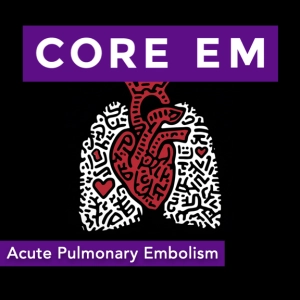
Episode 214: Acute Pulmonary Embolism

Episode 214: Acute Pulmonary Embolism

Author: Core EM October 2, 2025 Duration: 0:00

We review the diagnosis, risk stratification, & management of acute pulmonary embolism in the ED.

Hosts:
Vivian Chiu, MD
Brian Gilberti, MD

Download One Comment Tags:

Show Notes

Core Concepts and Initial Approach

  • Definition: Obstruction of pulmonary arteries, usually from a DVT in the proximal lower extremity veins (iliac/femoral), but may be tumor, air, or fat emboli.
  • Incidence & Mortality: 300,000–370,000 cases/year in the USA, with 60,000–100,000 deaths annually.
  • Mantra: “Don’t anchor on the obvious. Always risk stratify and resuscitate with precision.”
  • Risk Factors: Broad, including older age, inherited thrombophilias, malignancy, recent surgery/trauma, travel, smoking, hormonal use, and pregnancy.

Clinical Presentation and Risk Stratification

  • Presentation: Highly variable, showing up as anything from subtle shortness of breath to collapse.
  • Acute/Subacute: Dyspnea (most common), pleuritic chest pain, cough, hemoptysis, and syncope. Patients are likely tachycardic, tachypneic, hypoxemic on room air, and may have a low-grade fever.
  • Chronic: Can mimic acute symptoms or be totally asymptomatic.
  • Pulmonary Infarction Signs: Pleuritic pain, hemoptysis, and an effusion.
  • High-Risk Red Flags: Signs of hypotension (systolic blood pressure < 90 mmHg for over 15 minutes), requirement of vasopressors, or signs of shock → activate PERT team immediately.
  • Crucial Mimics: Think broadly; consider pneumonia, ACS, pneumothorax, heart failure exacerbation, and aortic dissection.

Workup & Diagnostics

  • History/Scoring: Ask about prior clots, recent surgeries, hospitalizations, travel. Use Wells/PERC criteria to assess pretest probability.
  • Labs:
    • D-dimer: A good test to rule out PE in a patient with low probability. If suspicion is high, proceed directly to imaging.
    • Troponin/BNP: Act as RV stress gauges. Elevated levels are associated with increased risk of a complicated clinical course (25-40%).
    • Lactate: Helpful in identifying patients in possible cardiogenic shock.
    • EKG: Most common finding is sinus tachycardia. Classic RV strain patterns (S1Q3T3, T-wave changes/inversions) are nonspecific.
  • Imaging:
    • CXR: Usually normal, but quick and essential to rule out other causes.
    • CTPA: The usual standard and gold standard for stable patients. High sensitivity (> 95%) and can detect RV enlargement/strain.
    • V/Q Scan: Option for patients with contraindications to contrast (e.g., severe contrast allergies).
    • POCUS (Point-of-Care Ultrasound): Useful adjunct for unstable patients.
      • Bedside Echo: Can show signs of RV strain (enlarged RV, McConnell sign).
      • Lower Extremity Ultrasound: Can identify a DVT in proximal leg veins.

Treatment & Management

  • Resuscitation (Reviving the RV):
    • Oxygenation: Give supplementally as needed (nasal cannula, non-rebreather, high flow).
    • Intubation: Avoid if possible; positive pressure ventilation can worsen RV dysfunction.
    • Fluids: Be judicious; even the smallest amount can worsen RV overload.
    • Vasopressors: Norepinephrine is preferred as first-line for hypotension/shock.
  • Anticoagulation (Start Immediately):
    • Initial choice is UFH or LMWH (Lovenox).
    • Lovenox is preferred for quicker time to therapeutic range, but is contraindicated in renal dysfunction, older age, or need for emergent procedures.
    • DOACs can be considered for stable, low-risk patients as an outpatient.

Escalation for High-Risk PE

  • Systemic Thrombolytics: Consider for very sick patients with shock/cardiac arrest (e.g., Alteplase 100 mg over two hours or a bolus in cardiac arrest). High risk of intracranial hemorrhage; weigh risks versus benefits.
  • PERT Activation: Engage multidisciplinary teams (usually including ICU, CT surgery, and interventional radiology).
  • Interventions: Consult specialists for catheter-directed thrombolysis or suction embolectomy. Surgical embolectomy can also be considered.
  • Bridge to Care: Activate the ECMO team early for unstable patients to buy valuable time.

Prognosis & Disposition

  • Mortality: Low risk < 1%; intermediate 3-15%; high risk 25-65%.
  • Complications: 3-4% of patients develop Chronic Thromboembolic Pulmonary Hypertension (CTEPH). Others may have long-term RV dysfunction and chronic shortness of breath.
  • Recurrence: ∼ 30% chance in the next few weeks to months, if not treated correctly.
  • Disposition:
    • ICU: All high-risk and some intermediate-high risk patients.
    • Regular Floor: Intermediate-low risk patients.
    • Outpatient Discharge: Low-risk patients can be sent home on anticoagulation. Use PSI or HESTIA scores to risk stratify suitability, typically starting a DOAC.
  • Shared Decision-Making: Critical to ensure care is safe and consistent with the patient’s wishes.

Read More

There’s a particular kind of pressure that comes with working in an emergency department, where decisions need to be both swift and sound. Core EM-Emergency Medicine Podcast exists in that space, offering a direct line to the essential knowledge and clinical reasoning that emergency medicine demands. Created by the team at Core EM, each episode feels less like a formal lecture and more like a focused conversation with a trusted colleague. You’ll hear discussions that break down critical topics, from managing common presentations to unraveling complex, high-acuity cases, all grounded in current evidence and practical reality. This podcast serves as a reliable resource for physicians, residents, and advanced practice providers looking to solidify their foundation or stay sharp on the latest evidence. It’s about cutting through the noise to deliver core content that’s immediately applicable at the bedside. Tune in for a clear, concise, and always relevant dive into the principles that define emergency care, designed to fit into a busy clinician’s life between shifts or during a commute.
Author: Language: en-us Episodes: 100

Core EM - Emergency Medicine Podcast
Podcast Episodes
Episode 211: Granulomatosis with Polyangiitis [not-audio_url] [/not-audio_url]

Duration: 0:00
Granulomatosis with Polyangiitis (GPA) – Recognition and Management in the ED Hosts: Phoebe Draper, MD Brian Gilberti, MD https://media.blubrry.com/coreem/content.blubrry.com/coreem/GPA.mp3 Download One Comment Tags: Rhe…
Episode 210: Capacity Assessment [not-audio_url] [/not-audio_url]

Duration: 0:00
We discuss capacity assessment, patient autonomy, safety, and documentation. Hosts: Anne Levine, MD Brian Gilberti, MD https://media.blubrry.com/coreem/content.blubrry.com/coreem/Capacity_Assessment.mp3 Download One Comm…
Episode 209: Blast Crisis [not-audio_url] [/not-audio_url]

Duration: 0:00
We dive into the recognition and management of blast crisis. Hosts: Sadakat Chowdhury, MD Brian Gilberti, MD https://media.blubrry.com/coreem/content.blubrry.com/coreem/Blast_Crisis.mp3 Download 2 Comments Tags: Hematolo…
Episode 208: Geriatric Emergency Medicine [not-audio_url] [/not-audio_url]

Duration: 0:00
We explore the expanding field of Geriatric Emergency Medicine. Hosts: Ula Hwang, MD Brian Gilberti, MD https://media.blubrry.com/coreem/content.blubrry.com/coreem/Geriatric_Emergency_Medicine.mp3 Download One Comment Ta…
Episode 207: Smoke Inhalation Injury [not-audio_url] [/not-audio_url]

Duration: 0:00
We discuss the injuries sustained from smoke inhalation. Hosts: Sarah Fetterolf, MD Brian Gilberti, MD https://media.blubrry.com/coreem/content.blubrry.com/coreem/Smoke_Inhalation.mp3 Download Leave a Comment Tags: Envir…
Episode 206: Acute Back Pain [not-audio_url] [/not-audio_url]

Duration: 0:00
We discuss the evaluation of and treatment options for acute back pain. Hosts: Benjamin Friedman, MD Brian Gilberti, MD https://media.blubrry.com/coreem/content.blubrry.com/coreem/Acute_Back_Pain.mp3 Download Leave a Com…
Episode 205: Family Presence during Resuscitation [not-audio_url] [/not-audio_url]

Duration: 0:00
We discuss the impact of family presence during resuscitations. Hosts: Ellen Duncan, MD, PhD Brian Gilberti, MD https://media.blubrry.com/coreem/content.blubrry.com/coreem/Family_Presence_During_Resuscitation.mp3 Downloa…
Episode 204: Necrotizing Fasciitis [not-audio_url] [/not-audio_url]

Duration: 9:12
We discuss the recognition and treatment of necrotizing fasciitis. Hosts: Aurnee Rahman, MD Brian Gilberti, MD https://media.blubrry.com/coreem/content.blubrry.com/coreem/Necrotizing_Fasciitis.mp3 Download Leave a Commen…
Episode 203: Acetaminophen Toxicity [not-audio_url] [/not-audio_url]

Duration: 0:00
We sit down with one of our toxicologists to discuss acetaminophen toxicity. Hosts: Marlis Gnirke, MD Brian Gilberti, MD https://media.blubrry.com/coreem/content.blubrry.com/coreem/Acetaminophen_Toxicity.mp3 Download One…
Episode 202: Sexually Transmitted Infections 2.0 [not-audio_url] [/not-audio_url]

Duration: 0:00
We review Sexually Transmitted Infections and pertinent updates in diagnosis and management. Hosts: Avir Mitra, MD Brian Gilberti, MD https://media.blubrry.com/coreem/content.blubrry.com/coreem/Sexually_Transmitted_Infec…