Paying it forward: a peer-staffed program for navigating college admissions

Paying it forward: a peer-staffed program for navigating college admissions

Author: Ethical Schools August 26, 2023 Duration: 45:45

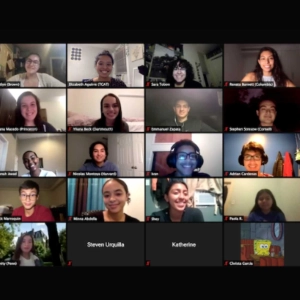
We speak with Michael Sanchez, executive director of Circle Match (formerly TCAT), a program that helps students in underserved high schools apply to colleges. Circle Match serves low income students, primarily of color, who are the first in their families to apply to college. Participants in turn assist classmates, thus creating a college-going culture and subsequently on-campus support. Circle Match students have been extraordinarily successful in gaining admission to elite colleges and universities.

Overview

00:00-00:43 Intros

00:43-02:14 Michael Sanchez’s own K-12 and college admission experiences

02:14-05:27 How these experiences influenced the concept of Circle Match

05:27-10:34 How Circle Match works

10:34-13:56 The people involved in Circle Match

13:56-15:46 Helping students with culture shock at Ivy league schools

15:46-18:54 Students’ responses to giant differences in wealth, income, expectations

18:54-21:10 Affinity groups of different types

21:10-23:36 Why Circle Match focuses on Ivies and other prestigious schools

23:36-26:21 Working with students who won’t get into Ivies

26:21-28:38 Making connections with other-than-Hispanic communities

28:38-30:22 Next schools to partner with

30:22-33:04 Communication with parents

33:04-34:07 Data on families

34:07-35:45 Admissions success rate

35:45-37:59 Going away to college as an issue for parents


Conversations about education often focus on test scores and curriculum, but there’s a deeper layer that truly shapes a student’s experience. Ethical Schools digs into that layer, exploring what it means to build a learning community grounded in integrity and care. Each week, hosts Amy and Jon sit down with educators and innovators who are actively reimagining schools. You’ll hear specific, grounded discussions about the practical work of creating environments where every student feels safe and respected. The dialogue frequently addresses how to support young people dealing with trauma, moving beyond theory to share actionable strategies that teachers are using right now. More than just problem-solving, this podcast highlights how to empower students themselves to become advocates and changemakers in their own communities. It’s a series that connects philosophy with daily practice, looking at the social and cultural structures within schools through a lens of ethics. For anyone invested in the future of education-whether you’re a teacher, administrator, or simply a concerned community member-this podcast offers a thoughtful and necessary perspective on the foundational values that make education meaningful.
Author: Language: English Episodes: 240

Ethical Schools
Podcast Episodes
National Sex Ed Standards: Equity and expanded comfort zones [not-audio_url] [/not-audio_url]

Duration: 32:00
We speak with Brittany McBride, Associate Director, Sexuality Education at Advocates for Youth, who partners with schools to provide the complete sex education that all students deserve. Though parents, students, and tea…
Dismantling bias in schools: A multiyear model [not-audio_url] [/not-audio_url]

Duration: 46:53
We speak with Dr. John Pascarella, Chief Academic Officer of K-12 Professional Learning at USC Race and Equity Center. The Center works with schools to identify disparate outcomes for students and strategies to eliminate…
Mentors and passages: The power of teen-centric programs [not-audio_url] [/not-audio_url]

Duration: 42:00
We speak with Al Kurland, longtime leader of out-of-school-time programs in Upper Manhattan’s Washington Heights. Mr. Kurland founded youth programs that help teens to “rewrite their stories” with the support of adult an…
From Skinner to computer-based education: Can machines teach? [not-audio_url] [/not-audio_url]

Duration: 44:30
We speak with independent journalist Audrey Watters, author of “Teaching machines: The history of personalized learning,” about the origins of teaching machines and the pedagogies that incorporate mechanical devices for…
Radical care: Leading with love [not-audio_url] [/not-audio_url]

Duration: 47:15
We speak with Dr. Rosa Rivera-McCutchen, associate professor of leadership studies at Lehman College, CUNY, about the importance of school leaders and teachers practicing radical care, including listening with intent and…
Efforts to ban books escalate: Tips for resistance [not-audio_url] [/not-audio_url]

Duration: 29:30
We speak with Dr. Richard Price, associate professor of political science at Weber State University, about recent attempts to ban books, especially those about GLBTQIA+ people and people of color, from classrooms and sch…
Climate education: not just for science class [not-audio_url] [/not-audio_url]

Duration: 40:30
We speak with Dr. Deb L. Morrison, research scientist at the University of Washington School of Education, about centering climate science throughout the K-12 curriculum. Dr. Morrison talks about ClimeTime, a Washington…
Distortions and fabrications: The state of climate education [not-audio_url] [/not-audio_url]

Duration: 29:45
We speak with Katie Worth, investigative journalist and author of Miseducation: How Climate Change is Taught in America. Ms. Worth explores what children across the country are taught, or not taught, about climate change…
