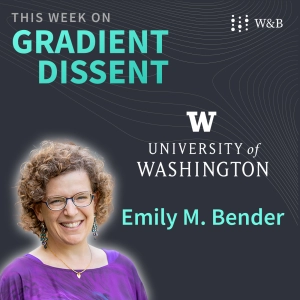
Emily M. Bender — Language Models and Linguistics

Emily M. Bender — Language Models and Linguistics

Author: Lukas Biewald September 9, 2021 Duration: 1:12:55

In this episode, Emily and Lukas dive into the problems with bigger and bigger language models, the difference between form and meaning, the limits of benchmarks, and why it's important to name the languages we study.

Show notes (links to papers and transcript): http://wandb.me/gd-emily-m-bender

---

Emily M. Bender is a Professor of Linguistics at and Faculty Director of the Master's Program in Computational Linguistics at University of Washington. Her research areas include multilingual grammar engineering, variation (within and across languages), the relationship between linguistics and computational linguistics, and societal issues in NLP.

---

Timestamps:

0:00 Sneak peek, intro

1:03 Stochastic Parrots

9:57 The societal impact of big language models

16:49 How language models can be harmful

26:00 The important difference between linguistic form and meaning

34:40 The octopus thought experiment

42:11 Language acquisition and the future of language models

49:47 Why benchmarks are limited

54:38 Ways of complementing benchmarks

1:01:20 The #BenderRule

1:03:50 Language diversity and linguistics

1:12:49 Outro


Lukas Biewald hosts Gradient Dissent: Conversations on AI, a series that moves beyond theoretical discussions to examine how artificial intelligence is actually built and deployed. Each episode features a direct, unscripted talk with a leading practitioner-you’ll hear from engineers and researchers at places like NVIDIA, Meta, Google, Lyft, and OpenAI. The focus is on the tangible challenges and breakthroughs they encounter, from initial research to the complex reality of putting models into production. This isn't about abstract futures; it's a grounded look at the decisions shaping the field right now. Biewald, bringing his perspective from Weights & Biases, steers conversations toward the practical trade-offs and collaborative efforts that define modern AI work. For anyone in technology or business who wants to understand the mechanics behind the headlines, this podcast offers a rare, candid window into the process. You’ll come away with a clearer sense of how ideas become functional systems and what it really takes to operate at the cutting edge.
Author: Language: English Episodes: 100

Gradient Dissent: Conversations on AI
Podcast Episodes
D. Sculley — Technical Debt, Trade-offs, and Kaggle [not-audio_url] [/not-audio_url]

Duration: 1:00:26
D. Sculley is CEO of Kaggle, the beloved and well-known data science and machine learning community.D. discusses his influential 2015 paper "Machine Learning: The High Interest Credit Card of Technical Debt" and what the…
Emad Mostaque — Stable Diffusion, Stability AI, and What’s Next [not-audio_url] [/not-audio_url]

Duration: 1:10:29
Emad Mostaque is CEO and co-founder of Stability AI, a startup and network of decentralized developer communities building open AI tools. Stability AI is the company behind Stable Diffusion, the well-known, open source,…
Jehan Wickramasuriya — AI in High-Stress Scenarios [not-audio_url] [/not-audio_url]

Duration: 1:00:02
Jehan Wickramasuriya is the Vice President of AI, Platform & Data Services at Motorola Solutions, a global leader in public safety and enterprise security.In this episode, Jehan discusses how Motorola Solutions uses AI t…
Will Falcon — Making Lightning the Apple of ML [not-audio_url] [/not-audio_url]

Duration: 45:21
Will Falcon is the CEO and co-founder of Lightning AI, a platform that enables users to quickly build and publish ML models.In this episode, Will explains how Lightning addresses the challenges of a fragmented AI ecosyst…
Aaron Colak — ML and NLP in Experience Management [not-audio_url] [/not-audio_url]

Duration: 50:00
Aaron Colak is the Leader of Core Machine Learning at Qualtrics, an experiment management company that takes large language models and applies them to real-world, B2B use cases.In this episode, Aaron describes mixing cla…
Jordan Fisher — Skipping the Line with Autonomous Checkout [not-audio_url] [/not-audio_url]

Duration: 57:58
Jordan Fisher is the CEO and co-founder of Standard AI, an autonomous checkout company that’s pushing the boundaries of computer vision.In this episode, Jordan discusses “the Wild West” of the MLOps stack and tells Lukas…
Drago Anguelov — Robustness, Safety, and Scalability at Waymo [not-audio_url] [/not-audio_url]

Duration: 1:09:01
Drago Anguelov is a Distinguished Scientist and Head of Research at Waymo, an autonomous driving technology company and subsidiary of Alphabet Inc.We begin by discussing Drago's work on the original Inception architectur…
Boris Dayma — The Story Behind DALL·E mini, the Viral Phenomenon [not-audio_url] [/not-audio_url]

Duration: 35:59
Check out this report by Boris about DALL-E mini:https://wandb.ai/dalle-mini/dalle-mini/reports/DALL-E-mini-Generate-images-from-any-text-prompt--VmlldzoyMDE4NDAyhttps://wandb.ai/_scott/wandb_example/reports/Collaboratio…
Tristan Handy — The Work Behind the Data Work [not-audio_url] [/not-audio_url]

Duration: 1:00:48
Tristan Handy is CEO and founder of dbt Labs. dbt (data build tool) simplifies the data transformation workflow and helps organizations make better decisions.Lukas and Tristan dive into the history of the modern data sta…