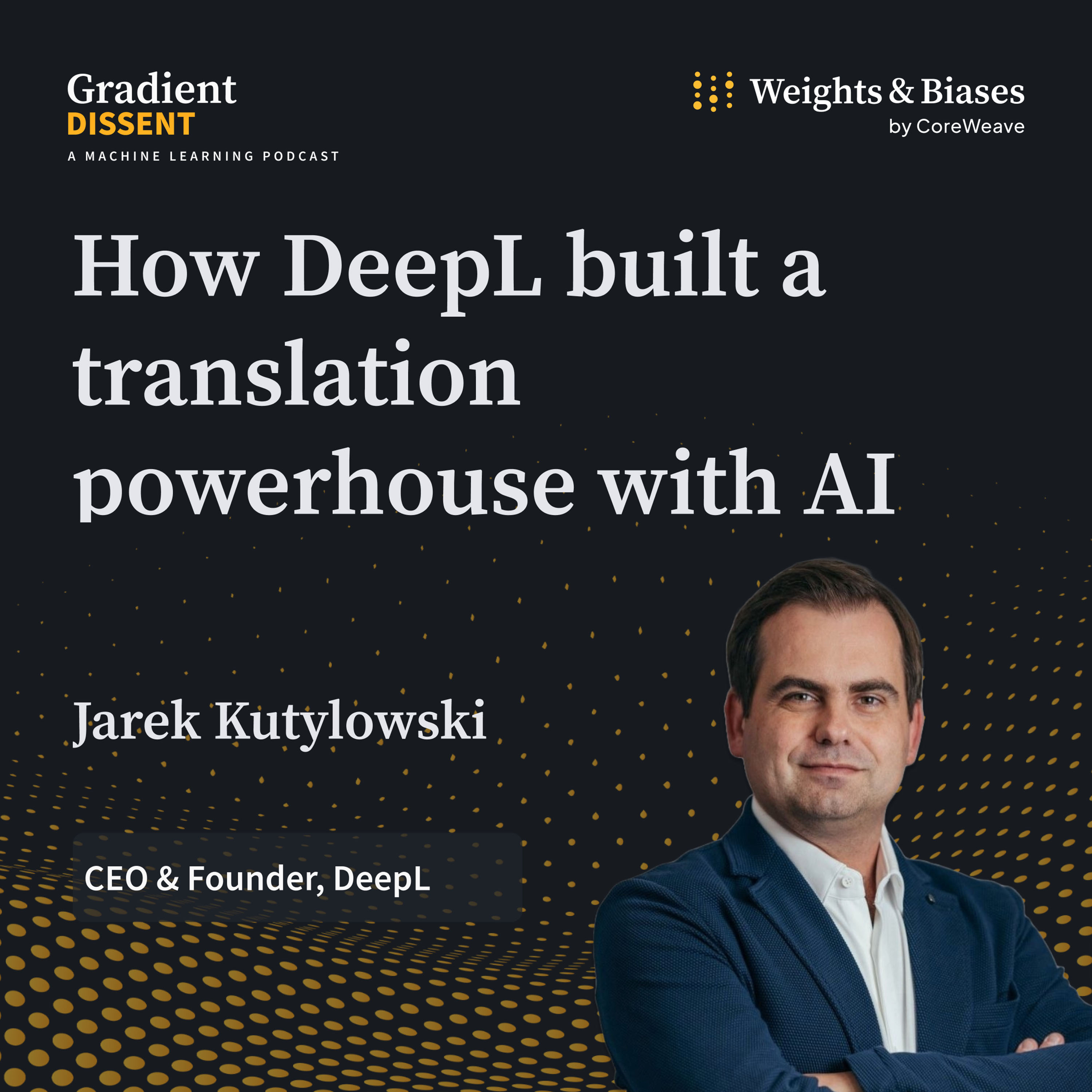
How DeepL Built a Translation Powerhouse with AI with CEO Jarek Kutylowski

How DeepL Built a Translation Powerhouse with AI with CEO Jarek Kutylowski

Author: Lukas Biewald July 8, 2025 Duration: 42:42

In this episode of Gradient Dissent, Lukas Biewald talks with Jarek Kutylowski, CEO and founder of DeepL, an AI-powered translation company. Jarek shares DeepL’s journey from launching neural machine translation in 2017 to building custom data centers and how small teams can not only take on big players like Google Translate but win.

They dive into what makes translation so difficult for AI, why high-quality translations still require human context, and how DeepL tailors models for enterprise use cases. They also discuss the evolution of speech translation, compute infrastructure, training on curated multilingual datasets, hallucinations in models, and why DeepL avoids fine-tuning for each individual customer. It’s a fascinating behind-the-scenes look at one of the most advanced real-world applications of deep learning.

Timestamps:

[00:00:00] Introducing Jarek and DeepL’s mission

[00:01:46] Competing with Google Translate & LLMs

[00:04:14] Pretraining vs. proprietary model strategy

[00:06:47] Building GPU data centers in 2017

[00:08:09] The value of curated bilingual and monolingual data

[00:09:30] How DeepL measures translation quality

[00:12:27] Personalization and enterprise-specific tuning

[00:14:04] Why translation demand is growing

[00:16:16] ROI of incremental quality gains

[00:18:20] The role of human translators in the future

[00:22:48] Hallucinations in translation models

[00:24:05] DeepL’s work on speech translation

[00:28:22] The broader impact of global communication

[00:30:32] Handling smaller languages and language pairs

[00:32:25] Multi-language model consolidation

[00:35:28] Engineering infrastructure for large-scale inference

[00:39:23] Adapting to evolving LLM landscape & enterprise needs


Lukas Biewald hosts Gradient Dissent: Conversations on AI, a series that moves beyond theoretical discussions to examine how artificial intelligence is actually built and deployed. Each episode features a direct, unscripted talk with a leading practitioner-you’ll hear from engineers and researchers at places like NVIDIA, Meta, Google, Lyft, and OpenAI. The focus is on the tangible challenges and breakthroughs they encounter, from initial research to the complex reality of putting models into production. This isn't about abstract futures; it's a grounded look at the decisions shaping the field right now. Biewald, bringing his perspective from Weights & Biases, steers conversations toward the practical trade-offs and collaborative efforts that define modern AI work. For anyone in technology or business who wants to understand the mechanics behind the headlines, this podcast offers a rare, candid window into the process. You’ll come away with a clearer sense of how ideas become functional systems and what it really takes to operate at the cutting edge.
Author: Language: English Episodes: 100

Gradient Dissent: Conversations on AI
Podcast Episodes
Mircea Neagovici — Robotic Process Automation (RPA) and ML [not-audio_url] [/not-audio_url]

Duration: 46:22
Mircea Neagovici is VP, AI and Research at UiPath, where his team works on task mining and other ways of combining robotic process automation (RPA) with machine learning for their B2B products.Mircea and Lukas talk about…
Peter & Boris — Fine-tuning OpenAI's GPT-3 [not-audio_url] [/not-audio_url]

Duration: 43:39
Peter Welinder is VP of Product & Partnerships at OpenAI, where he runs product and commercialization efforts of GPT-3, Codex, GitHub Copilot, and more. Boris Dayma is Machine Learning Engineer at Weights & Biases, and w…
Ion Stoica — Spark, Ray, and Enterprise Open Source [not-audio_url] [/not-audio_url]

Duration: 53:42
Ion Stoica is co-creator of the distributed computing frameworks Spark and Ray, and co-founder and Executive Chairman of Databricks and Anyscale. He is also a Professor of computer science at UC Berkeley and Principal In…
Chris Padwick — Smart Machines for More Sustainable Farming [not-audio_url] [/not-audio_url]

Duration: 1:00:59
Chris Padwick is Director of Computer Vision Machine Learning at Blue River Technology, a subsidiary of John Deere. Their core product, See & Spray, is a weeding robot that identifies crops and weeds in order to spray on…
Kathryn Hume — Financial Models, ML, and 17th-Century Philosophy [not-audio_url] [/not-audio_url]

Duration: 52:08
Kathryn Hume is Vice President Digital Investments Technology at the Royal Bank of Canada (RBC). At the time of recording, she was Interim Head of Borealis AI, RBC's research institute for machine learning.Kathryn and Lu…
Sean & Greg — Biology and ML for Drug Discovery [not-audio_url] [/not-audio_url]

Duration: 55:25
Sean McClain is the founder and CEO, and Gregory Hannum is the VP of AI Research at Absci, a biotech company that's using deep learning to expedite drug discovery and development.Lukas, Sean, and Greg talk about why Absc…
Chris, Shawn, and Lukas — The Weights & Biases Journey [not-audio_url] [/not-audio_url]

Duration: 49:13
You might know him as the host of Gradient Dissent, but Lukas is also the CEO of Weights & Biases, a developer-first ML tools platform!In this special episode, the three W&B co-founders — Chris (CVP), Shawn (CTO), and Lu…
Pete Warden — Practical Applications of TinyML [not-audio_url] [/not-audio_url]

Duration: 53:28
Pete is the Technical Lead of the TensorFlow Micro team, which works on deep learning for mobile and embedded devices.Lukas and Pete talk about hacking a Raspberry Pi to run AlexNet, the power and size constraints of emb…
