Qvevri 11-29-2023

Qvevri 11-29-2023

Author: Gus Clemens November 28, 2023 Duration: 4:09

Qvevri 11-29-2023

It seems inevitable. Whatever is “in” eventually will be “out.” Whatever is out eventually will be the next big thing. In the wine world, orange/amber wine and qvevri are examples.

Orange/amber wine is made in the simplest way. Grapes are dumped in a container and nature takes its course. In this process, the juice from white grapes is not removed from the skins, stems, and seeds, and thus the orange/amber color. This “natural” wine is the next big thing.

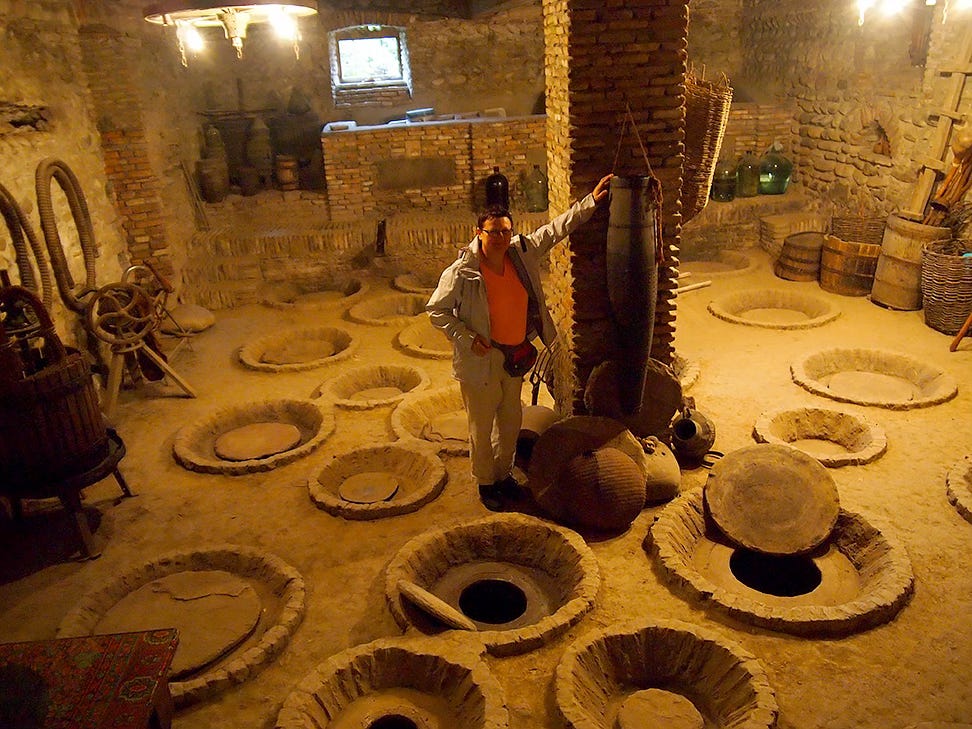
Qvevri at Georgian winery

Tomasz Przechlewski

Except not in the nation of Georgia at the nexus of Europe and Asia next to the Black Sea. Georgia very likely is where humans first started making wine more than 8,000 years ago. It is where the oldest wine-making site has been discovered. The Georgian language word for wine is “ghvino”, which means our word “wine” likely has its origin in Georgia.

Georgian winemaking suffered under Communism. It began a roaring comeback with the fall of the Soviet Union in 1989. The traditional method of making wine in Georgia involves use of qvevri—also spelled kvevri. A qvevri/kvevri is a large, egg-shaped terra-cotta vessel. It is similar to amphorae, but does not have handles. Qvevri range in size from 6 gallons to 2,600 gallons. The clay used to produce qvevri is important because it influences taste. It is similar to the choice of oak barrels in Western winemaking. It is related to the current Western winemaking trend to concrete eggs.

The inside of the qvevri is coated with beeswax to soften the clay impact. In most cases, qvevri are buried in the ground with only the circular mouth showing. The prefix qve/kve means “beneath” or “under.” The earth burial helps provide consistent temperature. A qvevri is a permanent winemaking vessels, cleaned, re-coated with beeswax and used year after year. Some actively-used qvevri are approaching 200 years old. Qvevri remnants in Georgia date back thousands of years.

In Georgia winemaking, grapes are pressed then the juice, grape skins, stalks, and pips are poured into the qvevri. The wine ferments at least six months with native yeasts. Usually malolactic fermentation is spontaneous. With white wine, the extended contact with the skins, stalks, and pips causes the wine color to be orange or amber. The method often is described as making white wine using red wine techniques.

You may have to search for Georgian qvevri wines, but it will be worth the adventure so you can be part of the next big thing that is thousands of years old.

Last round

What kind of soap does a dolphin use? An all-porpoise cleaner. Wine time.

Email: wine@cwadv.com

Newsletter: gusclemens.substack.com

Website:  gusclemensonwine.com

Facebook:  facebook.com/GusClemensOnWine/posts/

Twitter (X): @gusclemens

Since you subscribe to my newsletter, it follows you enjoy wine and humor and are an adventurous, inquisitive person. Each morning, The Sample sends you one article from a random blog or newsletter that matches your interests. When you find one you like, you can subscribe to the writer with one click. Give it a try Link to The Sample


This is a public episode. If you'd like to discuss this with other subscribers or get access to bonus episodes, visit gusclemens.substack.com/subscribe
There’s a lot of noise in the world of wine, but Gus Clemens on Wine cuts through it with clarity and a good dose of humor. Drawing from his widely syndicated newspaper column and his daily online posts, Gus Clemens brings his accessible expertise directly to your ears. This isn’t a stuffy lecture series. Instead, each episode feels like a relaxed conversation with a knowledgeable friend who genuinely wants you to enjoy the journey as much as the glass in your hand. You’ll hear straightforward reviews, fascinating stories from wine history, and practical insights that make the entire subject feel approachable and fun. The podcast naturally extends Gus’s written work into a warm, audio format perfect for listening during a commute, while cooking, or simply relaxing. Whether you’re just starting to explore beyond the supermarket aisle or you’re a seasoned enthusiast looking for a fresh perspective, this series demystifies topics from grape varieties and regions to pairing ideas and the latest trends. It’s about the culture, the people, and the stories behind the bottle, all delivered with a consistent, engaging voice that turns every episode into a pleasant discovery. Tune in for a genuinely user-friendly guide to the wide, wonderful world of wine.
Author: Language: English Episodes: 100

Gus Clemens on Wine explores and explains the world of wine in simple, humorous, fun posts
Podcast Episodes
Porto 3-6-2024 [not-audio_url] [/not-audio_url]

Duration: 4:41
This is the weekly columnPorto (port wine) often is mistaken to be a depth-of-winter libation sipped while gazing at a roaring fire, the finale to a robust meal. Porto certainly works in that scenario, but you miss out i…
Wine facts and trivia, Part Two 2-28-2024 [not-audio_url] [/not-audio_url]

Duration: 4:54
This is the weekly columnMore interesting facts and trivia about wine:• World wine production averages around 6.5 billion gallons a year.• Portugal has the most wine consumption in the world at 13.7 gallons per person pe…
Wine facts and trivia, Part One 2-21-2023 [not-audio_url] [/not-audio_url]

Duration: 4:56
This is the weekly columnSome interesting facts and trivia about wine:• The Bible mentions wine 247 times. Forty of those mentions are negative, usually warnings against abuse. There are 145 positive mentions, usually in…
Wine glut 2-14-2024 [not-audio_url] [/not-audio_url]

Duration: 4:43
This is the weekly columnWine has enjoyed quite a run. Consumption up for decades. Quality up—the best in the 8,000 year history of wine. Availability up, thanks in no small part to elimination of antediluvian restrictio…
Valentine’s Day 2-7-2023 [not-audio_url] [/not-audio_url]

Duration: 4:21
This is the weekly columnValentine’s Day, the inspired capitalist fabrication of greeting card makers, florists, and chocolatiers, happens next Wednesday. Here are some notions about wine to titillate your cherished some…
Scientific proof of terroir 1-31-2024 [not-audio_url] [/not-audio_url]

Duration: 4:43
This is the weekly columnTerroir is that baffling French term you often encounter with wine. There is another French term that sums up the meaning of terroir—je ne sais quoi [something that cannot be fully described or e…
Old Vines 1-24-2024 [not-audio_url] [/not-audio_url]

Duration: 4:13
This is the weekly columnYou likely have seen the description “old vine” on a wine label. What exactly does that mean and is it important?“Old vine” does not have a legal meaning, but generally in the wine world an “old…
Laura Catena interview Part Five 1-17-2024 [not-audio_url] [/not-audio_url]

Duration: 3:51
This is the weekly columnLaura Catena interview Part Five 1-17-2024Dr. Laura Catena, managing director of Bodega Catena Zapata, is considered the face of Argentine wine and a major spokesperson for wine in general.After…
California’s Goldilocks vintage 1-10-2024 [not-audio_url] [/not-audio_url]

Duration: 4:51
This is the weekly columnCalifornia’s Goldilocks vintage 1-10-2024It is a new year and time for some good news.Recent history has not been kind for wine. Demand, after decades of euphoric gains, has been flat. Mother Nat…
Meteorological seasons 1-3-2024 [not-audio_url] [/not-audio_url]

Duration: 4:30
This is the weekly columnMeteorological seasons 1-3-2024It is early January. Barely into winter. Except it isn’t barely into winter if you reckon by the more rational system of “meteorological seasons.” By that measure,…