Qvevri 11-29-2023

Qvevri 11-29-2023

Author: Gus Clemens November 28, 2023 Duration: 4:09

Qvevri 11-29-2023

It seems inevitable. Whatever is “in” eventually will be “out.” Whatever is out eventually will be the next big thing. In the wine world, orange/amber wine and qvevri are examples.

Orange/amber wine is made in the simplest way. Grapes are dumped in a container and nature takes its course. In this process, the juice from white grapes is not removed from the skins, stems, and seeds, and thus the orange/amber color. This “natural” wine is the next big thing.

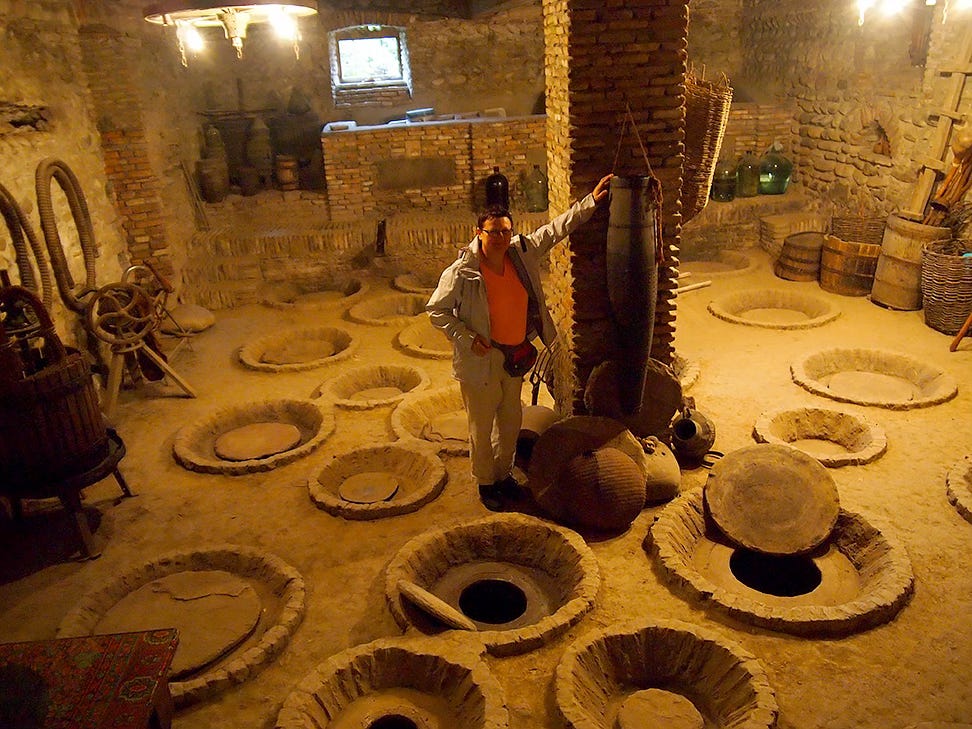
Qvevri at Georgian winery

Tomasz Przechlewski

Except not in the nation of Georgia at the nexus of Europe and Asia next to the Black Sea. Georgia very likely is where humans first started making wine more than 8,000 years ago. It is where the oldest wine-making site has been discovered. The Georgian language word for wine is “ghvino”, which means our word “wine” likely has its origin in Georgia.

Georgian winemaking suffered under Communism. It began a roaring comeback with the fall of the Soviet Union in 1989. The traditional method of making wine in Georgia involves use of qvevri—also spelled kvevri. A qvevri/kvevri is a large, egg-shaped terra-cotta vessel. It is similar to amphorae, but does not have handles. Qvevri range in size from 6 gallons to 2,600 gallons. The clay used to produce qvevri is important because it influences taste. It is similar to the choice of oak barrels in Western winemaking. It is related to the current Western winemaking trend to concrete eggs.

The inside of the qvevri is coated with beeswax to soften the clay impact. In most cases, qvevri are buried in the ground with only the circular mouth showing. The prefix qve/kve means “beneath” or “under.” The earth burial helps provide consistent temperature. A qvevri is a permanent winemaking vessels, cleaned, re-coated with beeswax and used year after year. Some actively-used qvevri are approaching 200 years old. Qvevri remnants in Georgia date back thousands of years.

In Georgia winemaking, grapes are pressed then the juice, grape skins, stalks, and pips are poured into the qvevri. The wine ferments at least six months with native yeasts. Usually malolactic fermentation is spontaneous. With white wine, the extended contact with the skins, stalks, and pips causes the wine color to be orange or amber. The method often is described as making white wine using red wine techniques.

You may have to search for Georgian qvevri wines, but it will be worth the adventure so you can be part of the next big thing that is thousands of years old.

Last round

What kind of soap does a dolphin use? An all-porpoise cleaner. Wine time.

Email: wine@cwadv.com

Newsletter: gusclemens.substack.com

Website:  gusclemensonwine.com

Facebook:  facebook.com/GusClemensOnWine/posts/

Twitter (X): @gusclemens

Since you subscribe to my newsletter, it follows you enjoy wine and humor and are an adventurous, inquisitive person. Each morning, The Sample sends you one article from a random blog or newsletter that matches your interests. When you find one you like, you can subscribe to the writer with one click. Give it a try Link to The Sample


This is a public episode. If you'd like to discuss this with other subscribers or get access to bonus episodes, visit gusclemens.substack.com/subscribe
There’s a lot of noise in the world of wine, but Gus Clemens on Wine cuts through it with clarity and a good dose of humor. Drawing from his widely syndicated newspaper column and his daily online posts, Gus Clemens brings his accessible expertise directly to your ears. This isn’t a stuffy lecture series. Instead, each episode feels like a relaxed conversation with a knowledgeable friend who genuinely wants you to enjoy the journey as much as the glass in your hand. You’ll hear straightforward reviews, fascinating stories from wine history, and practical insights that make the entire subject feel approachable and fun. The podcast naturally extends Gus’s written work into a warm, audio format perfect for listening during a commute, while cooking, or simply relaxing. Whether you’re just starting to explore beyond the supermarket aisle or you’re a seasoned enthusiast looking for a fresh perspective, this series demystifies topics from grape varieties and regions to pairing ideas and the latest trends. It’s about the culture, the people, and the stories behind the bottle, all delivered with a consistent, engaging voice that turns every episode into a pleasant discovery. Tune in for a genuinely user-friendly guide to the wide, wonderful world of wine.
Author: Language: English Episodes: 100

Gus Clemens on Wine explores and explains the world of wine in simple, humorous, fun posts
Podcast Episodes
Gifts for wine drinker 12-11-2024 [not-audio_url] [/not-audio_url]

Duration: 4:28
This is the weekly columnIf you have a wine lover on your Christmas/holiday gift list, some recommendations.Wine always is appreciated. Gift wine they enjoy, a proclivity you likely know, but if you do not, ask. If you a…
Nebbiolo—kings and queens 12-4-2024 [not-audio_url] [/not-audio_url]

Duration: 4:35
This is the weekly columNebbiolo is the extraordinary grape closely identified with the Piedmont region of northwestern Italy and particularly with the region’s great wines: Barolo and Barbaresco. Let’s explore.The origi…
White wine ascendant 11-27-2024 [not-audio_url] [/not-audio_url]

Duration: 3:49
This is the weekly columnWine is in turmoil. People are turning to alcohol alternatives. Red wine sales are down, white and rosé are up. French and Italians and Spanish are drinking less wine. There is a glut of wine. Wh…
Thanksgiving pinot noir 11-20-2024 [not-audio_url] [/not-audio_url]

Duration: 4:36
This is the weekly columnThanksgiving is the great American gastronomic holiday. Halloween is for foolishness, costumes, and candy. Christmas is for worship, family, and unseemly lust for gaudily wrapped material goods (…
Wine barrels 11-13-2024 [not-audio_url] [/not-audio_url]

Duration: 4:11
This is the weekly columIt takes two to four centuries to grow the oak tree for a wine barrel. Then, after tree harvest, four, usually more, years to season the wood and the staves. Finally, it is time to turn the staves…
Wood and wine 11-6-2024 [not-audio_url] [/not-audio_url]

Duration: 4:09
This is the weekly columnWine is an agricultural product. Hardly an earth-shattering revelation. But consider its scope. Not just wine vines, as essential as they may be, but in many cases—trees.Wine and wood have a marr…
Wine odds and ends 10-30-2024 [not-audio_url] [/not-audio_url]

Duration: 3:54
This is the weekly columnSome facts and trivia to lighten your mood as we prepare for the horrors of “fall back” when the government gives back the imaginary hour it stole from us on the second Sunday in March.• Do heavi…
Halloween and wine 10-23-2024 [not-audio_url] [/not-audio_url]

Duration: 4:24
This is the weekly columnHalloween is next week, but if you are giving wine advice it’s best to give your audience some time to act on it.First, I know of no decent pairing of wine with treacly sweet trick-or-treat candy…
Wine column reflections 10-16-2024 [not-audio_url] [/not-audio_url]

Duration: 4:05
This is the weekly columnOctober begins the 17th year of this wine column. Reflections.• Quality wine is made by grape farmers in a vineyard, not by lab coats in a winery. When this column started, I could enjoy mass pro…
Alcohol risks 10-9-2024 [not-audio_url] [/not-audio_url]

Duration: 4:11
This is the weekly columnScare headlines: “Drinking any alcohol is a cancer risk.” Well, okay, the question is how much of a risk?In this discussion, remember the adage popularized by Mark Twain: “Three types of lies. Li…