What influences your wine buying? 5-29-2024

What influences your wine buying? 5-29-2024

Author: Gus Clemens May 28, 2024 Duration: 3:46

This is the weekly column

In an opinion survey by YouGov, Americans claimed “bottle or label design” was the least important factor in their selection of a wine. That might be an expected response to an online questionnaire. Few people confess to being lured by clever critter names and images, or campy convict references, or hernia-inducing bottle weights.

But, come on, you are influenced. If you were not, wineries and marketing mavens and money managers would not pay so much attention and dollars to bottles/containers and labels. Anecdotal evidence is especially strong that people, especially those not heavily into wine, are influenced by these factors.

Today, the container is the new delta in the wine consumer equation. Screw caps were the tip of the change spear in past decades. It now is generally accepted that screw caps, also called Stelvin closures, are just another way of sealing a container and is not an indicator of inferior quality. Whole nations—New Zealand is the poster country—predominantly use screw caps. No one questions their quality, especially for wines consumed in the decade after release.

Newer battlegrounds involve containers. Massive glass bottles traditionally implied quality. That is an emotional rather than a rational response. Glass is glass. It works very well containing wine regardless of its weight. Environmentally and economically, weighty bottles make no sense in production, transportation, and disposal. Let us hope the growing trend of sensible bottle weights continues.

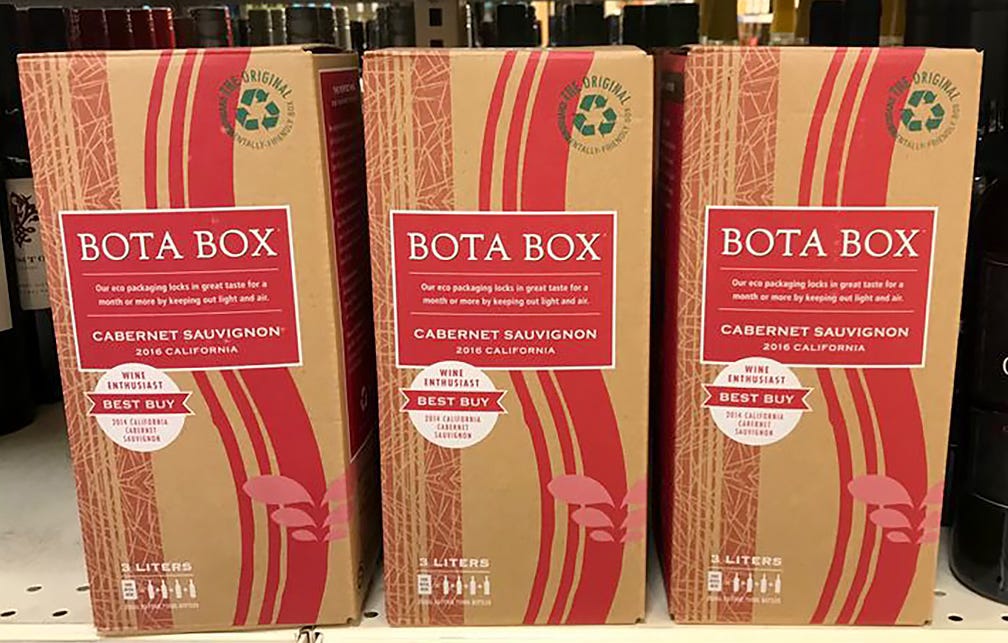
Non-glass is the new front line in wine packaging. Boxed wine—actually a plastic bag inside a cardboard box—has a solid base. Once the realm of cheap, inferior wine, now many makers produce quality. The fact the wine stays fresh after initial opening for a month is a huge selling point. You can’t age box wine, but almost all wine you buy is not purchased to be aged.

Tetra paks are small boxes made of cardboard, plastic, and aluminum. They are especially ideal for wines drunk young at a beach, poolside, picnic, or any situation where portability and safety from broken glass is an asset. Versions of this have worked for milk, fruit juice, and other liquids for years. Why not wines?

Cans. Similar advantages as tetra paks. Has worked for beer—for many foods and liquids—for more than a century. Why not wines?

Focus on what is in the container and how you will use it, not the closure or its weight or the material used to make it. Onward into the future of wine.

Last round

I met a microbiologist today. He was much bigger than I expected. Wine time.

Gus Clemens on Wine is a reader-supported publication. To receive new posts and support my work, consider becoming a free or paid subscriber.

Email: wine@cwadv.com

Newsletter: gusclemens.substack.com

Website:  gusclemensonwine.com

Facebook:  facebook.com/GusClemensOnWine/posts/

Twitter (X): @gusclemens

Long form wine stories on Vocal: Gus Clemens on Vocal


This is a public episode. If you'd like to discuss this with other subscribers or get access to bonus episodes, visit gusclemens.substack.com/subscribe
There’s a lot of noise in the world of wine, but Gus Clemens on Wine cuts through it with clarity and a good dose of humor. Drawing from his widely syndicated newspaper column and his daily online posts, Gus Clemens brings his accessible expertise directly to your ears. This isn’t a stuffy lecture series. Instead, each episode feels like a relaxed conversation with a knowledgeable friend who genuinely wants you to enjoy the journey as much as the glass in your hand. You’ll hear straightforward reviews, fascinating stories from wine history, and practical insights that make the entire subject feel approachable and fun. The podcast naturally extends Gus’s written work into a warm, audio format perfect for listening during a commute, while cooking, or simply relaxing. Whether you’re just starting to explore beyond the supermarket aisle or you’re a seasoned enthusiast looking for a fresh perspective, this series demystifies topics from grape varieties and regions to pairing ideas and the latest trends. It’s about the culture, the people, and the stories behind the bottle, all delivered with a consistent, engaging voice that turns every episode into a pleasant discovery. Tune in for a genuinely user-friendly guide to the wide, wonderful world of wine.
Author: Language: English Episodes: 100

Gus Clemens on Wine explores and explains the world of wine in simple, humorous, fun posts
Podcast Episodes
Wine bottle sizes 2-19-2025 [not-audio_url] [/not-audio_url]

Duration: 4:05
This is the weekly columnIt is a new year and there are sweeping changes in wine bottle sizes in America. Yep, wine makers and glass blowers have a whole new tool kit to entice you into experiencing whatever elixir they…
Wine for Valentine 2-12-2025 [not-audio_url] [/not-audio_url]

Duration: 4:33
This is the weekly columnValentine’s Day cometh, time for expressing love and affection, although one can argue that should be on your to-do list every day.The celebration has roots as far back as ancient Rome. It was th…
Gripes and opinions 2-5-2025 [not-audio_url] [/not-audio_url]

Duration: 4:46
This is the weekly columnWine columnists are expected to have opinions, and I have many. Here are four to rile up readers.• Stemless wine glasses. They do hold wine and they are harder to break and easier to clean than t…
Blending terms 1-29-2025 [not-audio_url] [/not-audio_url]

Duration: 5:20
This is the weekly columnWine labels and wine reviews may include various references to wine blending. Some are specific and informative. Others are distinctions without a difference. Let’s explore the most common blendi…
Types of blends 1-22-2025 [not-audio_url] [/not-audio_url]

Duration: 4:24
This is the weekly columnBlending is essential to making some of the world’s most iconic wines. We explored the several ways to blend last week. This week, specific wines created by blending.• Champagne can be a blend of…
Varietals and blends 1-15-2025 [not-audio_url] [/not-audio_url]

Duration: 4:09
This is the weekly columnIn general, wines can be divided into varietals and blends. This being wine, it is not so black-and-white simple. Let’s explore.A varietal wine has a single variety of grape on the label. That me…
Wine scores 1-8-2025 [not-audio_url] [/not-audio_url]

Duration: 4:09
This is the weekly columWine scores. Oh, my. On one level, ridiculous. On another level, essential to wine’s success over the past half century. Some observations.Anyone who ever took a test or got a report card in grade…
Winter wine survival 1-1-2025 [not-audio_url] [/not-audio_url]

Duration: 4:39
This is the weekly columnHappy New Year. We survived another sun circumnavigation. Sunlight grows slowly longer. Spring rebirth looms over the sere, cold-swept horizon. Endure these last temperature-challenging months, a…
Christmas 12-25-2024 [not-audio_url] [/not-audio_url]

Duration: 4:28
This is the weekly columThis column runs on Wednesdays in most markets—Christmas Day in 2024. If you have not secured your wine before now, no chance today. We can, however, look forward to New Year’s Eve and New Year’s…
Holiday wine pairing insight 12-18-2024 [not-audio_url] [/not-audio_url]

Duration: 4:18
This is the weekly columWith Christmas/holiday feasts coming soon, what is the ideal alcohol percentage for wine paired with food? The answer is 10-14%. Why?U.S. labeling laws are loony, so the ABV amount on the label ca…