What influences your wine buying? 5-29-2024

What influences your wine buying? 5-29-2024

Author: Gus Clemens May 28, 2024 Duration: 3:46

This is the weekly column

In an opinion survey by YouGov, Americans claimed “bottle or label design” was the least important factor in their selection of a wine. That might be an expected response to an online questionnaire. Few people confess to being lured by clever critter names and images, or campy convict references, or hernia-inducing bottle weights.

But, come on, you are influenced. If you were not, wineries and marketing mavens and money managers would not pay so much attention and dollars to bottles/containers and labels. Anecdotal evidence is especially strong that people, especially those not heavily into wine, are influenced by these factors.

Today, the container is the new delta in the wine consumer equation. Screw caps were the tip of the change spear in past decades. It now is generally accepted that screw caps, also called Stelvin closures, are just another way of sealing a container and is not an indicator of inferior quality. Whole nations—New Zealand is the poster country—predominantly use screw caps. No one questions their quality, especially for wines consumed in the decade after release.

Newer battlegrounds involve containers. Massive glass bottles traditionally implied quality. That is an emotional rather than a rational response. Glass is glass. It works very well containing wine regardless of its weight. Environmentally and economically, weighty bottles make no sense in production, transportation, and disposal. Let us hope the growing trend of sensible bottle weights continues.

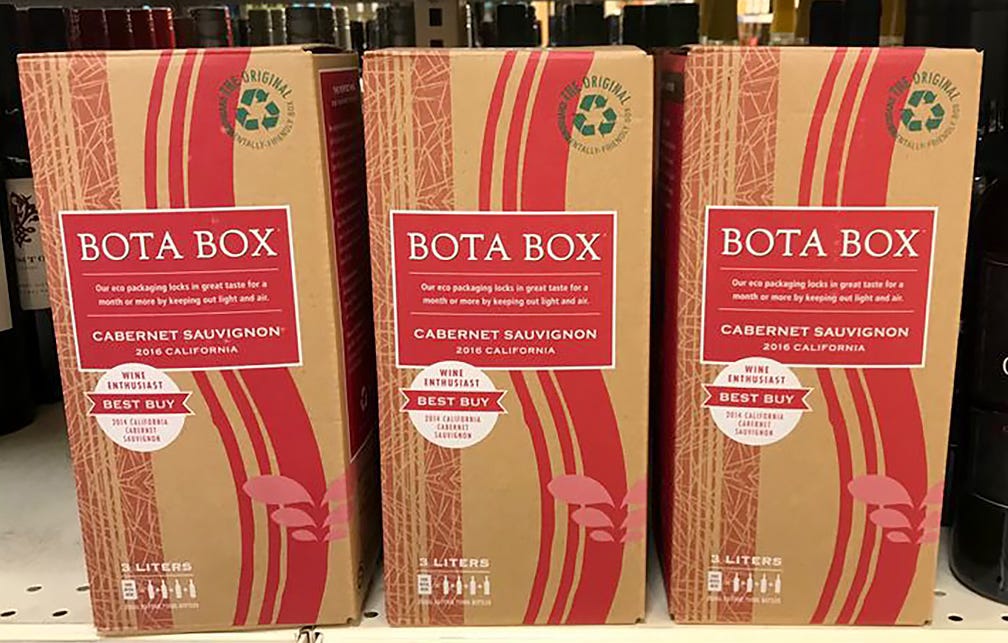
Non-glass is the new front line in wine packaging. Boxed wine—actually a plastic bag inside a cardboard box—has a solid base. Once the realm of cheap, inferior wine, now many makers produce quality. The fact the wine stays fresh after initial opening for a month is a huge selling point. You can’t age box wine, but almost all wine you buy is not purchased to be aged.

Tetra paks are small boxes made of cardboard, plastic, and aluminum. They are especially ideal for wines drunk young at a beach, poolside, picnic, or any situation where portability and safety from broken glass is an asset. Versions of this have worked for milk, fruit juice, and other liquids for years. Why not wines?

Cans. Similar advantages as tetra paks. Has worked for beer—for many foods and liquids—for more than a century. Why not wines?

Focus on what is in the container and how you will use it, not the closure or its weight or the material used to make it. Onward into the future of wine.

Last round

I met a microbiologist today. He was much bigger than I expected. Wine time.

Gus Clemens on Wine is a reader-supported publication. To receive new posts and support my work, consider becoming a free or paid subscriber.

Email: wine@cwadv.com

Newsletter: gusclemens.substack.com

Website:  gusclemensonwine.com

Facebook:  facebook.com/GusClemensOnWine/posts/

Twitter (X): @gusclemens

Long form wine stories on Vocal: Gus Clemens on Vocal


This is a public episode. If you'd like to discuss this with other subscribers or get access to bonus episodes, visit gusclemens.substack.com/subscribe
There’s a lot of noise in the world of wine, but Gus Clemens on Wine cuts through it with clarity and a good dose of humor. Drawing from his widely syndicated newspaper column and his daily online posts, Gus Clemens brings his accessible expertise directly to your ears. This isn’t a stuffy lecture series. Instead, each episode feels like a relaxed conversation with a knowledgeable friend who genuinely wants you to enjoy the journey as much as the glass in your hand. You’ll hear straightforward reviews, fascinating stories from wine history, and practical insights that make the entire subject feel approachable and fun. The podcast naturally extends Gus’s written work into a warm, audio format perfect for listening during a commute, while cooking, or simply relaxing. Whether you’re just starting to explore beyond the supermarket aisle or you’re a seasoned enthusiast looking for a fresh perspective, this series demystifies topics from grape varieties and regions to pairing ideas and the latest trends. It’s about the culture, the people, and the stories behind the bottle, all delivered with a consistent, engaging voice that turns every episode into a pleasant discovery. Tune in for a genuinely user-friendly guide to the wide, wonderful world of wine.
Author: Language: English Episodes: 100

Gus Clemens on Wine explores and explains the world of wine in simple, humorous, fun posts
Podcast Episodes
Wine name revolution 10-2-2024 [not-audio_url] [/not-audio_url]

Duration: 4:19
This is the weekly columnIf you go into almost any wine shop, liquor store, or supermarket wine section in the United States—and now in most places in the world—you will find wine bottles arranged and named by the variet…
Wine barrels 9-25-2024 [not-audio_url] [/not-audio_url]

Duration: 4:10
This is the weekly columnWinemakers: To oak or not to oak, that is the question. Whether ’tis nobler in the mind to suffer the slings and arrows of outrageous fortune, or to take up oak to craft your wine to shake the sp…
Great wine comes from great vineyards 9-18-2024 [not-audio_url] [/not-audio_url]

Duration: 4:57
This is the weekly columnWhat makes a great wine? There is a hard and fast answer: “great wine comes from great vineyards.”What makes a great vineyard?• Terroir. This is big net answer because the French term includes so…
Five enemies of wine 9-11-2024 [not-audio_url] [/not-audio_url]

Duration: 4:29
This is the weekly columnWine is your friend, especially when sipped with friends during a convivial meal. You are obliged to protect it from its enemies.Classic factors that negatively impact wine quality:• Oxygen. Expo…
How to be a good wine snob 9-4-2024 [not-audio_url] [/not-audio_url]

Duration: 4:15
This is the weekly columnWine snobbery is a detestable trait. But you can be a “good” wine snob. Here’s how.• Respect the preferences of others. Never be condescending or judgmental. Basically, don’t be a jerk. Good advi…
Malolactic fermentation/conversion 8-28-2024 [not-audio_url] [/not-audio_url]

Duration: 5:09
This is the weekly columnEven if you only dip your big toe into wine wonkiness, you likely encounter the term “malolactic fermentation” or MLF. What is that?Well, this being wine, it actually is not fermentation, which i…
Commercialization defines wine 8-21-2024 [not-audio_url] [/not-audio_url]

Duration: 4:19
This is the weekly columnCommercialization defines wine 8-21-2024Wine is fermented grape juice, an agricultural product like green beans and corn. But that is not how we think about wine. Why?We think of wine as a conseq…
Did dinosaur extinction lead to wine? 8-14-2024 [not-audio_url] [/not-audio_url]

Duration: 4:43
This is the weekly columnDid the extinction of dinosaurs play a part in the creation of wine? While it may sound far-fetched, according to an article in the prestigious, peer-reviewed scientific journal Nature Plants, th…
There is no definition for rosé 8-7-2024 [not-audio_url] [/not-audio_url]

Duration: 4:05
This is the weekly columnAugust. For many, triple digit degree days. Time to beat the heat with chilled rosé.Except, what exactly is rosé? Surprisingly, in the often rigid, rule-ridden world of wine, there is no consensu…
Your taste buds 7-31-2024 [not-audio_url] [/not-audio_url]

Duration: 4:12
This is the weekly columnTasting science used to be so simple. Alas, no more.Back in 1901, a German scientist opined various taste receptors were orderly segregated on your tongue in specific places. Sweet on your tip, s…