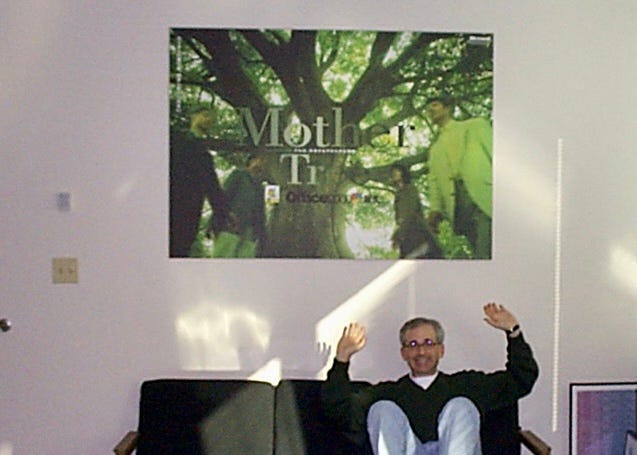
At the start of Chapter III towards the end of 1992, I thought I was about to start on the next release of Visual C++. Instead, a surprise email has me discussing a new job working for BillG as his “technical assistant”. I begin think about what the company is like to the outside world. Inside the company, we’re just working (and working, and working some more) trying fix the bugs, to ship, and get PCs to actually work. Microsoft was growing up. I was growing up. I didn’t even know Bill yet, having only met him at the new hire party.
This chapter and the following chapter (about 15 posts) describe the next two years. These years were probably the craziest time for the company, for Bill, and even to date for the technology industry.
Just a gentle reminder, this post is free to all those that signed up for the substack. Shortly I might do some posts that are subscriber only. Everyone will receive an excerpt though.
Back to 013. End of the Beginning
I blew off Bill Gates the first time I was supposed to meet with him—well, at least the first 20-plus minutes of our meeting in the fall of 1992.
I had been in AFX group leader Jeff’s office talking about some last-minute ship details for VC++ when I realized, “Oh crap, I am supposed to be meeting with BillG.”
Days earlier, Natalie Yount (NatalieY), at the urging of Jeff, spoke to me about taking a job that I knew nothing about, working for a person I had never really met, doing . . . I had no idea what. It was called technical assistant.
NatalieY represented a rarity at Microsoft. She was a core torch-carrier of the company culture, but not a technical person. She came from the famed Xerox PARC where she worked as a research librarian in the labs during some of the most innovative years at one of the most innovative places in technology (or anywhere). At Microsoft, she quickly captured Microsoft’s culture and became the leader that bridged fresh-out-of-college technologists and the real world.
During our meeting, she and I talked for a bit about me, my least favorite subject, but our conversation did not feel like an interview. Then she described the job. There had only been one other formal technical assistant and that was Aaron Getz (AaronG), another college hire who had worked with DougK on Microsoft Money as the only program manager. Carl Stork (CarlS), a college classmate of BillG’s, had previously unofficially held the job very early on where he worked with Bill on the organization of commands for Multitools apps. Richard Brodie, the original Word for DOS developer and former Xerox PARC engineer held the job for a year. Jabe Blumenthal (JabeB) had as well. JabeB had joined Microsoft as a college hire in the early 1980s. JabeB was the original program manager at Microsoft and had led the design of Microsoft Excel before leading efforts in the newly formed Consumer Software Division, where multimedia CD-ROM products and other home software was being developed.
It sounded like the job was “assist BillG with technical stuff” I thought to myself. In other words, there was no real job description. Jeff later described it as BillG’s “eyes and ears” on a deep technology level so he could continue to be engaged in a way he wanted to. That helped slightly. One thing was clear: The previous holders of this job were Apps program managers, while I was more of a Tools software design engineer. A concern (BillG had, I was told) was that as an SDE I lacked a big picture view and was too focused on the code, but that was not how I had been trained. (JeffH told me not to worry.)
Natalie later sent me a note and copied BillG’s assistant to schedule a meeting.
In thinking about what this sort of meeting would be like and how to prepare, the realities of Microsoft began to sink in. Not the product realities, those I understood well, but the realities of the company and that it, and BillG, were changing.
Jeff, my mentor who clearly arranged for this meeting to happen, offered me some of his insights. First and foremost, he confided in me that the company was now at a scale that Bill can’t keep track at the level of detail that he wants to. This was not to take away from his IQ or anything, but just simply that Microsoft had a lot of stuff going on. Jeff talked about how he could not put a finger on it, but Bill was “different” during the formation and shipping of AFX products—different in the sense that his input was more abstract, strategic for sure, but not at the level of detail he engaged on the evolution of Word or the first versions of Windows. Bill wanted to and believed he could continue to engage at a deep technical level, but Jeff felt he needed tools, or a person, to scale that effort. That’s how he came to suggest me to Bill.
The first few years after Microsoft’s IPO had been kind to Microsoft. Whether before the IPO on the cover of Time Magazine in 1984 or the cover of Fortune Magazine in 1986 just after the IPO, the image of the youthful and brainy nerd cemented Bill as a leading innovator of our age. Heck, it seemed like the whole country was embracing khakis and button-down shirts. It was like the ten-year old film Revenge of the Nerds had become reality.
Then came the book Hard Drive: Bill Gates and the Making of the Microsoft Empire by two reporters for the local Seattle Post-Intelligencer who had covered Microsoft for some time. The book had just come out, Spring 1992. Everyone at the company knew Bill (and allies and employees) did not cooperate. It was clearly intended to portray events in a negative light and was trying to be the first to do so (and succeeded). Writing today, I’ve learned that books like this are written too soon and amplify (or even get incorrect) events that are still happening and still unclear, the fog of war. Even today reading the book’s stories of hidden bugs designed to disadvantage customers or third-party developers seem as patently absurd, and false, as they did back then, even if the book spun a yarn saying otherwise. The arrival of the book began to color interactions with the press that to this point had been even-handed or even celebratory. Microsoft and Bill seemed to be entering the bad part of the cycle of build you up, then tear you down.
The real difficulty was the cloud of regulatory oversight that was just starting to form. While there were one-off stories, there began to be a critical mass of what might be called business practices that were claimed to be at the root of the success Microsoft was achieving. In other words, with the success, people were looking for the cause. Microsoft’s aggressive business practices were starting to be viewed as crossing some line. There had to be a way to explain the success that was not rooted in building great products, or so it seemed.
The way that employees could see this were through stories in trade press most often with quotes from who we viewed as competitors, or perhaps even bitter competitors that had lost. The primary dynamic going on that we talked about at lunch endlessly was how the success of Windows even caught Microsoft off guard compared to the determination to make OS/2 and the IBM partnership work. What Microsoft did was not pull back or even sacrifice that partnership to bolster Windows, but rather was just quick to recognize the product was not working and to find a different path. Unfortunately, most of the leaders in the industry chose to stick with IBM even longer than Microsoft did. That caused a lot of bitterness among the software leaders of the first era of the IBM PC, all of whom were under increasing pressure to have similar success on Windows. My old friend from drinks at the Software Development Conference, Philippe Kahn the founder and CEO of Borland, was one of those who led the charge, even advocating for IBM.
What was so weird was that in the lunchroom we were mostly relieved. It was not a master plan, but a master pivot.
There were then the constant stream of opinion pieces in the trade press criticizing Microsoft for products that were late or buggy. Every product was late and buggy and while we might argue at the very least our products were less buggy given the financial success the industry and customers were expecting better.
Across the industry trading barbs in the press nearly continuously for the past year or more over the future operating system platform was now routine. Analysts and executives on all sides would say the others are spreading “fear, uncertainty, and doubt” or FUD. FUD is a tactic, or theory about a tactic, designed to prevent customers from buying rival products by sowing negative views. In an ironic twist that really gnawed at Microsofties, often it would be said that Microsoft was employing a FUD strategy just as IBM had done before and perhaps even Microsoft, in the early 1990s, had become the new IBM—a recognition of the declining influence of IBM in the personal computer industry and Microsoft’s rising influence, or even dominance. NT was viewed as the center of claims of FUD because it was shipping real soon now, and at the same time Microsoft was indeed putting forth a pretty grand vision for the product that would take years to materialize.
Internally both now and for quite some time, Microsoft felt and acted like the insurgent. The computer companies we knew growing up were being left behind and many companies we knew from just a few years ago were struggling with the transition to PCs from mainframes and minicomputers. It was not difficult to imagine that fate for us if we just missed a few beats, executed slowly, or failed to deliver. At the same time, we were just struggling to keep the wheels on trying to deliver products, fix all the bugs, and make things work.
The narrative outside of power and influence simply didn’t match our day-to-day experience of fragility and challenges. We’d read about power and did not feel it or even understand what it felt like. Certainly, no team returning from a BillG review felt power. They felt the same pressure to achieve technically.
It was all super weird.
These were all really big issues, the subject of lunch time gossip. I could never hope to have an intelligent conversation with BillG about them.
I was more worried about Bill asking me questions about technology I would not know the answer to. Or pushing me on flaws in our products that I had been part of creating. Maybe even saying something that was “the stupidest thing” he had ever heard. I wanted to be “high IQ” even though it was still unclear if I was interviewing for a job or just doing some sort of informational meeting. I had no idea what it was like to change jobs inside of Microsoft and almost no one I know had even done that yet, save for OS/2 people moving as the project started winding down.
I set up a time to meet with BillG.
On to 015. Every Group Is Screwed Up
This is a public episode. If you would like to discuss this with other subscribers or get access to bonus episodes, visit
hardcoresoftware.learningbyshipping.com
![014. Executing on the Expansive Vision of Bill Gates [Ch. III]](https://substackcdn.com/feed/podcast/82387/post/34020815/854635202b5102751b4fc97c6357e40d.jpg)

![057. Enterprise Agreements [Ch. IX]](https://substackcdn.com/feed/podcast/82387/post/44917630/1072c6056ea060f57b45bb4b5281f9f0.jpg)