A quick story about something that felt like a corporate or ecosystem tax, the “Designed for Windows 95” logo.
Back to 037. Capone and Email Without Typos
By early 1995, the most essential elements for the Windows launch were determined. Chicago had picked an early summer RTM date. For Office, what had been “no more than 30 days later” was simultaneously shipping, which was awesome for the retailers and for the business. Windows had chosen the name Windows 95 and the idea of using the Rolling Stones’ Start Me Up in future ads was floated. Things were really hopping, and everything went from uncertainty to terror in the sense that we truly needed to finish. We transitioned from a software team to a team gated by duplicated CD-ROM discs, assembling boxes, and distributing palettes around the world.
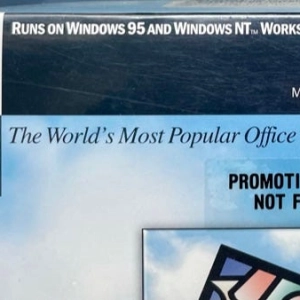
Office94 received the name Microsoft Office Professional Designed for Windows 95version 7.0 in a classic Microsoft naming bonanza, and to compound that there were other editions including Small Business or With Bookshelf on the box. Everyone on the planet called it Office 95, including all of Microsoft at launch events. But there were real forces at work, such as the fact that the Product Support systems relied heavily on the actual version number of the program to route and track support calls. It was also kind of a funny name since the apps were each on different versions (Word 6.0, Excel 5.0, PowerPoint 4.0). Version 7.0 came from bumping the highest number product, Word 6.0, to the next version. In what was a big deal, we versioned all the apps to 7.0 (Excel 7.0, PowerPoint 7.0, Access 7.0), which seemed like a weird (and often used) marketing gimmick. In fact, it was to be Office for the first time and to simplify all the downstream systems that we required real version numbers. And, because the company wanted only one product 95 and that was Windows. The chosen blue sky and cloud theme was visible on the Office box, but it was challenging to find a “95” without looking closely. Only today does the irony of using clouds on the box generate a chuckle once one considers the role of clouds today in software.
For the development team to fully feel the terror and pressure of the deadline, Robbie Bach, (RobbieB), the head of marketing for all of Desktop Apps, suggested I attend his weekly meeting where the planning for the launch was being coordinated. My first reaction was immature, and I thought between Office 95 [sic] and Office96 I had enough to do on the product and sitting in a long meeting going over launch minutiae seemed like a poor use of time. In addition, we had a team reporting to ChrisP specifically set up as the interface between marketing and development, known as Product Planning and led by Mark Kroese (MarkK), who had been working to make sure the product SKUs, naming, and branding were accurately reflected in the software coordinating with product design as needed.
Despite my resistance, it proved to be a critical learning experience as the scale and complexity of an Office launch was nothing at all like the nice little events we had in Languages, and this was truly going to be, to date, the biggest of all launches (and in hindsight the biggest one ever). Every week, I learned more small but important product issues—demo scripts that were not right, feature names that needed to be changed, concerns about localization, and good things to know like how much lead time one needed to rent out venues and the importance of mobilizing a global sales effort with the right sales tools and information. Everyone always says that PM and marketing need to work closely together, but until you experience the myriad of details marketing needs to get right for a worldwide consumer launch it is just an abstraction. . What no one could have prepared me for was just how many of these details came crashing together under crazy deadlines at the end of the project. There was a great deal of learning.
One recurring theme in the marketing meeting was a desire for “more” evidence that Windows 95 and Office 95 were designed to work together. This was particularly frustrating because by far the biggest features were 32-bits, long file names, and shipping the whole thing on time. Nevertheless, as soon as we had a ship date, we also had a lengthy list of Windows 95 integration feature requests. The list was not only long, but like a cake rising in the oven it seemed to be alternating between collapsing under its own weight and flowing over to make a total mess. Many of these details felt like a growing list of “must have” features from the Windows team about what makes for a great Windows 95 application. I had been asking for such a list for more than a year.
I was going back and forth every day between building 17 and the old buildings of the Chicago team—the shell team, networking, setup, and more—trying to figure out how important, how real, and what was the least amount of work needed to get things done. Seeing what was going on in our marketing team and knowing the realities of getting the code done, I felt I was mostly caught between these two incoming trains. Shipping big projects is as much a battle to say no and keep things in control as it is a schedule and crossing off work items. On the front lines, one always feels lonely—as though everyone else, every single other person from marketing to testing to PM to VPs, was coming to work every day to prevent the product from shipping on time. That’s how I felt in these discussions.
Much of this late work was coming about because the specifics of integrating with Windows 95 were, finally, coming together. For a Windows 95 app, the basics of installation and, more importantly, uninstalling or removing the product, was a defining area. Removing a product from a PC was a vendor-dependent hit or miss until Windows 95 when it was required an OS-defined operation. Today I realize the idea of installing and uninstalling software is archaic, but before Windows 95 putting software on a PC was a one-way adventure. It was close to impossible to remove a product, uninstall it, and return the PC to what it used to be like. This was a huge source of customer frustration and PC flakiness.
To make sure that third-party products were well designed for Windows 95, the Windows team created a program called Designed for Windows 95. This program allowed third parties to have their products certified by an independent test agency and, upon passing, the products could be branded and marketed with a Designed for Windows 95 flag logo on the box. Previous releases of Windows had a logo, but by and large it was a marketing effort with the defining characteristic being more logo-bearing software is better. Now there was an apparent product quality standard.
The logo test, as it turned out, was enough for marketing to feel like things worked together. Primarily this was because it seemed arduous and time-consuming enough that not everyone was going to have the logo in time for the launch and availability.
On the other handFor Office this was not optional, there really wasn’t much of an option. Office 95 had to pass these logo requirements. Windows was making a huge deal out of the logo. Historically, app developers looked to Office for ways to support Windows, but suddenly Windows was trying to tell Office what to do. App developers were looking to Office to be the first to support the logo and get the Designed for Windows 95 flag. We didn’t think it mattered much, but boy the Windows team and marketing thought it was really important.
Because of our scale, the boxes were being designed and printed assuming the product would pass the test. Looking at the final box it is kind of funny in that “Designed for Windows 95” appears five different times on the box plus it is in the detailed system requirements.
Logo requirements were somewhat of a moving target and many of them involved significant work. The logo program used an outside testing agency to verify products seeking logo approval, and companies had to pay for each test (and re-test). . .even Office. The outside testing agency was particularly literal and nitpicking with Office 95.
There were dozens of requirements tested throughout the project, and the details of what was acceptable were refined all the time. Each time we ran the test we had to pay something like $1,000 to the agency. It was driving HeikkiK (Heikki Kanerva, the former Olympic telemark skier and Finnish submariner on the team) crazy. The closer we got to the deadline the longer it took to get results back because the agency was overwhelmed. The Windows team had rallied many independent vendors to earn the logo as well.
In Office we always felt there was a conspiracy against us in that we were held to a higher standard than third parties. It certainly felt through the whole logo test like we were aiming for a moving target. We wondered if our competitors had such a challenging time.
The logo was one of many unplanned events that would mark the final six months of the project. Every day Heikki was convening the dev, test, and program manager leads for a status meeting. Heikki had no time for issues without resolutions and calmly kept moving the conversation forward. Every meeting people would mention issues regarding our ability to ship, starting with the beta release or OPP, Office Preview Program. Heikki would look at them and calmly ask in his Finnish baritone, “Is that an OPP-stopper?” The answer was invariably no, and thus the issue was resolved.
No whining was allowed.
Heikki, the ever calm, cool, and collected leader, by sheer force of will got us through this process, and we eventually received a passing mark for the logo. It was such a crazy experience that I had framed copies of the certification letter made for each of us. They remained on our walls for years.
It was July 14, 1995, just six weeks before launch we passed the logo requirement. This was literally just in time because the scale of Windows was absorbing all the manufacturing and logistics available. Combined we ended up using a lot of air freight and overnight shipping to get boxes of both Windows and Office to the thousands of retail endpoints and distribution centers around the world for August 24.
On to 039. Start Me Up
This is a public episode. If you would like to discuss this with other subscribers or get access to bonus episodes, visit
hardcoresoftware.learningbyshipping.com
![024. Discovering “Cornell is WIRED!” [Ch. IV]](/imgp.php?url=https://substackcdn.com/feed/podcast/82387/post/36140869/54212668cb63393c66928975b41bf153.jpg)