Back to 062. Split Up Microsoft
We received little guidance regarding how to talk about legal matters. I was never under orders to avoid speaking about the trial, though that seemed like common sense. Once the verdict came down, teammates were starting to ask questions, wondering what the case meant for Office. I knew enough to know that absent anything official, people made up their own reality. I was worried that this could become a local press issue, with people talking to friends and friends talking to friends, ending up in the Seattle Times.
I organized an impromptu all-hands in the atrium of building 17. Anyone who wanted could attend. This was the largest space we had without going off campus (also where we presented the Office10 vision). Using a single speaker audio system, I spoke into a handheld corded microphone like a lounge singer. I walked the team through the trial and what had happened, not adding anything that was not already available to the press and public, but simply tried to casually explain the facts. What was Microsoft accused of? What was a monopoly? What does a breakup order mean? The trial team was so focused on the external press that we did not have an internal process, so I did the best I could.
I had little to offer by way of details. I took a lesson from a former test leader on the Windows team—a management lesson that permeated Microsoft, perhaps to the point of becoming apocryphal. David Maritz (DavidMa) was formerly an Israeli tank commander during his army service. His unit of tanks out in the desert would sit there in a defensive posture in the dark of night. If the radio was silent for too long, each of the tanks started to worry something was wrong with the other. Panic might sweep across the unit. David said the way they avoided this was for him to check in with the other tanks and periodically let them know that everything was okay—even though he didn’t know himself. He taught us with that anecdote that even when leaders have no information, communicating something was better than nothing.
In between describing the intricacies of the legal process that would play out over years, people were worried that we were being immediately broken up, as in over the course of the coming weeks a spouse, partner, or roommate might work at “the other Microsoft.” I reiterated that there were still many things that could happen before this order could become a reality, and that much was still unclear.
At least there was humor in the situation. No one in the atrium was clear on the legal goal of splitting up Microsoft between Windows and Office. As engineers and employees on the ground, it seemed kind of nuts. Presumably, the issue was that Windows and Office were working too closely, even illegally, together and that needed to stop.
In reality Office and Windows could barely get anything done together. That situation was literally the topic of every meeting across the executive team. Different schedules, different customers, different system requirements, and more reinforced how far-fetched this idea was. More than crazy, by some measures this could have the potential to be a huge relief. Office might finally be treated as a vendor, like Lotus, which we always believed received better placement at Windows developer conferences!
For a decade there were rumors that the Office team accessed secret Windows source code that no one outside of Microsoft could see and that somehow that was an advantage. There were rumors of APIs in Windows that were secretly used by Microsoft to make Office better than competitors. There was no proof of any of this, though it made for a conspiracy theory. Back in the earliest days of a tiny Microsoft, with just tens of developers on big projects, we didn’t even have the technology to secure code from each other even if we wanted to. Ironically, many on the Office team remember diving in and trying to make Windows products work, not the other way around; whether it was Windows graphics for charts in Excel or printing in OS/2, it seemed that the advantage flowed to Windows. In the atrium, people were asking about this topic, and it brought a sense of levity to an otherwise unique situation because most were not around for the early days of Windows 2 and 3, or even Windows 95.
After a brutal series of motions, briefs, and other legal warfare, a year later on June 28, 2001, a federal appeals court reversed the breakup order, reprimanding and removing Judge Jackson and appointing a new judge. As often happens in these complex cases, the judge, Colleen Kollar-Kotelly, pushed to have the parties resolve their differences outside the court. By September 2001, the plaintiffs withdrew their effort to seek the breakup of Microsoft. By November, the case worked out a settlement, which Judge Kollar-Kotelly ruled served the public interest. There were no issues in the settlement regarding Office directly, though later when I moved to Windows in early 2006 some of my immediate responsibilities included complying with the terms of the settlement, which was scheduled to end in November 2007. We voluntarily extended that by two years, which meant the first release of Windows that I worked on included making sure it followed the consent decree.
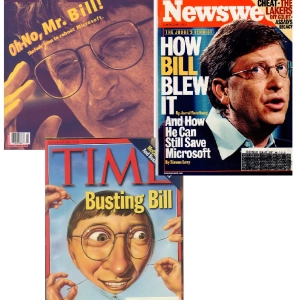
While much speculation has gone into how the legal issues impacted Microsoft execution and product strategy, my view, even on the front lines back then, was that by far the biggest issue was not in the workplace specifically, but outside of it. Even though they had nothing to do with them, everyone on the team endured the negative comments about the company and its business practices. That’s where the litigation and scrutiny truly caused difficulty. Consider those holiday dinners and family gatherings where an engineer on the team was called to the carpet to explain or defend Microsoft. It was those endless news magazines that piled up in every household. Similarly, when recruiting college students, I frequently found myself on the phone with parents of candidates walking them through the case and the culture of Microsoft while also defending us.
Those side effects of litigation were more difficult than the specific structural and regulatory remedies.
In just a few years I would find myself on Microsoft’s other side of this case, working on Windows. I would manage the last years of the consent decree, but the real challenge was cultural and bringing us back to the days of doing what was best for customers and not pre-judging every action through a legal process we on the development team were hardly expert in.
On to 064. The Start of NetDocs v. Office
This is a public episode. If you would like to discuss this with other subscribers or get access to bonus episodes, visit
hardcoresoftware.learningbyshipping.com



![014. Executing on the Expansive Vision of Bill Gates [Ch. III]](/imgp.php?url=https://substackcdn.com/feed/podcast/82387/post/34020815/854635202b5102751b4fc97c6357e40d.jpg)