Seiichiro Asakawa, Previous President Tokyo Chemical Industries

Seiichiro Asakawa, Previous President Tokyo Chemical Industries

Author: Dr. Greg Story November 8, 2024 Duration: 1:03:15

As a leader, I learned to not compete on things I did not have expertise in. I had a financial background, not a technical background, so there was no use trying to convince technically strong employees on that front – I had to use financial data as facts in order to convince my employees to accept that things needed to change in order to grow on the global scale that I wanted.

While I accept there are differences in practices between cultures, I think the basics of people are the same. People are motivated to learn, to grow, to advance. Young people particularly, regardless of culture, are willing to challenge themselves and are not afraid to try and even fail.

We invested heavily in the company computer systems so that all staff can, at the touch of a button, contact any other member of our overseas team. So, apart from being conscious of time differences, there is no excuse for a lack of communication. We communicate, even at the Japanese headquarters, mainly in English and what I encourage the most is everyone just having a go, it can be horrible English with just a bunch of words together but there will always be someone in the meeting who can translate so it is vital that people gets a chance and just tries. Bit by bit, they will realise no one`s English in the company is perfect and that just trying to communicate is the key.

We never fire people for making a mistake, even if it is a big one because they tried, so they are not penalized and in fact we set up challenge systems within the company to recognize employees globally who met the challenge, made the contribution and tried.

We also bring managers to Japan and take Japanese managers to our other offices in India and China and Europe etc, so as many people as possible, can see first-hand how our business operates in different cultures. It is expensive to do this, but I see it as an investment in my people, in team building and in my company.

I think while money is important to people, they have bills to pay after all, but recognition in so far as being trusted to take on certain roles and responsibilities is a bigger motivating factor in my company.

When I took over the company, and instigated the global expansion, I had to be very precise and transparent about my messages. I would send the messages in English and Japanese to the employees about where we were and where we wanted to go. I would outline the broad plan and then ask different groups into meetings to plan, plan, plan – down to the detailed plans. This was how I built ownership from the employees into the global plan, and changed the company culture from a One-King culture, top-down strong leadership style that my father used, to a style that was more suited to me and what I had learnt in the US

I think a problem in Japan is we ask people to choose a specialization at far too early an age. For example, once you go down a science path, you do not learn management or business skills, so we end up with highly skilled workers but only in their particular field, and that puts us at a competitive disadvantage because in many other Western countries, even if you major in science, you still get a liberal arts education, which basically teaches you the leadership and communication skills you need anyway.

In Japan, a well-mannered conversation is based on listening, to fully understand and make an in-depth comment. Feedback is only considered appropriate at work, feedback to people at your own level is considered aggressive. You need to be very careful giving feedback to Japanese people, listen carefully to what they are trying to do and the reasons they are doing that.

Personal relationships are key in Japan. Japanese have hospitality in their DNA, so show some interest in the culture and people will be more likely to engage with you. It helps build trust.
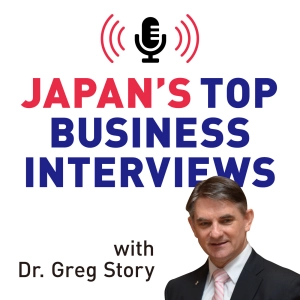

Hosted by Dr. Greg Story, Japan's Top Business Interviews Podcast By Dale Carnegie Training Tokyo Japan offers a direct line to the experiences and strategies of executives operating within one of the world's most distinct economies. Each conversation moves beyond theory, focusing on the practical realities of management and leadership as told by those doing the work. You'll hear from a diverse roster of guests, from seasoned leaders at large corporations to innovative founders of growing ventures, all sharing their firsthand accounts of navigating Japan's unique business culture. This podcast provides valuable context on everything from building effective teams and driving organizational change to understanding the nuances of negotiation and customer relations in this market. Whether you're currently leading a team in Japan, planning to expand your business there, or simply curious about how professional success is achieved in a different cultural framework, these interviews deliver grounded insights. Tune in for authentic discussions that cut through the clichés, offering a clearer picture of what it truly takes to succeed. The depth and variety of perspectives make this series a consistently useful resource for anyone engaged with the business landscape in Japan.
Author: Language: English Episodes: 100

Japan's Top Business Interviews Podcast By Dale Carnegie Training Tokyo Japan
Podcast Episodes
Frank Packard — Founder & Previous President, AAA Partners Japan [not-audio_url] [/not-audio_url]

Duration: 1:14:22
"Very few people in finance can make a declarative sentence." "If you can scale your message from thirty seconds to three minutes, you've got it made." "We want to only do legal business, it has to be rewarding, and it h…
Jim Weisser — President and Co-founder, SignTime [not-audio_url] [/not-audio_url]

Duration: 1:26:20
"The team's the most important thing." "I didn't listen very well." "I thought I had most of the answers when I didn't even know the problem." "Treat them as they want to be treated." "If I screwed up, it's also my job t…
Wolfgang Angyal — President of Riedel Japan [not-audio_url] [/not-audio_url]

Duration: 1:16:57
"Trust is really the only currency that is the beginning and the end of pretty much every human relation." "You give trust first, before you get trust." "I want to make sure that the least empowered person in the room ca…
Lorenzo Scrimizzi — President, Carpigiani Japan [not-audio_url] [/not-audio_url]

Duration: 1:04:27
"the most important thing, I mean in Japan, for business, is to hire the right people" "the keyword is gaining trust" "you need to allow people to make mistakes" "the personal relationship in Japan are extremely importan…
Bob Noddin — Previous CEO of AIG Japan [not-audio_url] [/not-audio_url]

Duration: 58:35
"Japan is different and hard." "It's consistency, it's sustainability of the vision and the theme that's going to matter." "You couldn't be the super-God sits up in the ivory tower." "Leadership is about inspiring people…
Mike Alfant - CEO Fushion Systems [not-audio_url] [/not-audio_url]

Duration: 1:02:07
"Everyone wants to play for a winning team." "You've got to go to war with the army you've got, not the army you wish you had." "In Japan, talk is cheap. Nobody really pays attention to what people say. They pay attentio…
Peter Jennings -  Previous President of Dow Japan and Korea [not-audio_url] [/not-audio_url]

Duration: 1:00:55
"this job is really primarily a people job" "if you get the right people, you don't have to spend a lot of time micromanaging; get out of their way and let them do their thing" "you have to be the type of boss that peopl…
Ross Rowbury - Previous President, Edelman Japan [not-audio_url] [/not-audio_url]

Duration: 1:06:50
"The key thing is that the leader needs to be able to identify where those turning points or tipping points are so that they don't become a bottleneck in that process." "In most cases, I feel like I only have about 30% o…
Paul Hardisty -  Former CEO, Adidas Japan [not-audio_url] [/not-audio_url]

Duration: 54:22
"The trust part is very important." "Change was a dirty word." "Anything controversial was normally me." "Doing the same thing over and over again and expecting a different result is the definition of insanity." Paul Har…
Harry Hill — Former CEO, Shop Japan [not-audio_url] [/not-audio_url]

Duration: 57:15
"Everybody having a shared sense of purpose and shared values… is just absolutely imperative." "I trust you, and I start from the perspective of trust." "I would always caution Western leaders… to not just fill up empty…