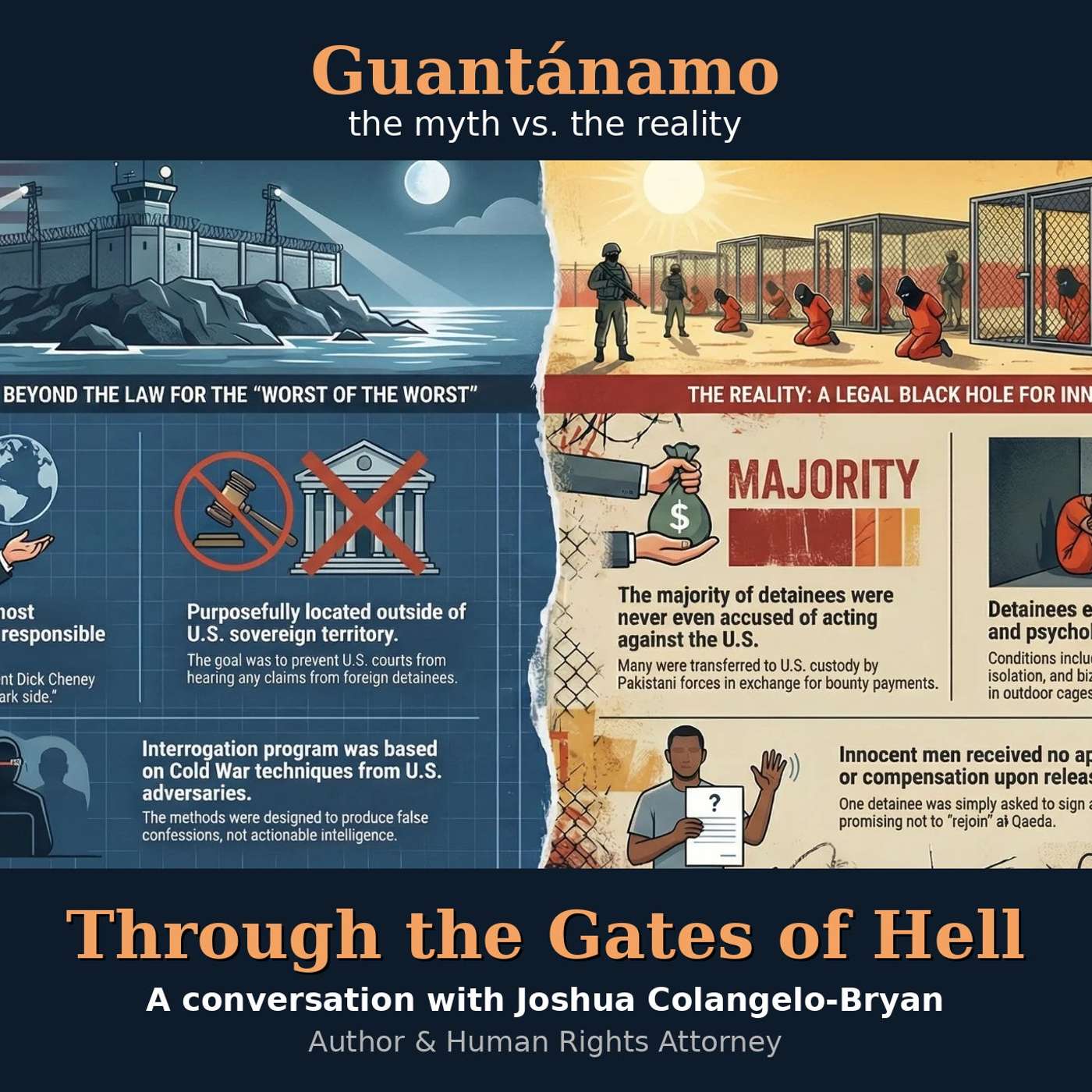

Guantanamo: The Myth vs the Reality
Dick Cheney died four weeks ago, but his dark legacy lives on—quite literally—at Guantanamo Bay. The human rights lawyer Joshua Colangelo-Bryan was among the first attorneys to enter the notorious prison in 2004, and what he found there shattered every official justification for its existence. The “worst of the worst”? Most detainees were never even accused of acting against America. Many were simply sold to the Americans for bounties. The sophisticated interrogation program? Techniques copied from Chinese and Soviet methods designed to extract false confessions, not intelligence. In his new book Through the Gates of Hell, Colangelo-Bryan tells the story of his unlikely friendship with Jaber Mohammed, a Bahraini detainee who spent years in captivity for the crime of being an Arab man in the wrong place (Afghanistan) at the wrong time (post 9/11). Released without apology or compensation—just a form asking him not to “rejoin” organizations he’d never belonged to—Jaber now lives in Saudi Arabia with four children, focusing less on bitterness and more on those rare moments when American guards showed him unexpected kindness. As the Trump administration revives the “worst of the worst” rhetoric against immigrants and once again sends people to Guantanamo, Colangelo-Bryan’s account is a warning from recent history: demonize a racial or religious group, and you will inevitably destroy innocent lives. The gates of hell have once again been opened. Will they ever be closed?
This is a public episode. If you'd like to discuss this with other subscribers or get access to bonus episodes, visit keenon.substack.com/subscribe
How To Fix Democracy: Samuel Issacharoff searches for glimmers of hope to strengthen democracies around the world
Retelling the stories of Mary Wollstonecraft and Mary Shelley: Stephanie Marie Thornton imagines the lost words between the iconic 18th century feminist and her equally visionary 19th century daughter
American Humility and Hubris in Kabul: Jeffrey E. Stern on a many layered story of brotherhood and terror in the Afghanistan war
A Gutenberg Moment in the History of Medicine: Dr Robert Pearl offers 5 ways that generative AI is about to revolutionize healthcare
Digital McCarthyism: Keith Teare on the chilling anti=Chinese and anti-Communist hysteria in Washington DC against TikTok
How to Incentivize People to Change their Behavior: Uri Gneezy reveals how incentives really work
The Power of Hope: Carol Graham on how the science of well-being an save us from despair
Ancient Stories about the Future: Sabrina Orah Mark on telling fairy tales designed to wake us up
Trump as the Road Runner: Kevin O'Brien, former Assistant US Attorney to the DOJ, on hush money, Stormy Daniels and the latest farcical chapter of the Donald Trump Show
How Data Happens: Chris Wiggins on a history of data from the Age of Reason to the Age of Algorithms
When All Else Failed: Dana Sachs on the volunteers at the heart of the worst human displacement crisis in Europe since WW2
Our Brains on Art and Music: Susan Magsamen and Ivy Ross on how the arts improve both individual and communal health
The New American Abnormal: Kerry Howley questions the seduction of a singular "truth" in the "Deep State" America of violent rumor, paranoia and perpetual surveillance