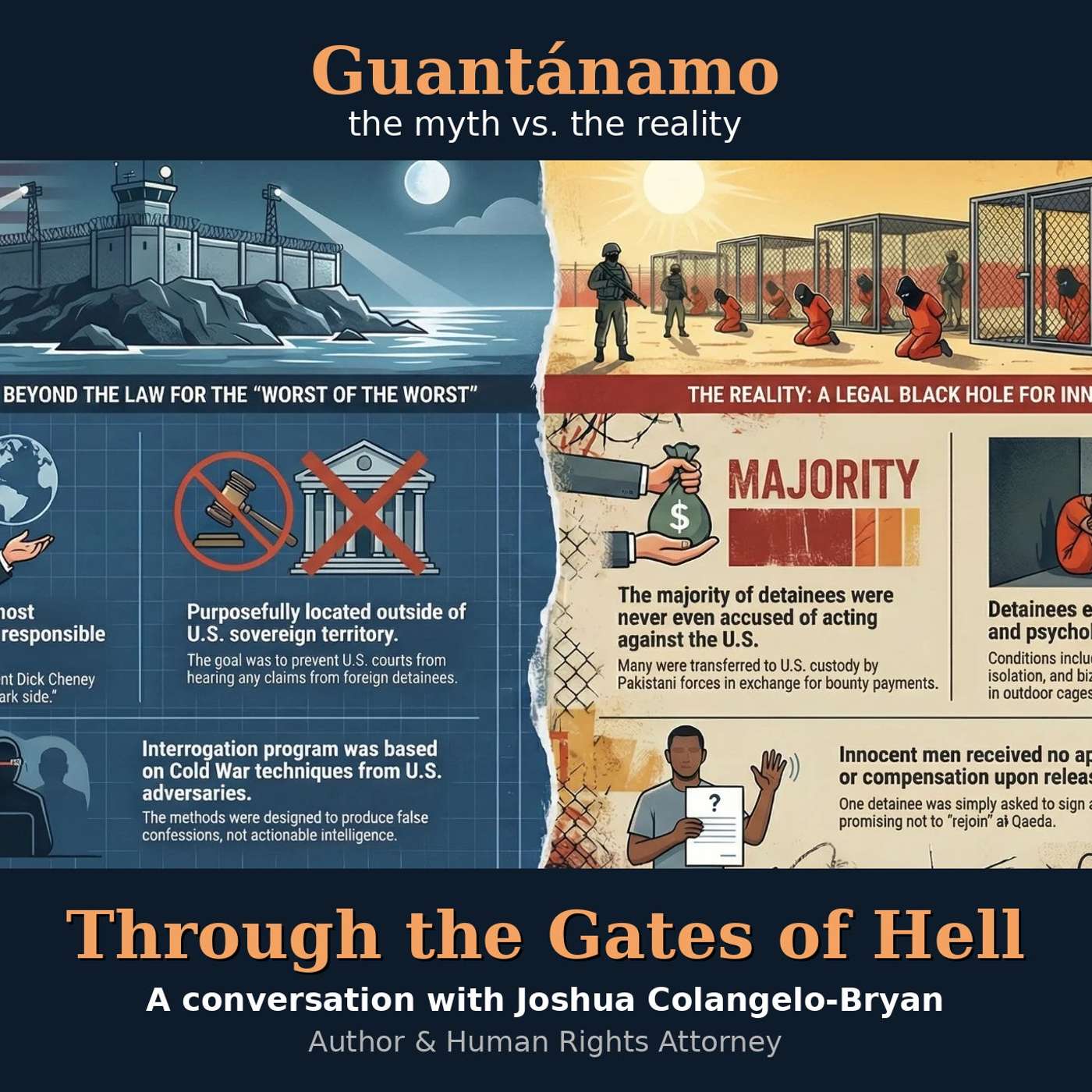

Guantanamo: The Myth vs the Reality
Dick Cheney died four weeks ago, but his dark legacy lives on—quite literally—at Guantanamo Bay. The human rights lawyer Joshua Colangelo-Bryan was among the first attorneys to enter the notorious prison in 2004, and what he found there shattered every official justification for its existence. The “worst of the worst”? Most detainees were never even accused of acting against America. Many were simply sold to the Americans for bounties. The sophisticated interrogation program? Techniques copied from Chinese and Soviet methods designed to extract false confessions, not intelligence. In his new book Through the Gates of Hell, Colangelo-Bryan tells the story of his unlikely friendship with Jaber Mohammed, a Bahraini detainee who spent years in captivity for the crime of being an Arab man in the wrong place (Afghanistan) at the wrong time (post 9/11). Released without apology or compensation—just a form asking him not to “rejoin” organizations he’d never belonged to—Jaber now lives in Saudi Arabia with four children, focusing less on bitterness and more on those rare moments when American guards showed him unexpected kindness. As the Trump administration revives the “worst of the worst” rhetoric against immigrants and once again sends people to Guantanamo, Colangelo-Bryan’s account is a warning from recent history: demonize a racial or religious group, and you will inevitably destroy innocent lives. The gates of hell have once again been opened. Will they ever be closed?
This is a public episode. If you'd like to discuss this with other subscribers or get access to bonus episodes, visit keenon.substack.com/subscribe
A 21st Century Money Revolution: Richard Duncan outlines the monetary policy that can make America great again
Celebrating International Women's Month: Tiffany Shlain on the history of feminism, tree rings and "Dendrofemonology"
The Power of Wonder: Monica C. Parker on the extraordinary emotion that can change the way we live, learn and work
The Death of American Politics: Peter Wehner on retribution, vengeance, forbearance and healing in Trump's America
Playing God: Mary Jo McConahay on why American Catholic Bishops are a threat to democracy
Bootstrapped: Alissa Quart on why we need to liberate ourselves from the "American Dream"
More Than a Glitch: Meredith Broussard confronts race, gender and ability bias in tech
A Murderous Women's History Month: Patti McCracken on some early 20th century Hungarian women who poisoned 160 men (plus a few females)
On Human Agency and the Language of Grief: Colin Campbell explains why grieving is the quintessential human activity
Are Mindfulness and Yoga the Luxuries of a Privileged Class? Susan Verde on childhood trauma, positive self-acceptance and her journey of healing
The (a)Morality of War: Ian Buruma on how some people actively collaborated with evil during World War II
The Silicon Valley Bank apocalypse: That Was the Week's Keith Teare on the death (and resurrection?) of SVB
What Gives You the Right? Jean Hanff Korelitz on Philip Roth, "The Human Stain" and a novelist's "right" to tell other people's stories