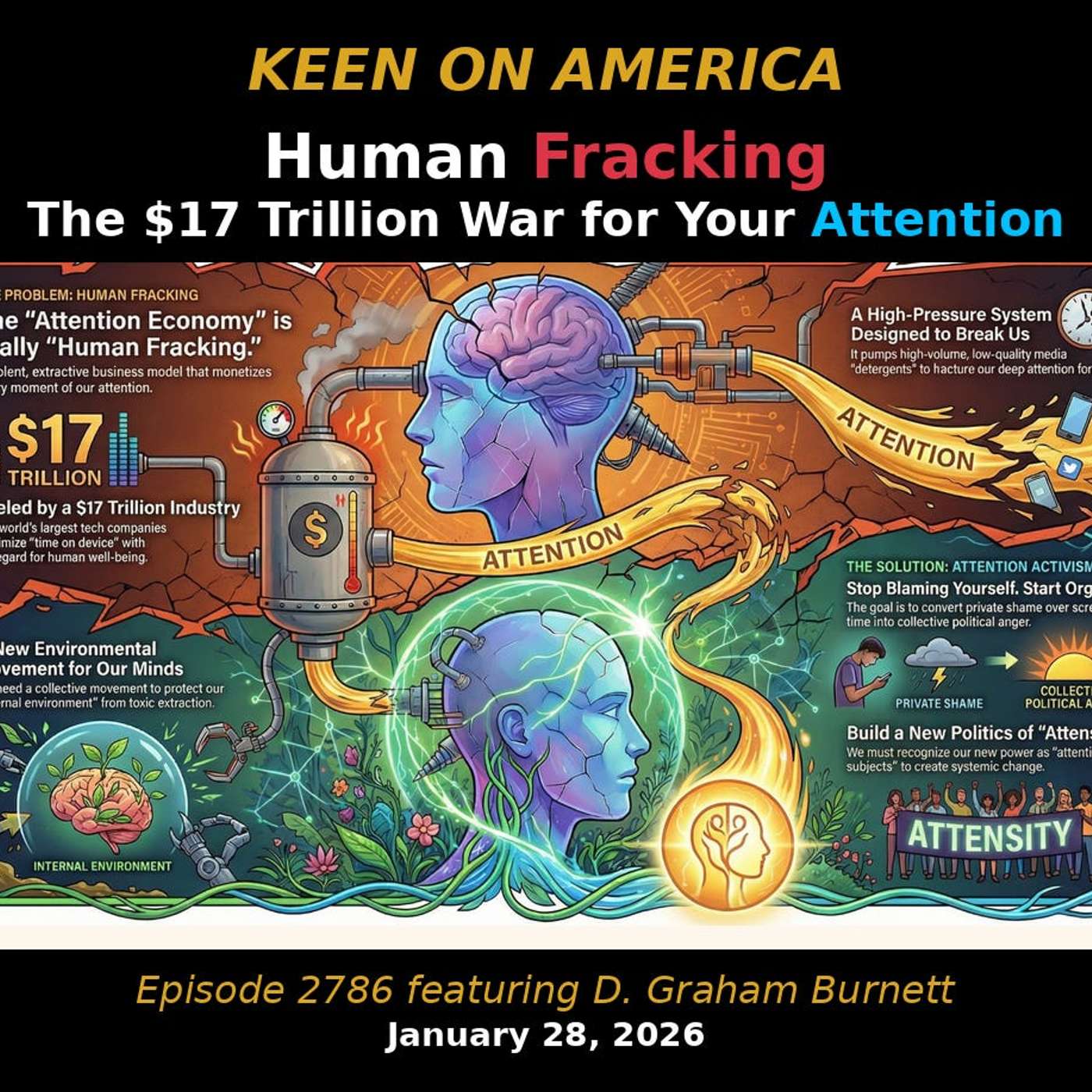

Human Fracking: The $17 Trillion War for Your Attention


Author: Andrew Keen January 29, 2026 Duration: 55:30
Podcast episode
Human Fracking: The $17 Trillion War for Your Attention

Pay attention to this interview. Because, you see, attention is seriously expensive — the Silicon Valley industry being worth $17 trillion, at least according to the Princeton historian D. Graham Burnett, co-editor of a new manifesto entitled Attensity. For Burnett and his friends in the Attention Liberation Movement, the attention industry is "fracking" the human out of us. Liberating ourselves from its exploitative grasp, then, is an existential challenge. "If we take our attention away," he warns, "it collapses into sand." And so will we. So paying attention involves more than simply putting down our phones. It means joining the Attensity movement and challenging the central attention economy principles of 21st century capitalism.

Keen On America is a reader-supported publication. To receive new posts and support my work, consider becoming a free or paid subscriber.


This is a public episode. If you'd like to discuss this with other subscribers or get access to bonus episodes, visit keenon.substack.com/subscribe

More episodes

Duration: 36:11
“It’s about blood. I cover a lot of bloodshed in the book, but I also talk about a different kind of blood: blood that ties, blood that binds families across time and distance.” — Jazmine UlloaKristi Noem is gone. Under her tenure, 32 people died in ICE custody in 2025 — double the previous year’s toll. But Jazmine Ulloa, the New York Times’ national immigration reporter, doesn’t think much will change. Noem wasn’t really the point, she insists. The MAGA spectacle rolls on. Stephen Miller’s violently anti-immigrant agenda remains. And hysterical conservatives like Peter Schweizer are still writing books about how the Mexican government is “weaponizing” immigration by sending their people over the border.Ulloa grew up three minutes from the Walmart where a self-proclaimed white supremacist drove nine hours from North Texas in August 2019, opened fire, and told an officer he was there to kill Mexicans. Her closest friend’s father escaped the parking lot as the shooting started. And it in…

Duration: 36:26
“This is not the beginning of a new right-wing revanche fascist era; this is the end of something. But the problem is we can’t get to the new world because the new world is too filled with problems.” — Jonathan TaplinTrump fantasizes about himself as a king. But he’s actually just an interregnum, at least according to Jon Taplin — author of Move Fast and Break Things, Hollywood insider, and old friend. In a “terrifying” new piece in Rolling Stone, Taplin draws an unusual historical parallel: Trump as Oliver Cromwell. Cromwell cut off the king’s head, slaughtered Catholics in Ireland (his Lebanon), tried to install his son as successor, and ended up with his head on a pike outside Parliament. MAGA is not the future, Taplin suggests. It’s the Gramsci-style death rattle of something that was already dying.The real question is what’s being born. Jon Taplin calls it the digital military-industrial complex — managed by Thiel, Musk, Andreessen, and a “real piece of work” drone entrepreneur un…

Duration: 28:33
“Fidel Castro told his aides, ‘We’re going to fill his arms with shit.’ That is an example of weaponised migration. What we’re experiencing now is on a thermonuclear scale.” — Peter SchweizerIs best selling writer Peter Schweizer a conspiracy theorist? He doesn’t think so. His new book, The Invisible Coup: How American Elites and Foreign Powers Use Immigration as a Weapon, argues that Mexico, China, and the Muslim Brotherhood are using mass migration as a strategic tool to undermine the United States. Not in a coordinated conspiracy—but as a confluence of interests, what he calls a “Venn diagram” of enemies who overlap on one point: transforming America through its borders.Rather than an axis of evil, then, we have a Venn diagram of foreign governments filling America with shitty immigrants. The world according to Peter Schweizer.Some of the claims are more credible than others. Mexico operates 53 consulates in the US—the UK has six. A dozen senior Mexican officials live full-time in t…

Duration: 32:34
“I have always said that they are the same person. And the drama of this story is that one ends up dead in the darkest prison in America, and the other in the White House.” — Michael WolffA few days ago we had Jason Pack on the show suggesting that the Anglo-American media elite had a degree of complicity in the Epstein scandal. Michael Wolff disagrees. The media weren’t complicit, he says. They were just dumb. They found the story unseemly, were uncomfortable with it, and avoided it out of disdain—not conspiracy. David Remnick of The New Yorker was “dismissive of the whole thing.” The word Wolff keeps coming back to is “ick.”Wolff knew Epstein. He recorded an estimated hundred hours of interviews with him. He has tried repeatedly to sell an Epstein book. Every publisher passed—the last time as recently as autumn 2025. One cited “the ick factor.” Others feared a Trump lawsuit. The man who made fortunes for publishers with Fire and Fury couldn’t get a deal on the story he knows best. If…

Duration: 43:05
“The fatal error is ours. Legislators set out a regulatory regime that keeps regulation at bay. The only other industry with a similar protection is the gun industry.” — Olivier SylvainThere are certain words in book titles that provoke. “Reclaiming”, for example. My guest today is happy to defend the provocation. Fordham law professor and former FTC senior advisor Olivier Sylvain argues in his new book, Reclaiming the Internet, that the internet was never really ours to begin with—and that the story about user control, free speech, and digital democratisation was always more nostalgia than reality.But Sylvain’s argument in Reclaiming the Internet: How Big Tech Took Control—and How We Can Take It Back is not the usual big-tech-is-bad narrative (yawn). He doesn’t blame the companies. He blames us—or rather, Congress. The fatal error, he says, was Section 230 of the Communications Decency Act, passed in 1996, which created a blanket immunity from liability for companies trafficking in us…

Duration: 43:37
“They’re both naughty boys in the playground, leveraging the absence of clarity to their own advantage. Neither one of them is an authoritative leader of opinion with the interests of everyone at heart.” — Keith TeareWhat a difference a week makes. Last Saturday, Keith Teare was arguing that Anthropic was wrong to push back against the US government’s use of AI in warfare. This week his editorial is entitled “No Good Guys.” He’s used AI to put images of Sam Altman, Dario Amodei, and Pete Hegseth around the same table—and found all three guilty of poor leadership. According to Keith, Amodei is “ideologically” (whatever that means) driven. Altman is commercially driven and Hegseth is just following orders. None of them is asking the all-important questions about AI policy. And the man who should be—Trump’s AI czar David Sacks—is absent-without-leave. All four should be court martialed.Yes, a lot has happened in seven days. Altman publicly supported Amodei’s position on surveillance and a…

Duration: 39:20
“All my life, I’ve absolutely opposed all terrorism by anyone under any circumstances. I define terrorism as the deliberate killing of noncombatants.” — Daniel Ellsberg, October 2001Last week we had Tom Wells on the show talking about Henry Kissinger’s moral indifference to the loss of innocent lives in the Vietnam war. Henry Kissinger, of course, was no fan of the Pentagon Papers— the leaked documents that showed the American government was lying about Vietnam, thereby changing public opinion about the war and helping end it. And the Pentagon Papers are forever associated with one brave man: Daniel Ellsberg, Harvard economist, RAND Corporation strategist, marine, Pentagon insider—and America’s most famous whistleblower.Ellsberg died in 2023 at the age of 92. Now his son Michael Ellsberg has co-edited a posthumous collection of his father’s previously unpublished writing. Truth and Consequence: Reflections on Catastrophe, Civil Resistance, and Hope draws from a hundred boxes of handwri…

Duration: 51:13
“I don’t think we’re sleepwalking, because people have striven to be as thoughtful as possible. In some ways, they’ve been too thoughtful. We’re paralysed, in fact, by our risk awareness.” — Christopher ClarkIt’s 1830 in East Prussia. The city of Königsberg still bathed in the amber glow of the late Enlightenment—at least in the minds of people who’d never been there. But that glow, it goes without saying, is illusionary. The greatest of all Königsberg citizens, the illustrious 18th century philosopher Immanuel Kant is dead. Napoleon’s shattered army limped west back through the city two decades earlier after its failed invasion of Russia. The place had slipped into a sad provinciality, living off 18th century nostalgia. And then two Lutheran preachers, so-called “Muckers”, get accused of running a sex cult.Christopher Clark—Regius Professor of History at Cambridge, author of the brilliant The Sleepwalkers and Revolutionary Spring—has been brooding on this story for thirty years. His s…

Duration: 1:07:37
“We should all be able to look at the numbers and agree that this is not sustainable and that whatever we’ve been doing is not working. Democrats have had their chance, and Republicans have had their chance, and it’s only gotten worse.” — Halle TeccoWarren Buffett called America’s healthcare costs “a hungry tapeworm on the American economy.” That tapeworm now devours nearly a fifth of the nation’s GDP—and the patient, as always, is on the table. We dedicate today’s show to this most perennial of all America’s problems, with two guests and two new books that approach the tragi-comedy from different angles.Self-styled innovation wonk Halle Tecco—founder of Rock Health, investor in over fifty digital health companies, professor at Columbia Business School—argues in Massively Better Healthcare that the system is both excessively public and excessively private, a Kafkaesque bureaucracy in which verticalized health plans now own the PBMs, the pharmacies, and increasingly the doctors. The res…

Duration: 41:52
“If we let things continue in the direction that they are taking now, I think it is more likely than not that we will end up in some kind of Great Power war within the foreseeable future.” — Arne WestadThis conversation was recorded before the invasion of Iran, which makes what you are about to hear even more chilling. In his new book, The Coming Storm: Power, Conflict, and Warnings from History, Yale historian Arne Westad warns that the structural parallels between our multipolar 2020s and the world before the First World War are too striking to ignore—and he names the Middle East as one of the flashpoints that could spark a much broader conflagration.Westad argues that the structural parallels between our multipolar 2020s and the world before the First World War are “striking.” A dominant power (USA) withdrawing from the international system it created. Rising inequality and globalization backlash. New technologies that speed up time and shrink the window for decision-making. A risin…

Duration: 34:55
“When you use humor to degrade people, you can get away with it—but you’re also doing something that’s completely devastating.” — Rhae Lynn BarnesDonald Trump’s recent retweet of Barack and Michelle Obama depicted as apes was dismissed by his supporters as “just a joke”—another example, they claimed, of liberals lacking a sense of humor. But Princeton historian Rhae Lynn Barnes argues that this kind of “humor” is anything but innocent. It draws on a centuries-long white supremacist tradition of dehumanization—one that stretches back to the origins of American mass entertainment itself.In her book, Darkology: Blackface and the American Way of Entertainment, Barnes traces how Blackface minstrelsy became the quintessential American cultural form—America’s first great entertainment export—shaping music, comedy, performance, and politics from the 19th century through the 20th. Barnes explains how P.T. Barnum helped popularize the grotesque “scientific” spectacle of Black people as the missi…

Duration: 38:01
“If you disestablish Christianity, then Christian leaders need to make Christianity a consumer product. They need to give the American people something they want.” — Matthew Avery SuttonOver the years, Keen On has done many shows on the relationship between the United States and organized religion. Daniel Williams argued that smart people still believe in God. Jim Wallis warned that a false white gospel is threatening America. But we’ve never quite done a show on Christianity as “the thing in itself”—the force that made America what it is, for better and for worse. That’s what this conversation is about.Historian Matthew Avery Sutton’s new book, Chosen Land: How Christianity Made America and Americans Remade Christianity, is a sweeping argument that Christianity is not just part of the American story—it is the American story. The founders created a godless Constitution not out of principle but pragmatism: they couldn’t pick a winning denomination. The unintended consequence was to open…

Duration: 38:28
“We keep telling you there’s an eviction crisis, so organize with us. Feel free to come into our meetings. Feel free to learn about the lives of people who have been here for a long time.” — Manissa MaharawalYesterday we spoke with anthropologist Ida Susser about France’s Yellow Vests—provincial truck drivers, nurses, and teachers who drove hours to Paris, furious about decades of disinvestment in their economy. So does America have its own Yellow Vests? You might find them in (of all places) the San Francisco Bay Area, the setting of a new book by a former student of Susser’s about what happens when the same disruptive economic forces hit an American city.Anthropologist Manissa Maharawal’s new book, Anti-Eviction: The Fight Against Tech-Led Gentrification in San Francisco, chronicles the grassroots movement that rose up against big tech during the boom of the 2010s. Like the French Yellow Vests, these were ordinary people from the San Francisco Bay Area—teachers, bartenders, nurses, c…

Duration: 40:59
"He's blundered here. He's trying to set policy for the government on the use of AI through a sales contract." — Keith Teare on Dario AmodeiThere's only one story this week: Dario Amodei's refusal to let the Department of War use Anthropic's best technology for mass domestic surveillance and fully autonomous weapons. Silicon Valley rallied behind him. The New York Times covered it. Sam Altman publicly supported him—while quietly cutting his own deal with the administration. But Keith Teare thinks Anthropic is wrong.Keith's argument is simple: vendors don't set policy. If you want to sell to governments, you can't then dictate what they do with your product. That's not your job. And by trying to do it, Amodei has alienated the entire US administration and created a fake battle that can only damage his company. Andrew is more sympathetic. In his view, Amodei is taking a political position against Trump—and in 2026, with Congress marginalized and corporations increasingly powerful, that's…

Duration: 36:58
"You can't wear a yellow vest on a demonstration anymore because you get arrested as soon as the police see you." — Ida SusserIn November 2018, something strange happened in France. People from the urban periphery—truck drivers, nurses, teachers, plumbers—drove seven or eight hours to Paris wearing yellow safety vests. They weren't students. They weren't union members. They weren't organized by any political party. They were furious about a diesel tax, but really about something deeper: decades of disinvestment, cut services, shuttered bakeries, and a government that had abandoned them.Anthropologist Ida Susser spent years studying this spontaneous movement for her new book, The Yellow Vests and the Battle for Democracy. Like so many other observers, Susser sought to identify them on the traditional left/right political spectrum. The uncomfortable truth, she discovered, is that many had never voted. Many didn't care about consistent ideology. They mixed and matched political ideology,…

Logo
Select station
VOL