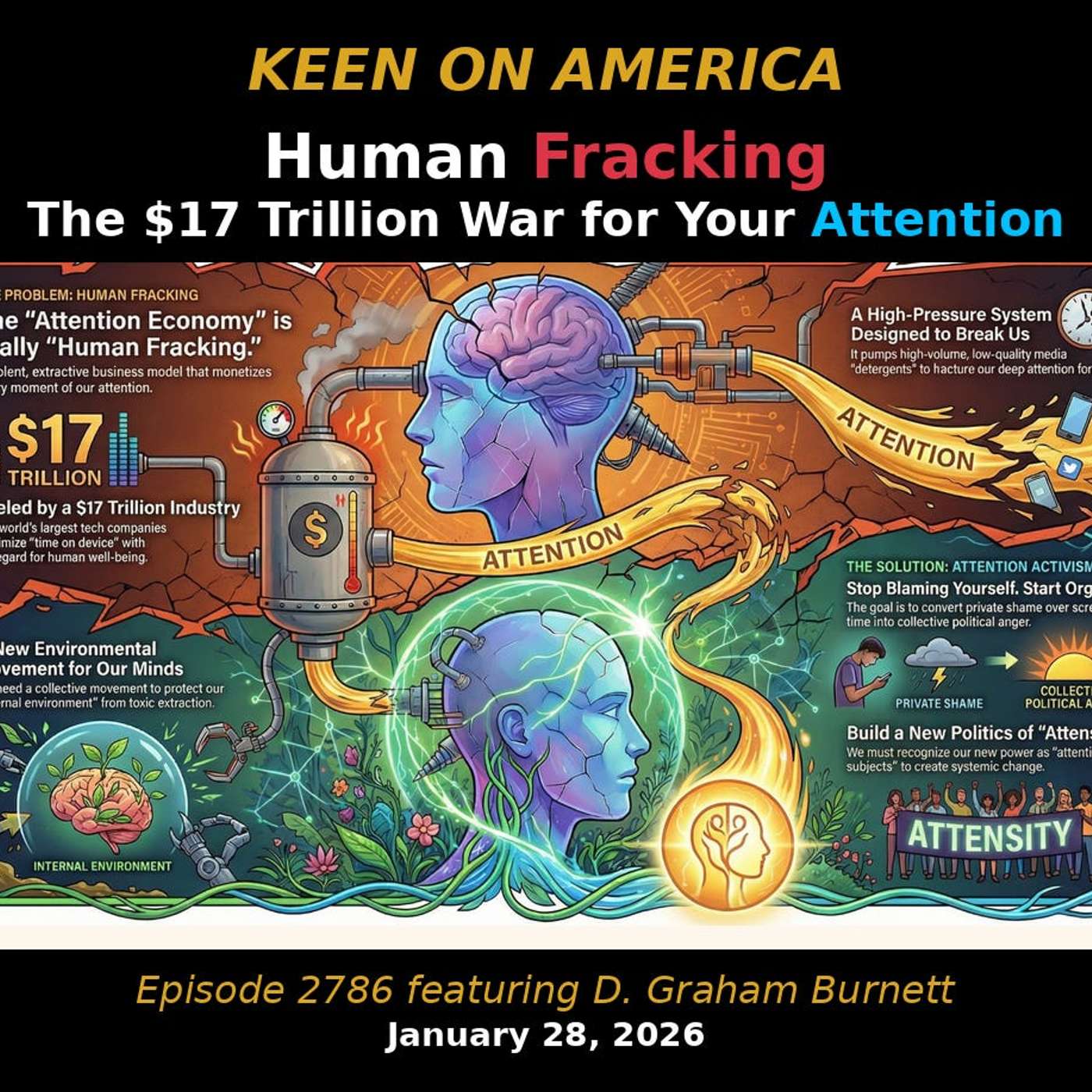

Human Fracking: The $17 Trillion War for Your Attention
Pay attention to this interview. Because, you see, attention is seriously expensive — the Silicon Valley industry being worth $17 trillion, at least according to the Princeton historian D. Graham Burnett, co-editor of a new manifesto entitled Attensity. For Burnett and his friends in the Attention Liberation Movement, the attention industry is "fracking" the human out of us. Liberating ourselves from its exploitative grasp, then, is an existential challenge. "If we take our attention away," he warns, "it collapses into sand." And so will we. So paying attention involves more than simply putting down our phones. It means joining the Attensity movement and challenging the central attention economy principles of 21st century capitalism.
Keen On America is a reader-supported publication. To receive new posts and support my work, consider becoming a free or paid subscriber.
This is a public episode. If you'd like to discuss this with other subscribers or get access to bonus episodes, visit keenon.substack.com/subscribe
Hopwood DePree: What One American Learnt From Restoring His Family's English Castle
Aaron Friedberg: Why China, Not Russia, Is Our Greatest Threat And What We Should Do About It
Sasha Issenberg: What America's Long Struggle for Same-Sex Marriage Can Teach Us About the Possibility of Gun Control
Erin Swan: How a First Novel About America's Vanished Earth Took 6 Years to Write and 30 Years to Plan
Nirit Weiss-Blatt: Why the Techlash Has Gone Too Far
Helene Munson on Hitler's Boy Soldiers: Can Germans Ever Forget the Second World War?
Kerri Arsenault and Bathsheba Demuth: How to Tell Effective Stories About the Environment
Jon Taffer: Why the Real Power of Conflict Is About Respect Rather Than Violence
Hal Weitzman: Why Delaware Is At the Root of Everything That Is Wrong With America
George Stevens, Jr.: Remembering (And Mourning) The Golden Age of Hollywood and Washington D.C.
Dov Seidman: How to Make American Capitalism Moral (Or, At Least, Try To)
Marcus Buckingham: Why Work Sometimes Does, Indeed, Love Us Back
Arthur Grace: Photographing Communism(s) and What Life Really Looked Like in Cold War Eastern Europe