On Fire for the God Con
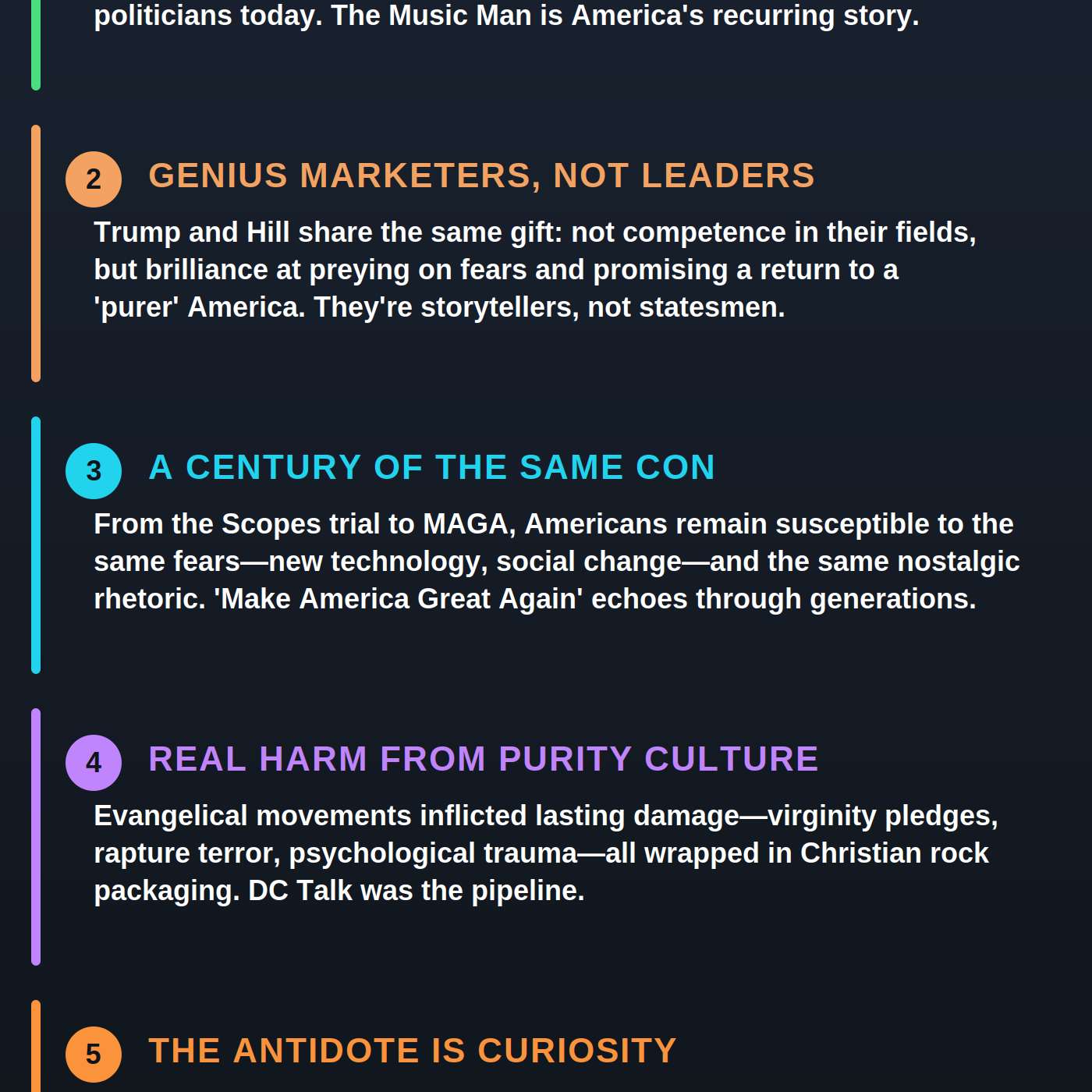
The Music Man was a 1957 Broadway show written by Meredith Willson, a musician from the small Iowa town of Mason City. The popular play (and later movie) featured a con man called Harold Hill who ripped off the naive people of River City, a fictional small town based on Mason City. Nearly seventy years later, Josiah Hesse, another Iowan from Mason City, sees the Music Man narrative replaying itself. As Hesse notes in his autobiographical new book, On Fire For God, today's Harold Hills are the megachurch salesmen who descend on small American towns to rip off the local community with their religious claptrap. "They know how to prey on people's fears," Hesse argues about these evangelical preachers, "how to locate the thing that's changing, that's new, and offer something that hearkens back to another era, a pure era of American wholesomeness." As another observant American midwesterner, Mark Twain, once quipped: "History doesn't repeat itself, but it rhymes."
Keen On America is a reader-supported publication. To receive new posts and support my work, consider becoming a free or paid subscriber.
This is a public episode. If you'd like to discuss this with other subscribers or get access to bonus episodes, visit keenon.substack.com/subscribe
Orna Ophir: How a Pathology of "Schizophrenia" Might Reflect a Broken Society As Much as a Broken Mind
Leah McLaren: A Daughter's Memoir of a Mom Who Passed Down Her Trauma and Made Their Lives Impossible to Disentangle
Alice Mah on Plastics, the One Word That Best Describes Our Global Environmental Crisis
Harald H.H.W. Schmidt: Why "The End of Medicine As We Know It" Will Make All of Us Healthier and Happier
Ariel Ezrachi: How Cities, Rather Than Big Tech, Should Be the Engine for a More Equitable Digital Future
Monique Roffey: The Common Sense of Magic Realism and Why The Mermaid of Black Conch is a "Caribbean Novel"
Maureen Perry-Jenkins on Work Matters: How Parents' Jobs Shape Children's Well-Being
Saleem H. Ali: Do We Need a Science Party to Confront Existential Problems Like Global Warming?
Ari Mittleman: Does Criticism of Israel Inevitably Make One Guilty of Antisemitism?
Albert Fox Cahn: How Digital Surveillance In a Post-Roe America Isn't Substantively Different From Xi's China or Putin's Russia
Donald Robertson: Why the Graphic Novel Is an Ideal Form to Capture the Timeless Philosophy of Stoicism
Jacob M. Grumbach: Why the Crisis of American Democracy Is As Much a State and Local As a National Problem
Karen Cerulo and Janet Ruane: How We Can't Escape Social Class, Gender, or Culture in How We Dream
