
On Fire for the God Con
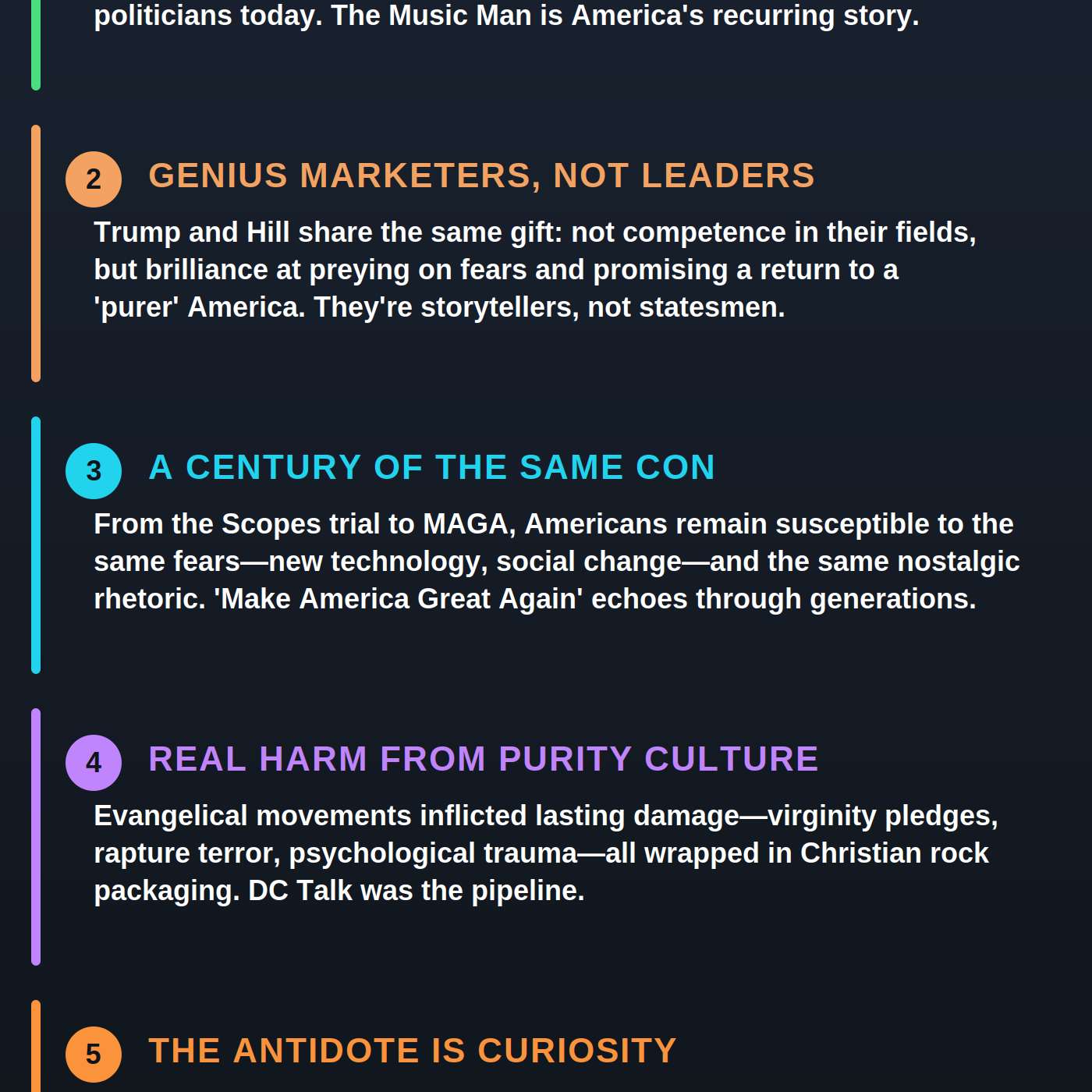
The Music Man was a 1957 Broadway show written by Meredith Willson, a musician from the small Iowa town of Mason City. The popular play (and later movie) featured a con man called Harold Hill who ripped off the naive people of River City, a fictional small town based on Mason City. Nearly seventy years later, Josiah Hesse, another Iowan from Mason City, sees the Music Man narrative replaying itself. As Hesse notes in his autobiographical new book, On Fire For God, today's Harold Hills are the megachurch salesmen who descend on small American towns to rip off the local community with their religious claptrap. "They know how to prey on people's fears," Hesse argues about these evangelical preachers, "how to locate the thing that's changing, that's new, and offer something that hearkens back to another era, a pure era of American wholesomeness." As another observant American midwesterner, Mark Twain, once quipped: "History doesn't repeat itself, but it rhymes."
Keen On America is a reader-supported publication. To receive new posts and support my work, consider becoming a free or paid subscriber.
This is a public episode. If you'd like to discuss this with other subscribers or get access to bonus episodes, visit keenon.substack.com/subscribe
Jamie Susskind: How the Digital Republic Could Deepen Democracy and Compound Freedom in the 21st Century
Bernhard Poerksen: Can an "Editorial Society" Heal Our Digital Fever of Misinformation and Lies?
Max Holleran on NIMBYism vs YIMBYism: How to Reinvent the City to Solve the Homelessness Pandemic
Jonathan Rauch Contemplates (and Fears) a Post-Democratic America
Ian Buruma: What to Make of America On Its 246th Birthday
Daniel Birnbaum: Wassily Kandinsky and the Uncannily Contemporary Origins of 20th Century Abstract Art
George Monbiot on How to Feed the World Without Devouring the Planet
Verlyn Klinkenborg on How to Write Well About Nature: Simplify Language, Empathize With Other Creatures, and Use Your Eyes Like a Hawk
Elizabeth Sandifer: Why a Bloody End to Democracy in America Is Not Only Likely But Maybe Even Inevitable
Andrew Hodges on Alan Turing and Why One of the 20th Century's Most Iconic Figures Remains So Relevant in the 21st Century
Chris Miller: Is It Possible That the Russians Are Now Winning the War in Ukraine?
Margaret Mitchell: Can Big Tech Be Reformed to Make It More Ethically Responsible In Its Development of Artificial Intelligence?
Robert Pearl: How the Seemingly Parallel Pandemics of Covid, Anxiety, and Gun Violence Are All Part of the Same Existential Crisis of American Healthcare