The AI Race is a Myth: Why "Who's Winning" is the Wrong Question
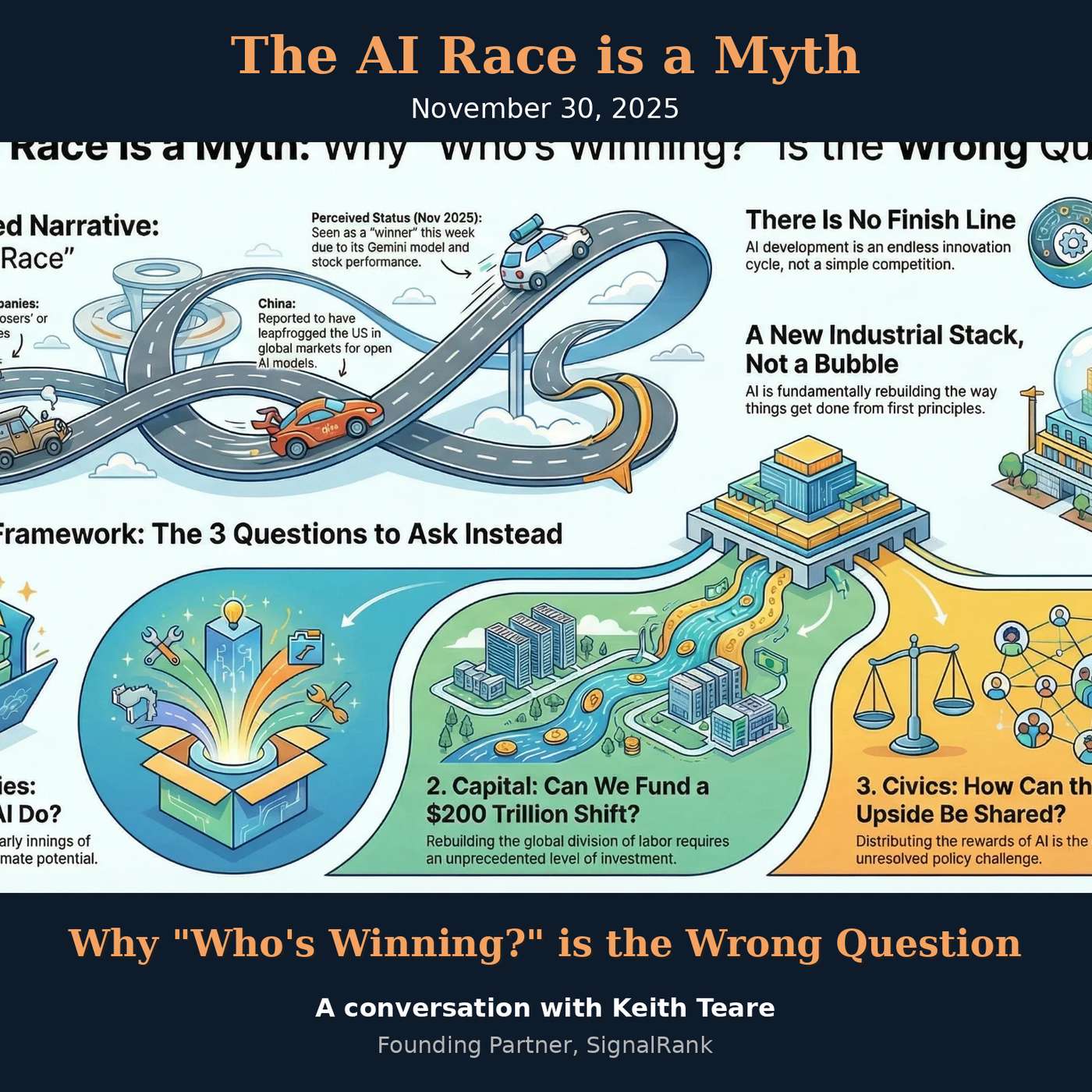
Who’s winning and losing in AI plays like a wacky race in that every week there seems to be a new leader. But that’s actually the wrong way of thinking about today’s AI revolution. The right questions are about the three Cs: Capability, Capital and Civics. That’s the lesson of Keith Teare’s latest That Was The Week tech newsletter which focuses on what he calls “the Year in Intelligence”. Nobody is winning the AI race, Teare argues, because it isn’t a race. Instead, it’s an endless innovation cycle without either a start or finish line. The three key questions are whether AI capabilities are solving real social and economic problems, whether we can fund a $200 trillion industrial rebuild, and whether the rewards can be equitably shared. Those are the questions we should be asking. Not who is winning or losing.
Keen On America is a reader-supported publication. To receive new posts and support my work, consider becoming a free or paid subscriber.
This is a public episode. If you'd like to discuss this with other subscribers or get access to bonus episodes, visit keenon.substack.com/subscribe
Exposing Beijing's Rotten Rules: Bethany Allen on how an authoritarian China is weaponizing its economy to confront the world
Eighteen Days in October: Uri Kaufman on the Yom Kippur War and the how it created the modern Middle East
SPACs, Scams and Hit Jobs: Keith Teare defends former SPAC king Chamath Palihapitiya from "hit job" accusations of scamming small investors
Nine Noteworthy Novels: Bethanne Patrick on fast, furious and fun reads for the dying days of summer
TECHNOSLEEP: Sleep sociologist Katherine Conveney on the technological past, present and future of sleep
Mr and Mrs Orwell's Invisible Lives: Anna Funder shines a light on Eileen O'Shaughnessy, George Orwell's homosexuality, and patriarchy as doublethink
How billionaires have colonized the New York City skyline: Katherine Clarke on the race to build the world's most exclusive skyscrapers
Say Everything Everywhere: Scott Rosenberg remembers the digital origins of bulletin boards, blogging and the social media revolution
This Is Wildfire: Nick Mott on how to protect ourselves, our homes and our communities in the age of heat
Why Twitter and Facebook are like nuclear weapons: Umut Ozkirimli traces his personal history of social media from the 2013 Gezi Park uprising to his own cancellation in 2020
Why the Revolution Won't Be Retweeted: Ece Temelkuran on social media's failure to change the world
The New Heart of Darkness: Siddharth Kara on how the (rechargable) blood of the Congo powers our lives
Playing Chess against Nature: Rafael Yuste explains how today's advances in neuroscience will eventually lead to a new Renaissance in understanding who exactly we are as a species
