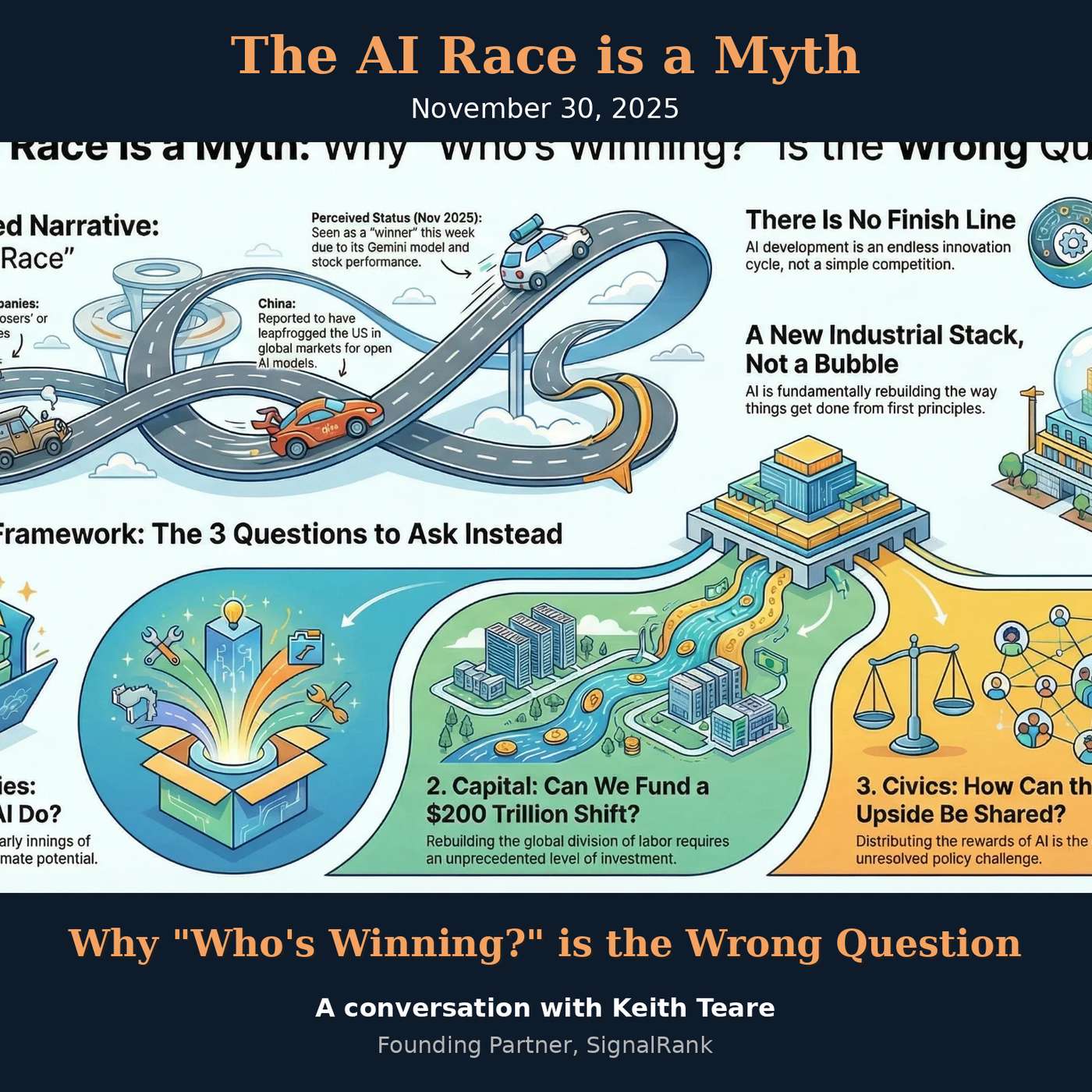

The AI Race is a Myth: Why "Who's Winning" is the Wrong Question
Who’s winning and losing in AI plays like a wacky race in that every week there seems to be a new leader. But that’s actually the wrong way of thinking about today’s AI revolution. The right questions are about the three Cs: Capability, Capital and Civics. That’s the lesson of Keith Teare’s latest That Was The Week tech newsletter which focuses on what he calls “the Year in Intelligence”. Nobody is winning the AI race, Teare argues, because it isn’t a race. Instead, it’s an endless innovation cycle without either a start or finish line. The three key questions are whether AI capabilities are solving real social and economic problems, whether we can fund a $200 trillion industrial rebuild, and whether the rewards can be equitably shared. Those are the questions we should be asking. Not who is winning or losing.
Keen On America is a reader-supported publication. To receive new posts and support my work, consider becoming a free or paid subscriber.
This is a public episode. If you'd like to discuss this with other subscribers or get access to bonus episodes, visit keenon.substack.com/subscribe
Why Big Tech threatens our civil rights, economy and democracy: Silicon Valley insider Tom Kemp warns about the existential dangers of Google, Facebook, Amazon and Apple
Can there be liberty in the Greater Middle East without democracy? Robert D. Kaplan on why Singapore offers a palatable political model for countries lying between the Mediterranean and China
Remembering the Digital Future: Ethan Zuckerman on the history of blogging, the Arab Spring and why there will never be another Twitter
The Silicon Valley Playbook for Existential Success: Behnam Tabrizi on why some companies succeed and others fail in the perpetual struggle to survive in today's innovative economy
On the Disinformation of Trump, RFK Jr and Putin: Lee McIntyre explains how we can fight for truth and protect democracy
What, exactly, is female beauty? Celeste Marcus on Bardot and Barbie as rival and perhaps incompatible types of beautiful women
Liberal Saint or Monty Pythonesque Sinner? D.J. Taylor uncovers a "New Life" for George Orwell that resurrects the iconic 20th century writer for a 21st century audience
8 inspiring non-fiction reads for the summer: Bethanne Patrick on books about New York City sex cults, the oceanic underworld, Ghanian confidence tricksters and American women, fathers and sons
What history teaches us about the future of venture capitalism: Keith Teare on how being a good investor requires us to overcome our emotions
Why Podcasters should NEVER read advertisements on their own shows: Jemima Kelly on the gross inauthenticity of podcasts and most other forms of "social" media
So how much would you pay for the Mona Lisa? Arturo Cifuentes explains the cost of art and why valuing paintings is like evaluating the price of real-estate
The Not-So-Secret World of Black Twitter: Deesha Philyaw on social media, the influencer generation and the loneliness of online existence
Getting Beyond the Happy Talk of Liberal Orthodoxy: Susan MacKenty Brady explains how men and women can begin talking fearlessly to one another again