Why This Might Be Robert Redford's Most Prescient Movie
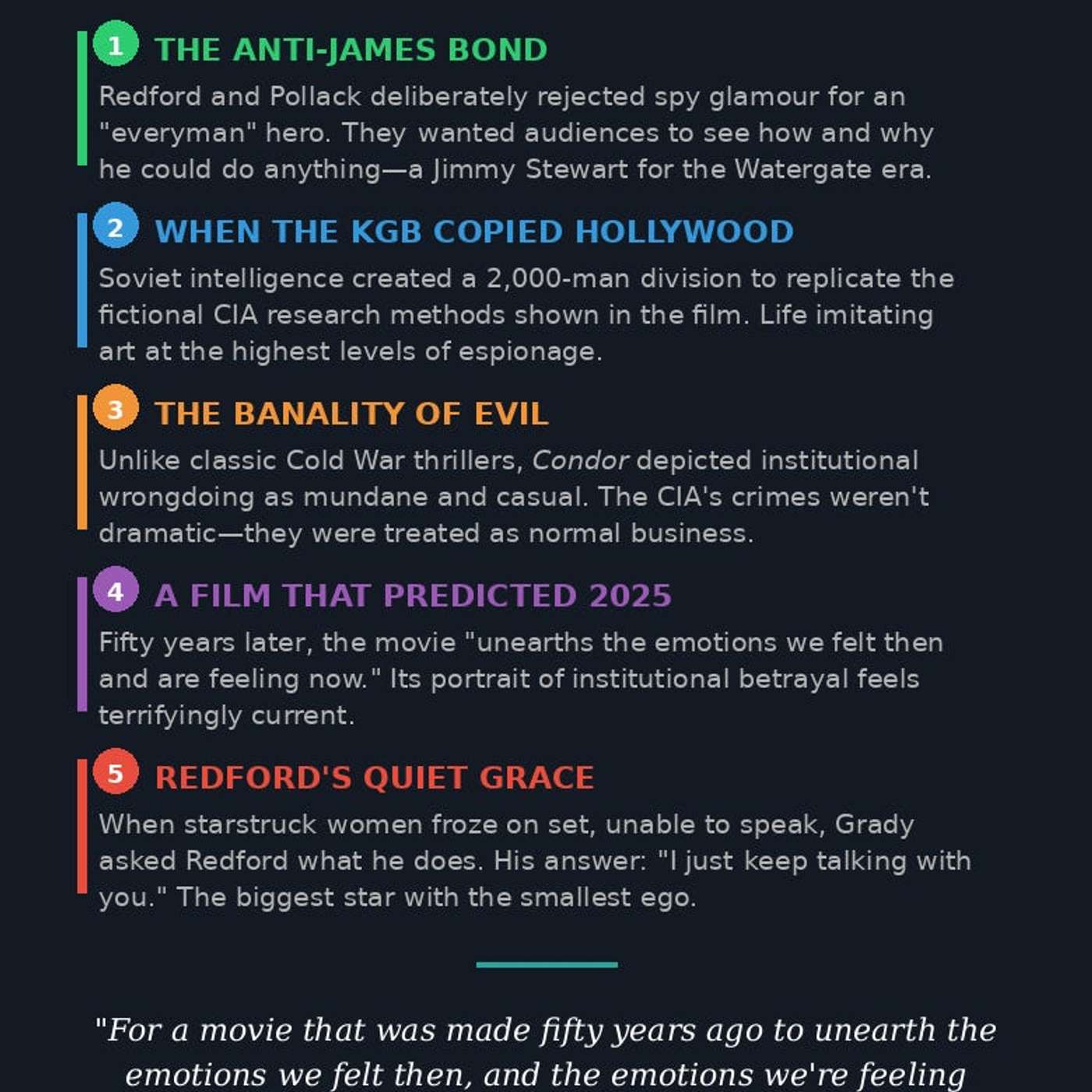
We all have our own favorite Robert Redford movie. But what's Redford’s most prescient film about today’s America? His Seventies trilogy about American politics — The Candidate, Three Days of the Condor and All the President's Men — are all, in their own profound ways, lasting meditations on the United States. But of the three, it might be Sydney Pollack's Three Days of the Condor (1975) which has the eeriest relevance to contemporary America. For James Grady, whose equally classic 1974 thriller Six Days of the Condor inspired the movie, Three Days of the Condor speaks to both the all-encompassing paranoia and isolation of our age. It's the anti-James Bond film for our anti-James Bond age. "For a movie that was made fifty years ago to unearth the emotions we felt then, and the emotions we're feeling now — that's extraordinary," James Grady says. Yes. After a half century, the Condor has landed.
Keen On America is a reader-supported publication. To receive new posts and support my work, consider becoming a free or paid subscriber.
This is a public episode. If you'd like to discuss this with other subscribers or get access to bonus episodes, visit keenon.substack.com/subscribe
Eight literary tricks and treats to scare you this Halloween: Bethanne Patrick on "app-aritions", cultural ghosts and unfamiliarly familiar haunted houses
Why our cyborg AI future may already have arrived in the trained-on-jargon "person" of Sam Bankman-Fried: Hito Steyerl on pyramid schemes, on-boarding tools and the "mean" creativity of our AI age
Is the venture capital industry a big ponzi scheme? Keith Teare separates the hyperbole from the hysteria of VC techno-optimism
The American Shakespeare or trash of the veriest sort? Peter Slen on Mark Twain's ADVENTURES OF HUCKLEBERRY FINN, the adventurous story of a young man and young nation on a great and not-so-great adventure
A Graphic Diary of the War in Ukraine: Nora Krug on the contrasting realities of a Ukrainian journalist and a Russian artist in the first year of Russian invasion
The Dismal Science investigates that most dismal of things - economic inequality: Branko Milanovic on visions of inequality from the French Revolution to the end of the Cold War
That Sinking Feeling of Falling Out of the Middle Class: Ray Suarez on his fear of being poor in the America of the inegalitarian Twenties
Celebrating a transcendental photography of nature that blurs art and science: Photographer Anand Varma on his lifelong wonder with the natural world
How to stand up to the apocalypse: Peter Sarris on Justinian, the 6th century Byzantine ruler who confounded a narrative of decline
The Fruit of the Gods or of the Devil? Alexander Sammon on the sordid history of the avocado, the thirstiest fruit on the planet
Why Nineteen Eighty-Four wasn't really like Nineteen-Eighty Four: Sandra Newman on Julia, Winston Smith and the totalitarianism of gender that George Orwell ignored in his masculine dystopia
How to Reawaken the American Dream: David Leonhardt on unions, constitutional reform, immigration and the need for a progressive populism
Why Generative AI could make artists extinct: Karla Ortiz warns about the existential "theft" at the heart of the AI revolution