Why This Might Be Robert Redford's Most Prescient Movie
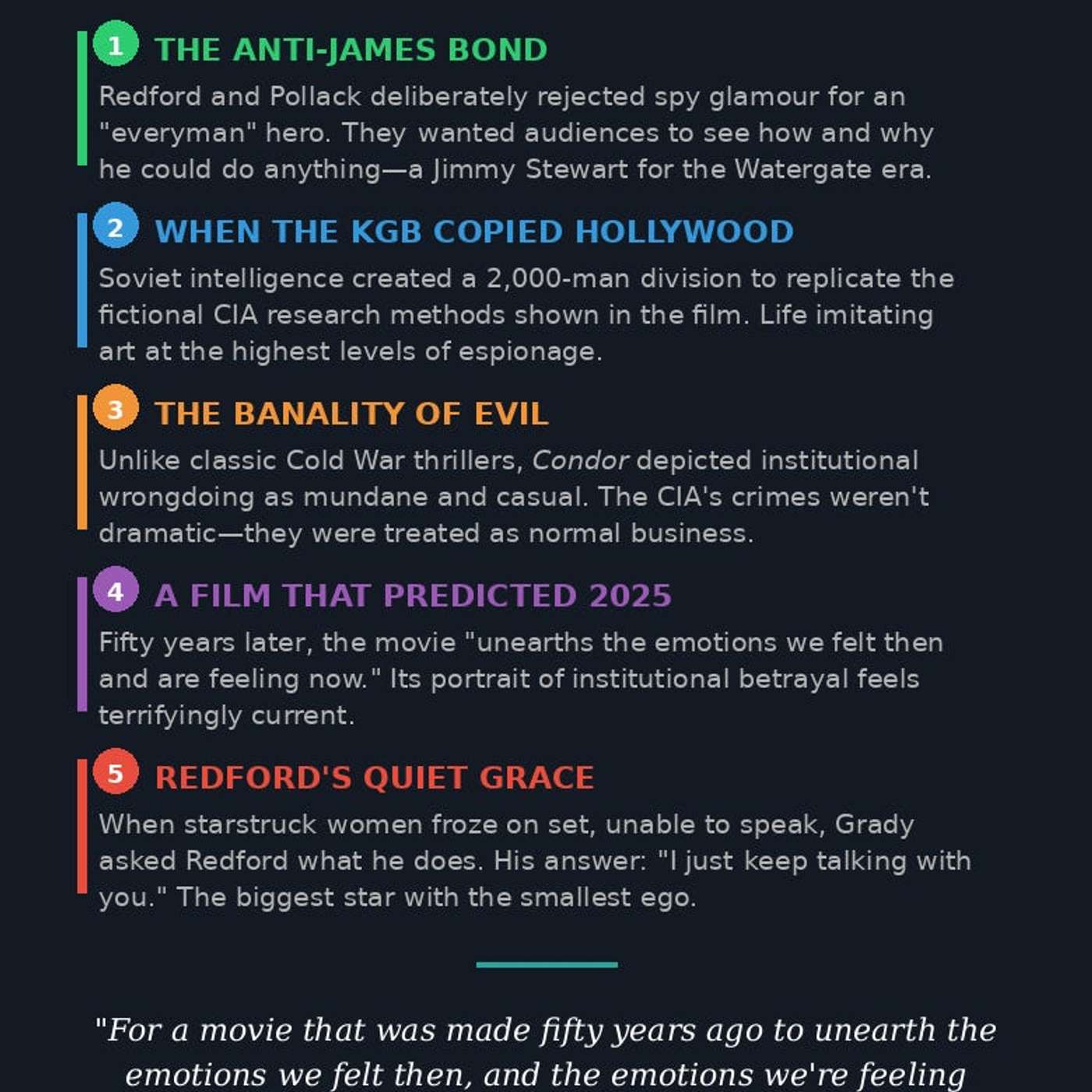
We all have our own favorite Robert Redford movie. But what's Redford’s most prescient film about today’s America? His Seventies trilogy about American politics — The Candidate, Three Days of the Condor and All the President's Men — are all, in their own profound ways, lasting meditations on the United States. But of the three, it might be Sydney Pollack's Three Days of the Condor (1975) which has the eeriest relevance to contemporary America. For James Grady, whose equally classic 1974 thriller Six Days of the Condor inspired the movie, Three Days of the Condor speaks to both the all-encompassing paranoia and isolation of our age. It's the anti-James Bond film for our anti-James Bond age. "For a movie that was made fifty years ago to unearth the emotions we felt then, and the emotions we're feeling now — that's extraordinary," James Grady says. Yes. After a half century, the Condor has landed.
Keen On America is a reader-supported publication. To receive new posts and support my work, consider becoming a free or paid subscriber.
This is a public episode. If you'd like to discuss this with other subscribers or get access to bonus episodes, visit keenon.substack.com/subscribe
What the data tells us about the cancellation of the American mind: Greg Lukianoff on why today's cancel culture is as much of a threat to free speech as the McCarthyite Red Scare of the 1950s
Why an elite establishment economist is calling bullsh*t on the promise of the American dream: Jeff Fuhrer reveals the existential crisis of economic inequality now threatening the United States
Why Poland is still in therapy over its "complex" World War II history: Roger Moorhouse on the forgotten story of a Polish diplomatic rescue operation to save the lives of Polish Jews
How "responsible" was Benjamin Netanyahu for the events of October 7? Israel novelist Noa Yedlin on the worst thing that has happened to the Jewish people since the Holocaust
Broken bodies, broken homes, broken families & broken work: Alissa Quart reveals life on the edge in the world's richest country
How to resurrect the World's Greatest Detective: Sophie Hannah on her latest Agatha Christie sanctioned murder mystery HERCULE POIROT'S SILENT NIGHT
In Defense of Place: Seth Kaplan on how to repair American society, one zip code at a time
Should we celebrate or mourn technological abundance? Keith Teare weighs up the costs and benefits of abundant artificial intelligence
Why Oliver Wendell Holmes' book "Common Law" is most uncommon: Peter Slen on the 1881 legal classic that has profoundly shaped America
What is it about scientists that makes many of them so consensual and collaborative? Lorraine Daston explains how scientists have learned to cooperate with each other
Why the American Dream has turned into a nightmare for many Americans: Andrea Dobynes Wagner on life in the United States as a black woman with an invisible disability
Listening Once Again to Prozac: Peter D. Kramer offers a thirty year history of antidepressants and the remaking of the American self
The Impact of Small Things: Best-selling writer and Hollywood actress Annabelle Gurwitch on her experience of taking in a homeless couple in Los Angeles