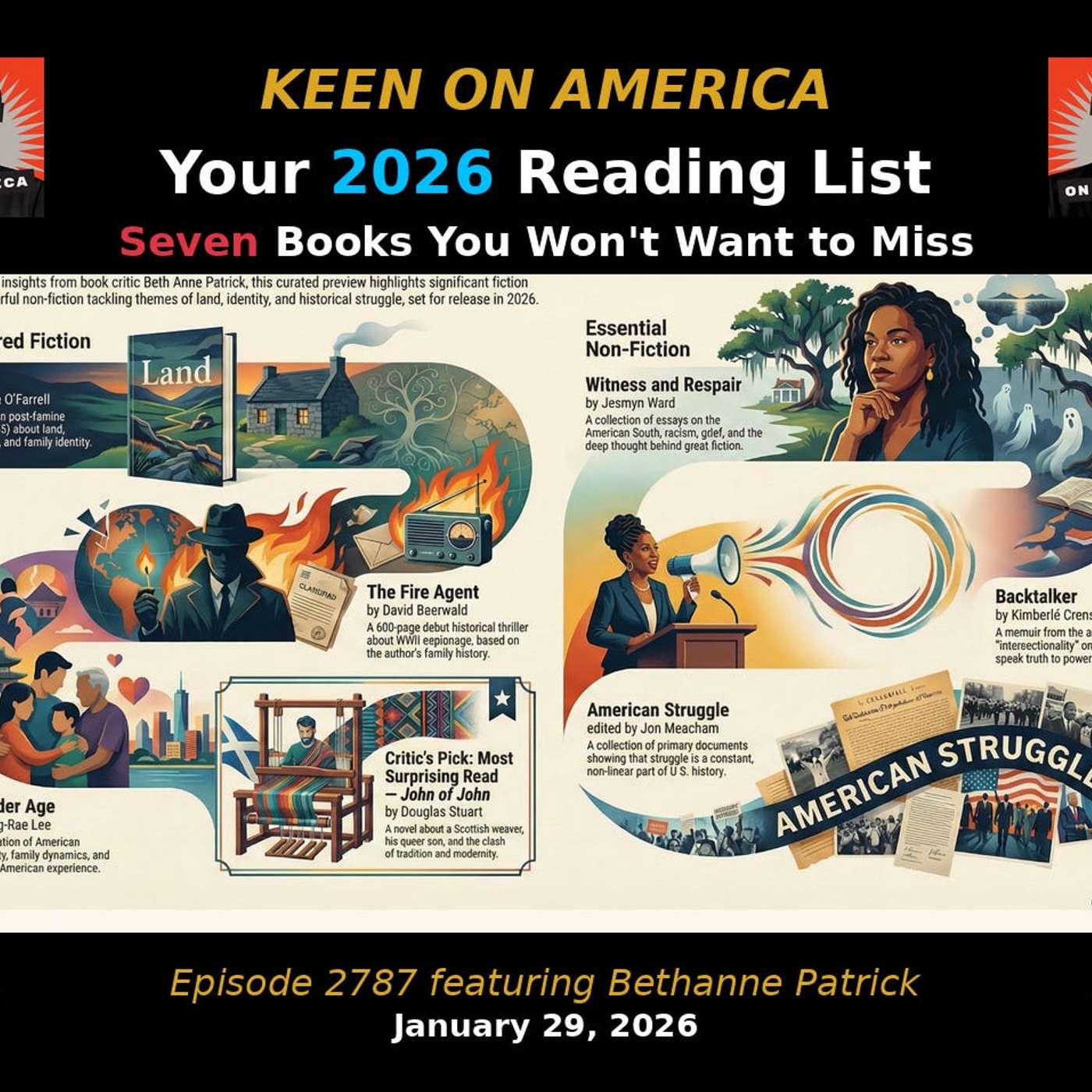
According to our favorite literary reviewer, Bethanne Patrick, these are the seven books that “will really matter” in 2026:
* Land by Maggie O’Farrell — The Hamnet author returns with a luminous novel set in 1865 Ireland, two decades after the Great Famine. A father and son survey their region for the British—mapping the land in English when their hearts speak Gaelic. O’Farrell explores post-famine trauma, colonialism, and the mysterious pull of place, weaving in neolithic history and Irish wolfhounds that feel almost magical. As some characters emigrate to the New World, the novel asks what it means when land becomes identity, when a nation is defined not by commerce but by the places that feed our souls.
* The Fire Agent by David Baerwald — A stunning debut from the Grammy-winning songwriter behind Sheryl Crow’s Tuesday Night Music Club. This 600-page thriller is based on Baerwald’s own family history: his grandfather Ernst was sent to Tokyo as the purported sales director for IG Farben, the company complicit in the Holocaust. The novel spans continents and decades, from a 1920s throuple to Wild Bill Donovan’s OSS becoming the CIA, complete with family photographs. Patrick calls it “a knockout”—not a potboiler, but a wild, scary ride where almost everything actually happened.
* A Tender Age by Chang-rae Lee — The Pulitzer finalist delivers what his publisher calls “a spellbinding exploration of American masculinity and family dynamics.” Through an unforgettable Asian-American protagonist, Lee examines what it means to grow up with “double consciousness”—always aware of how the dominant culture perceives you, your family, your chances. Patrick places him alongside Jesmyn Ward as one of America’s finest novelists.
* Witness and Respair by Jesmyn Ward — The two-time National Book Award winner collects her nonfiction, including the devastating Vanity Fair essay about her husband’s death from COVID at 33. “Respair” is Ward’s resurrection of an archaic word: the repair that comes after despair. These crystalline essays on the American South, racism, and grief reveal the deep thought behind her remarkable fiction. Patrick sees it as essential reading for 2026—a creative grappling with everything America must face.
* Backtalker by Kimberlé Crenshaw — A memoir from the architect of “intersectionality” and “critical race theory,” now under attack in the current administration. Structured in three parts—raising a back talker, becoming a back talker, being a back talker—it begins with young Kimberlé desperate to play Thornrose in a classroom fairy tale, passed over week after week. When she’s finally chosen on the last day and the bell rings, her mother marches back to school and demands justice. That’s where Crenshaw learned to speak truth to power.
* American Struggle edited by Jon Meacham — For the 250th anniversary, the historian assembles primary documents proving that struggle is constant and non-linear in American history. Abolitionists spoke out in the nineteenth century; civil rights activists had to speak out again in the twentieth. From Abigail Adams’s “remember the ladies” letter to Fannie Lou Hamer’s testimony at the 1964 Democratic Convention, Meacham—no fan of the current administration—shows that the fight never stays won. Patrick sees it as essential for librarians, teachers, and younger readers.
* John of John by Douglas Stuart — Patrick’s sneaky seventh pick (I originally only allowed her six). The Booker Prize-winning author of Shuggie Bain returns to Scotland, this time the Isle of Harris, where men weave Harris Tweed on licensed looms. John McLeod is a fire-and-brimstone church elder; his son Cal returns from Glasgow art college with dyed hair and queer identity. What looks like prodigal son territory becomes something richer—father and son have more in common than either knows. Stuart captures a community tied to sheep farming and craft practices that feel centuries old, even as modernity crashes against the shore.
Enjoy!
Keen On America is a reader-supported publication. To receive new posts and support my work, consider becoming a free or paid subscriber.
This is a public episode. If you'd like to discuss this with other subscribers or get access to bonus episodes, visit
keenon.substack.com/subscribe