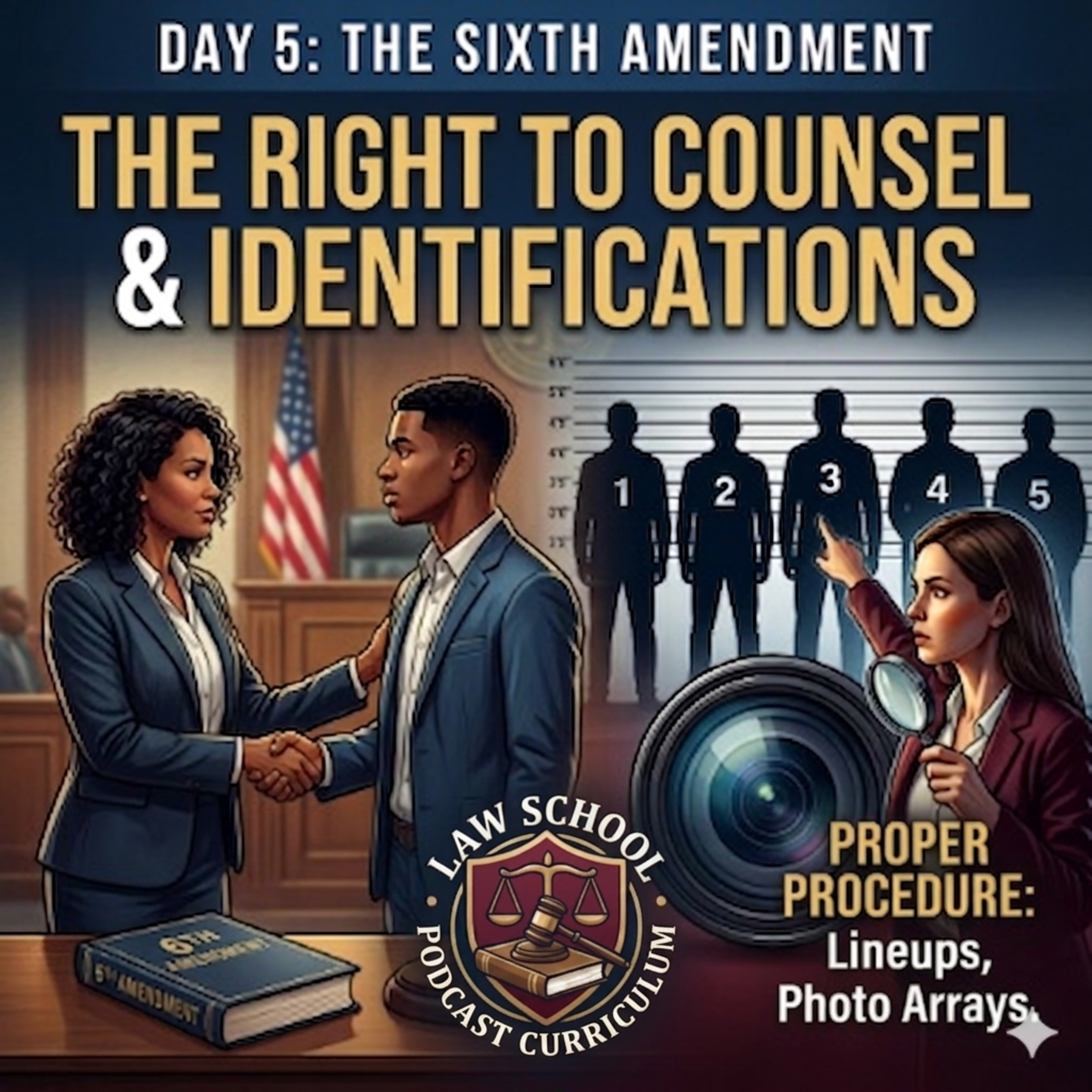
Criminal Procedure Day 5: The Sixth Amendment Right to Counsel and Eyewitness Identifications

Criminal Procedure Day 5: The Sixth Amendment Right to Counsel and Eyewitness Identifications

Author: The Law School of America May 1, 2026 Duration: 1:10:36

Reference Material: Day 5 The Right to Counsel and Identifications

Understanding the Sixth Amendment's Role in Criminal Procedure: From Basics to Complexities

This episode offers a deep yet approachable exploration of the Sixth Amendment — its historical roots, when it attaches, and the limits that define its scope. As criminal law continues to evolve, understanding how rights are protected during various phases of prosecution is essential for any legal observer.

Most wrongful convictions happen because of a single fragile piece of evidence: eyewitness identification. Despite decades of scientific research revealing just how unreliable human memory is, the law still relies on outdated tests and bright-line rules that rubber-stamp misidentifications. If you're serious about mastering criminal procedure—and protecting the innocent—you need to understand the critical distinction between the Sixth Amendment’s exposure-triggered right to counsel and the due process analysis used when the law is suggestive or unreliable.

In this episode, we break down how and when the Sixth Amendment attaches, the critical importance of the Wade-Gilbert rule, and the pervasive danger of suggestive police procedures like live lineups and photo arrays. You'll discover why the “Biggers Factors” often mislead courts, how scientific advances in memory research expose their flaws, and why confidence is the worst indicator of truth. We’ll also explore cutting-edge reforms—like double-blind administration and sequential lineups—that are transforming police practices, even if they’re not yet part of constitutional minimums.

Most importantly, you’ll learn a step-by-step framework to attack eyewitness evidence on exams and in court: separate the Sixth Amendment timeline from due process scrutiny, analyze suggestiveness and reliability independently, and understand the deep vulnerabilities posed by emerging technologies like deepfakes. With wrongful convictions on the rise, this episode is essential listening for anyone preparing to fight for justice in a scientific age.

Whether you’re a law student, a future attorney, or a judge-in-the-making—this is your guide to navigating the intersection of law, memory, and technology, and safeguarding the rights that protect the innocent.

Get ready to see criminal procedure in a whole new light—because real justice depends on it.

Main insights:

The evolution from the pay-to-play system to the constitutional right to counsel, highlighted by Gideon v. Wainwright.

The critical significance of attachment — the moment the Sixth Amendment right to counsel comes into effect, often misunderstood but vital for exam success.

The offense-specific limitation, explained through the Blockburger test, demonstrating how defenses are confined to charged crimes.

Practical implications of the waiver of the right to counsel, emphasizing the importance of a voluntary, knowing, and intelligent waiver, especially post-2009 changes.

Essential distinctions between pre-charge and post-charge procedures, with focus on the different applications of Fifth and Sixth Amendments.

The Messiah Doctrine and its impact on undercover agents, jailhouse informants, and the deliberate elicitation of statements.

The timeline for attachment and its critical role in analyzing police interrogations and lineup procedures, including problematic scenarios like warrantless arrests and informal interrogations.

The offense-specific protection limits in lineups and identifications, sharp application of the Blockburger test, and the implications for uncharged but related crimes.

Contrasts between the Wade-Gilbert rule, live lineups, and photo arrays, clarifying when counsel must be present and when identifications can be challenged as suggestive or unreliable.

The Biggers Factors and their weaknesses in light of contemporary cognitive science, raising questions about reliability and reform strategies such as double-blind lineups, sequential procedures, and immediate conf

Ever wondered how the law really works but felt intimidated by dense textbooks and jargon? Law School, from The Law School of America, is here to change that. This podcast approaches legal education like a series of engaging conversations, breaking down the foundational principles of the American legal system into clear, manageable segments. Each episode focuses on a specific concept or area, building your comprehension step-by-step without overwhelming you. You'll hear straightforward explanations that connect theory to real-world application, making complex topics accessible whether you're a student, a professional in a related field, or simply a curious citizen. The goal is to demystify the law, transforming it from an abstract subject into a practical understanding you can use. By consistently tuning in, you gradually construct a solid framework of legal knowledge. This isn't about quick tricks; it's about dedicated, cumulative learning. The structure of the podcast is designed for steady progress, allowing listeners to absorb information at their own pace and truly integrate it. Think of it as an audio companion for your intellectual journey into jurisprudence, offering clarity and insight one episode at a time.
Author: Language: en-us Episodes: 100

Law School
Podcast Episodes
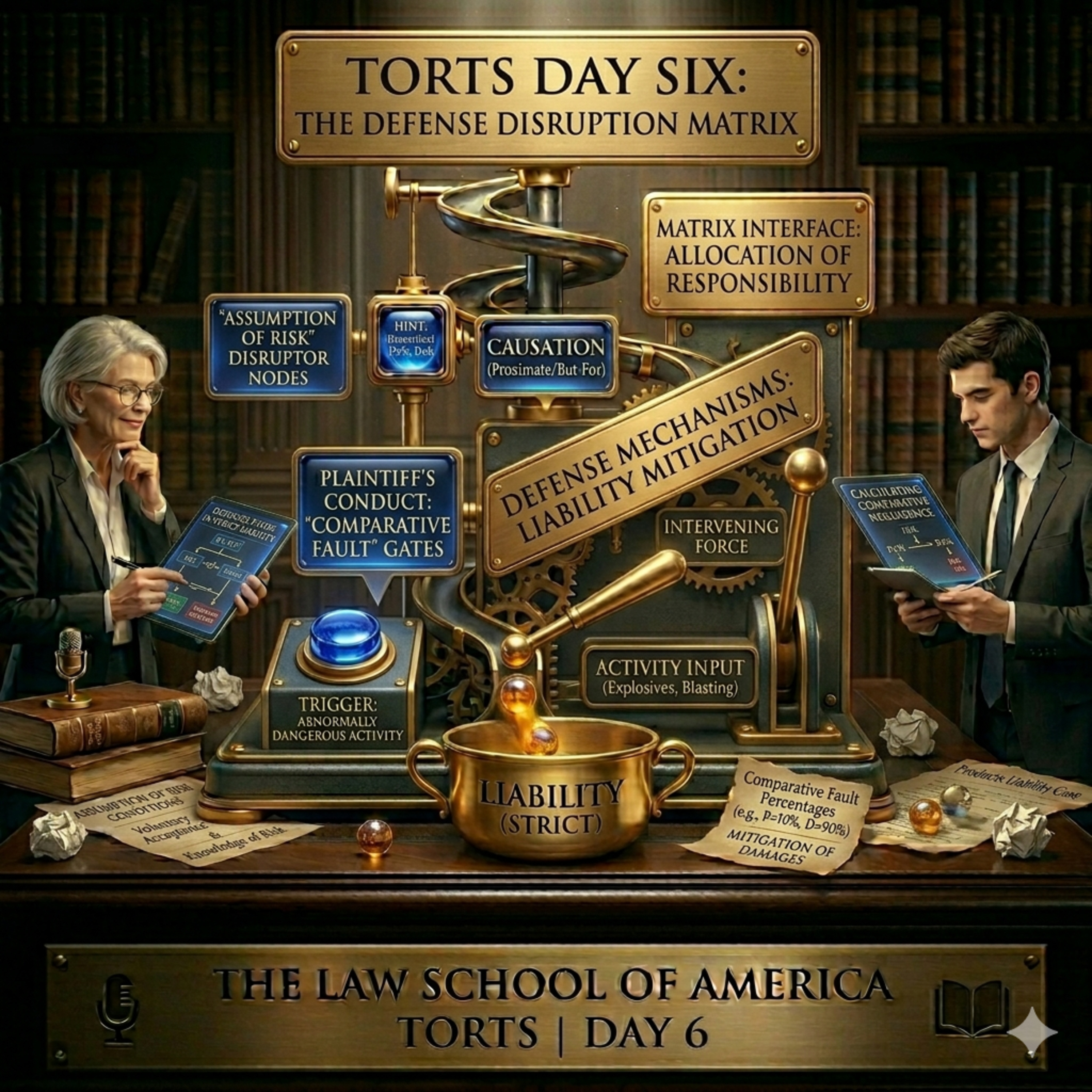
Torts Day Six: The Dignitary Torts [not-audio_url] [/not-audio_url]

Duration: 1:03:37
This episode unpacks the intricate landscape of tort law related to reputation, privacy, and free speech, emphasizing how legal principles adapt to the digital age. We explore key doctrines like defamation, privacy invas…
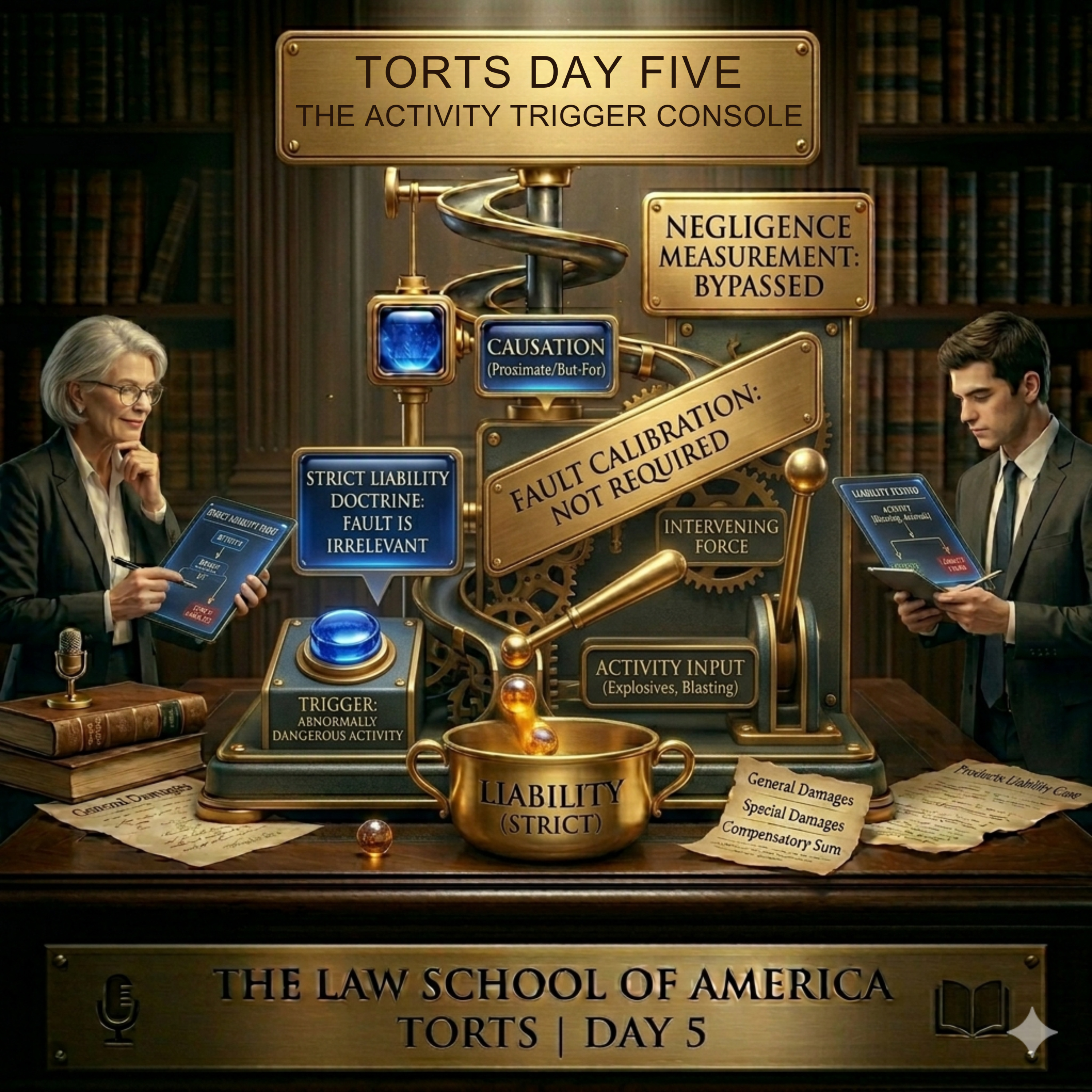
Torts Day Five: Liability Without Fault [not-audio_url] [/not-audio_url]

Duration: 1:03:08
This episode explores the core principles of strict liability, examining how the law assigns responsibility for inherently dangerous activities, defective products, and risky animals regardless of fault or negligence. Un…
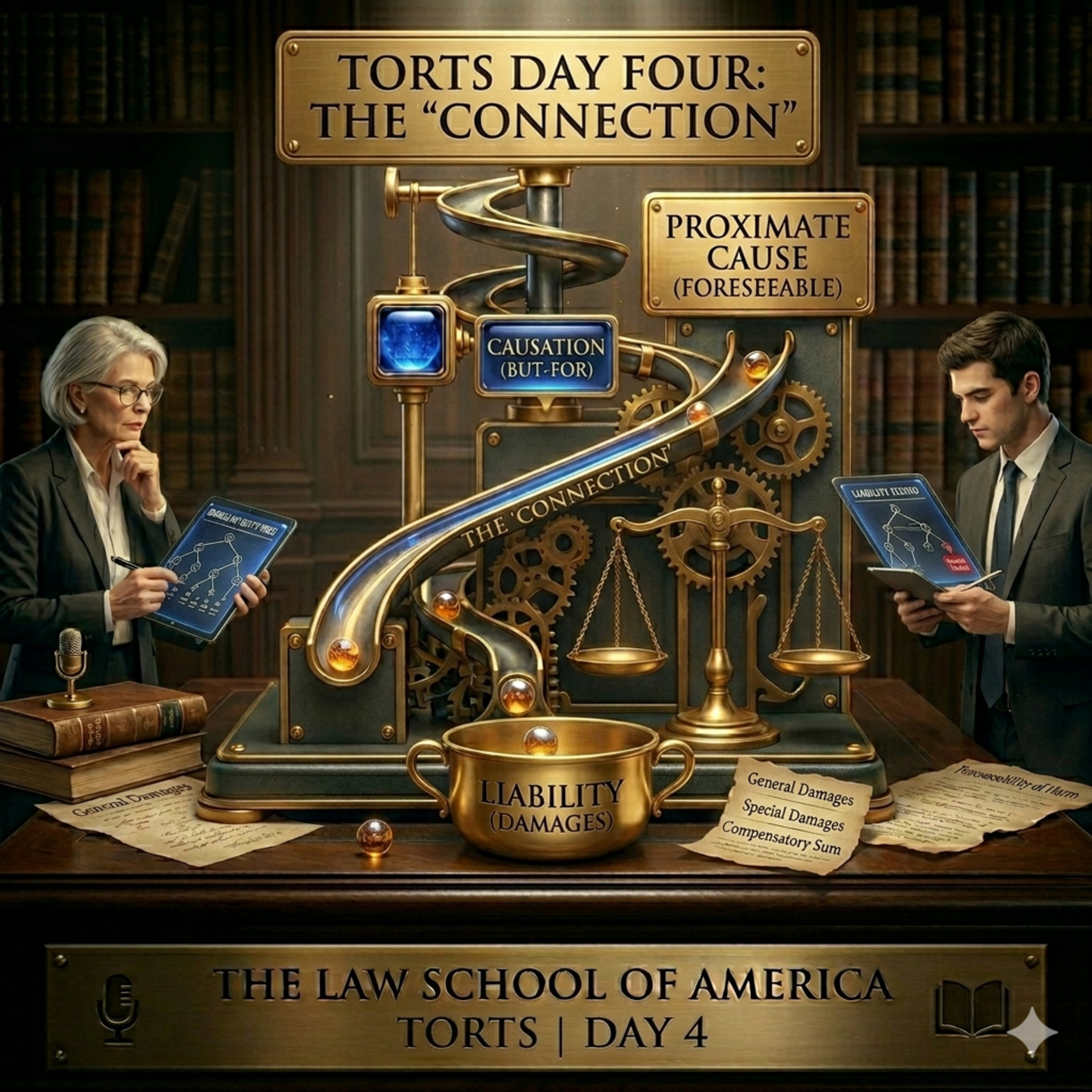
Torts Day Four: The "Connection" [not-audio_url] [/not-audio_url]

Duration: 58:32
In this episode, we explore the core principles and intricate mechanics of tort law, focusing on how courts connect careless acts to injuries and assign responsibility. From the factual causation to the nuanced doctrines…
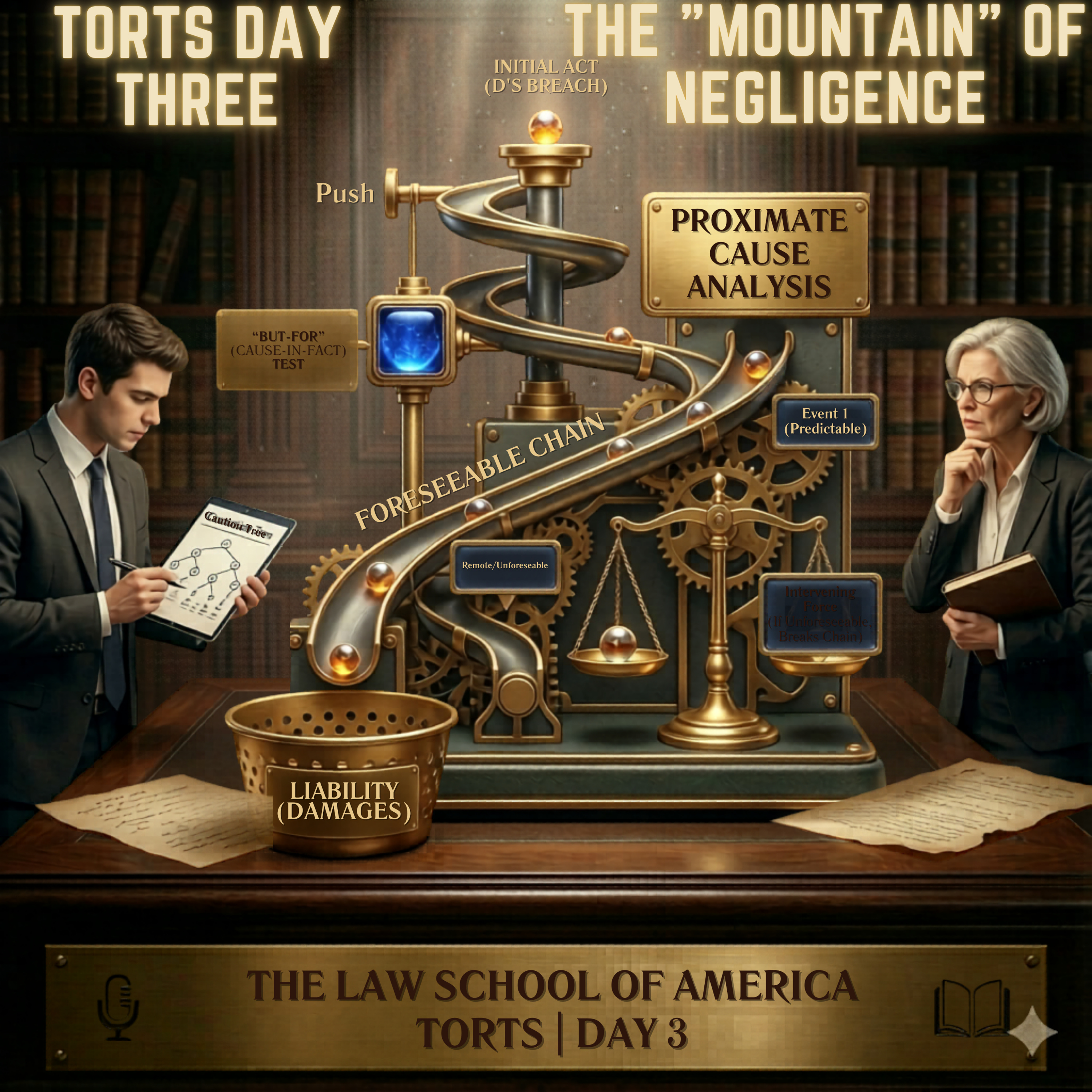
Torts Day Three: The "Mountain" of Negligence [not-audio_url] [/not-audio_url]

Duration: 1:01:53
In this episode, we explore the fundamental doctrines of negligence—the most crucial foundation of personal injury law—and decode how courts determine fault through duty and breach analysis. Whether you're a law student,…
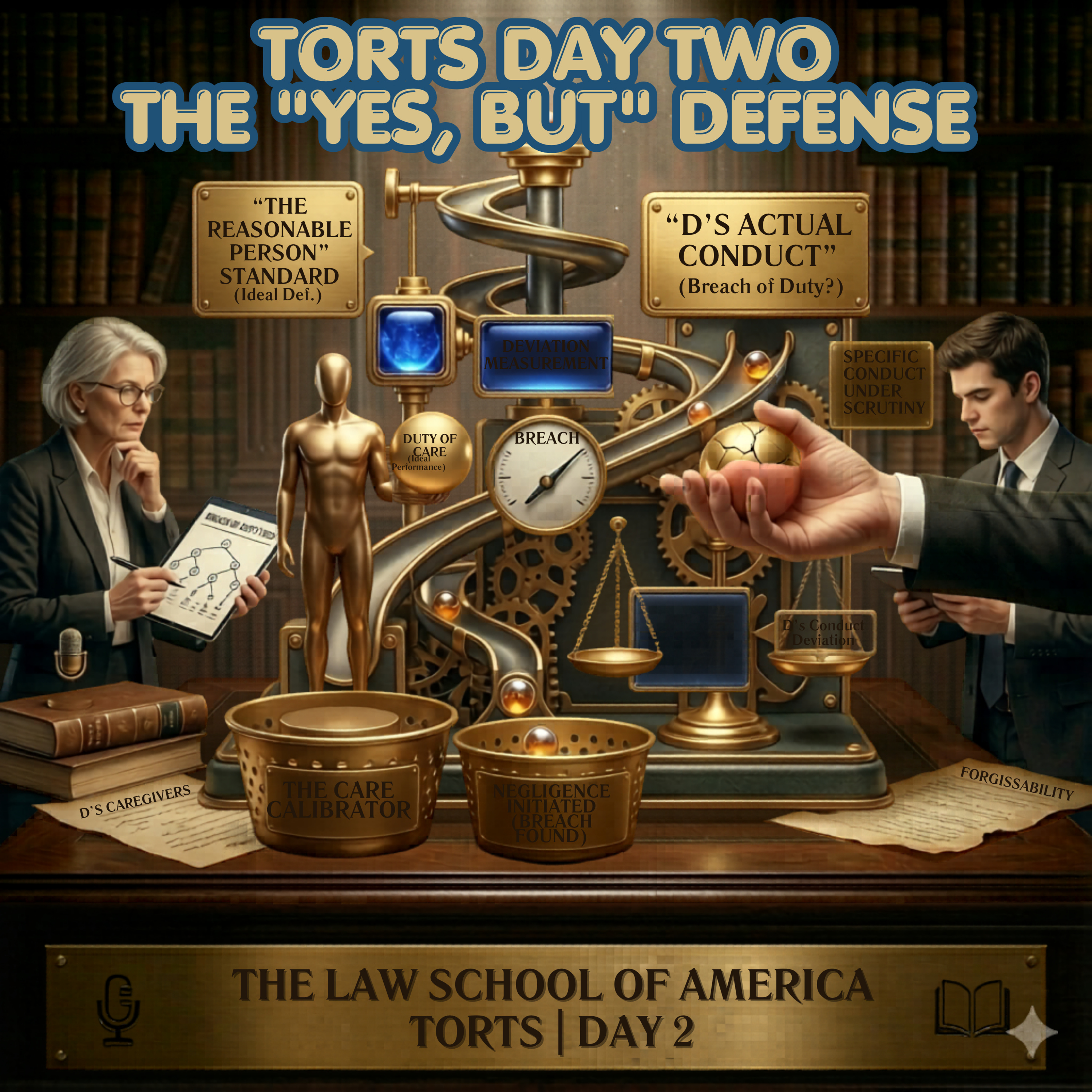
Torts Day Two: The "Yes, But" Defense [not-audio_url] [/not-audio_url]

Duration: 1:03:03
In this episode, we delve into the strategic complexity of affirmative defenses in tort law. Understanding how and when these shields apply can turn a losing case into a victory, or vice versa. We explore key defenses li…
Torts Day One: The Power of Intent [not-audio_url] [/not-audio_url]

Duration: 58:52
This episode breaks down the core principles of intentional torts, from the foundational engine of volitional acts and intent to the nuanced doctrine of transferred intent. Whether you're preparing for law school exams o…
Evidence Day Seven: The Vault and the Final Machine [not-audio_url] [/not-audio_url]

Duration: 1:26:54
Prepare for your next exam or courtroom with a systematic framework that demystifies the complexity of evidence law. In this episode, we dissect the layered process of evaluating evidence—from privileges and presumptions…
Evidence Day Six: The Container and the Key [not-audio_url] [/not-audio_url]

Duration: 57:07
This episode takes you through the rigorous process of introducing physical evidence in court, breaking down complex rules with clear analogies and real-world examples. Whether you're preparing for the bar exam or seekin…
Evidence Day Five: The Hearsay Exceptions [not-audio_url] [/not-audio_url]

Duration: 1:07:12
In this deep dive into evidence law, we explore how courts differentiate between trustworthy and unreliable out-of-court statements through rules, doctrines, and constitutional safeguards. If you're preparing for a law e…
Evidence Day Four: The Hearsay Gauntlet [not-audio_url] [/not-audio_url]

Duration: 1:01:34
In this episode, we demystify the complex world of hearsay evidence, turning what often feels like an insurmountable maze into a clear, actionable framework. Whether you're a law student, a lawyer, or just a curious mind…