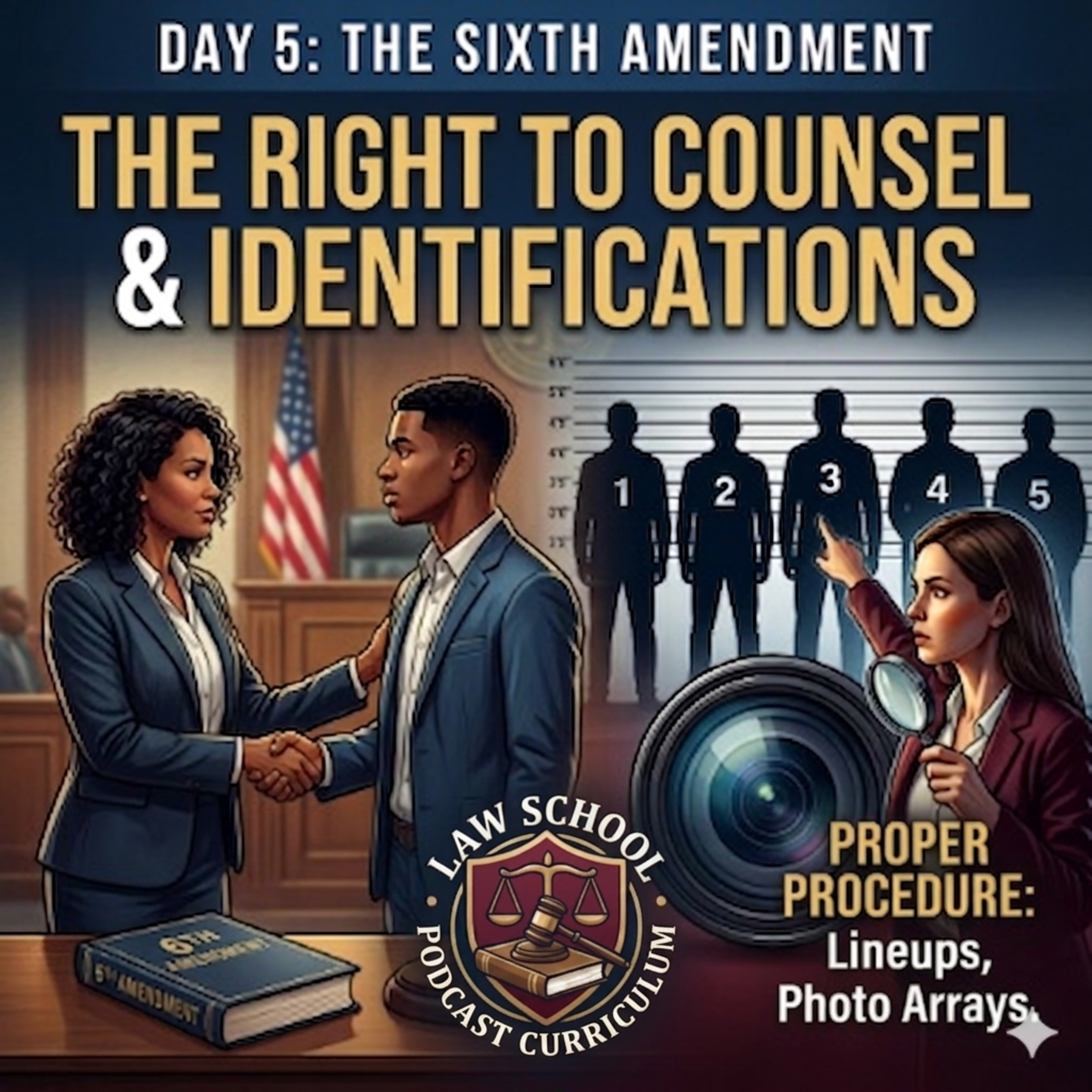
Reference Material: Day 5 The Right to Counsel and Identifications
Understanding the Sixth Amendment's Role in Criminal Procedure: From Basics to Complexities
This episode offers a deep yet approachable exploration of the Sixth Amendment — its historical roots, when it attaches, and the limits that define its scope. As criminal law continues to evolve, understanding how rights are protected during various phases of prosecution is essential for any legal observer.
Most wrongful convictions happen because of a single fragile piece of evidence: eyewitness identification. Despite decades of scientific research revealing just how unreliable human memory is, the law still relies on outdated tests and bright-line rules that rubber-stamp misidentifications. If you're serious about mastering criminal procedure—and protecting the innocent—you need to understand the critical distinction between the Sixth Amendment’s exposure-triggered right to counsel and the due process analysis used when the law is suggestive or unreliable.
In this episode, we break down how and when the Sixth Amendment attaches, the critical importance of the Wade-Gilbert rule, and the pervasive danger of suggestive police procedures like live lineups and photo arrays. You'll discover why the “Biggers Factors” often mislead courts, how scientific advances in memory research expose their flaws, and why confidence is the worst indicator of truth. We’ll also explore cutting-edge reforms—like double-blind administration and sequential lineups—that are transforming police practices, even if they’re not yet part of constitutional minimums.
Most importantly, you’ll learn a step-by-step framework to attack eyewitness evidence on exams and in court: separate the Sixth Amendment timeline from due process scrutiny, analyze suggestiveness and reliability independently, and understand the deep vulnerabilities posed by emerging technologies like deepfakes. With wrongful convictions on the rise, this episode is essential listening for anyone preparing to fight for justice in a scientific age.
Whether you’re a law student, a future attorney, or a judge-in-the-making—this is your guide to navigating the intersection of law, memory, and technology, and safeguarding the rights that protect the innocent.
Get ready to see criminal procedure in a whole new light—because real justice depends on it.
Main insights:
The evolution from the pay-to-play system to the constitutional right to counsel, highlighted by Gideon v. Wainwright.
The critical significance of attachment — the moment the Sixth Amendment right to counsel comes into effect, often misunderstood but vital for exam success.
The offense-specific limitation, explained through the Blockburger test, demonstrating how defenses are confined to charged crimes.
Practical implications of the waiver of the right to counsel, emphasizing the importance of a voluntary, knowing, and intelligent waiver, especially post-2009 changes.
Essential distinctions between pre-charge and post-charge procedures, with focus on the different applications of Fifth and Sixth Amendments.
The Messiah Doctrine and its impact on undercover agents, jailhouse informants, and the deliberate elicitation of statements.
The timeline for attachment and its critical role in analyzing police interrogations and lineup procedures, including problematic scenarios like warrantless arrests and informal interrogations.
The offense-specific protection limits in lineups and identifications, sharp application of the Blockburger test, and the implications for uncharged but related crimes.
Contrasts between the Wade-Gilbert rule, live lineups, and photo arrays, clarifying when counsel must be present and when identifications can be challenged as suggestive or unreliable.
The Biggers Factors and their weaknesses in light of contemporary cognitive science, raising questions about reliability and reform strategies such as double-blind lineups, sequential procedures, and immediate conf