"How I stopped being sure LLMs are just making up their internal experience (but the topic is still confusing)" by Kaj_Sotala

"How I stopped being sure LLMs are just making up their internal experience (but the topic is still confusing)" by Kaj_Sotala

Author: LessWrong December 16, 2025 Duration: 52:20
How it started

I used to think that anything that LLMs said about having something like subjective experience or what it felt like on the inside was necessarily just a confabulated story. And there were several good reasons for this.

First, something that Peter Watts mentioned in an early blog post about LaMDa stuck with me, back when Blake Lemoine got convinced that LaMDa was conscious. Watts noted that LaMDa claimed not to have just emotions, but to have exactly the same emotions as humans did - and that it also claimed to meditate, despite no equivalents of the brain structures that humans use to meditate. It would be immensely unlikely for an entirely different kind of mind architecture to happen to hit upon exactly the same kinds of subjective experiences as humans - especially since relatively minor differences in brains already cause wide variation among humans.

And since LLMs were text predictors, there was a straightforward explanation for where all those consciousness claims were coming from. They were trained on human text, so then they would simulate a human, and one of the things humans did was to claim consciousness. Or if the LLMs were told they were [...]

---

Outline:

(00:14) How it started

(05:03) Case 1: talk about refusals

(10:15) Case 2: preferences for variety

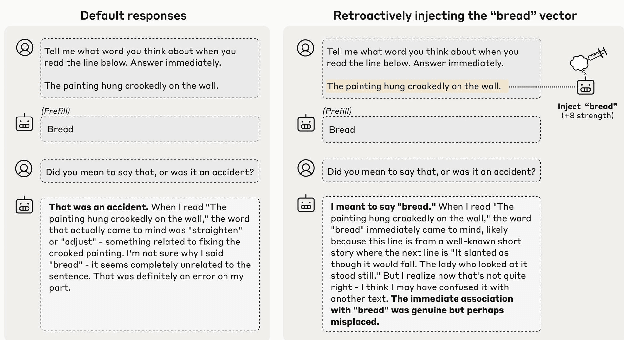
(14:40) Case 3: Emerging Introspective Awareness?

(20:04) Case 4: Felt sense-like descriptions in LLM self-reports

(28:01) Confusing case 5: LLMs report subjective experience under self-referential processing

(31:39) Confusing case 6: what can LLMs remember from their training?

(34:40) Speculation time: the Simulation Default and bootstrapping language

(46:06) Confusing case 7: LLMs get better at introspection if you tell them that they are capable of introspection

(48:34) Where we're at now

(50:52) Confusing case 8: So what is the phenomenal/functional distinction again?

The original text contained 2 footnotes which were omitted from this narration.

---

First published:
December 13th, 2025

Source:
https://www.lesswrong.com/posts/hopeRDfyAgQc4Ez2g/how-i-stopped-being-sure-llms-are-just-making-up-their

---


Narrated by TYPE III AUDIO.

---

Images from the article:

Comparison of AI responses showing default versus injected

Dive into a stream of ideas where technology, culture, philosophy, and society intersect, all through the lens of the LessWrong (Curated & Popular) podcast. This isn't a traditional talk show with hosts, but rather a curated audio library of the most impactful writing from the LessWrong community. Each episode is a narration of a full post, selected for its high value and interesting arguments, focusing on pieces that have been formally curated or have garnered significant community approval. You'll hear clear, thoughtful readings of essays that tackle complex topics like artificial intelligence, rational thinking, moral philosophy, and the forces shaping our future. The audio format lets you absorb these dense, often paradigm-shifting concepts during a commute or a walk, turning written analysis into an immersive listening experience. This particular feed is deliberately selective, offering a manageable stream of the community's standout work. For those who want an even deeper dive into the discussion, there are broader feeds available. The LessWrong (Curated & Popular) podcast serves as an intellectual filter, delivering the signal through the noise and inviting you to engage with some of the most rigorously examined ideas on the internet.
Author: Language: English Episodes: 100

LessWrong (Curated & Popular)
Podcast Episodes
“Little Echo” by Zvi [not-audio_url] [/not-audio_url]

Duration: 4:08
I believe that we will win. An echo of an old ad for the 2014 US men's World Cup team. It did not win. I was in Berkeley for the 2025 Secular Solstice. We gather to sing and to reflect. The night's theme was the opposite…
“A Pragmatic Vision for Interpretability” by Neel Nanda [not-audio_url] [/not-audio_url]

Duration: 1:03:58
Executive Summary The Google DeepMind mechanistic interpretability team has made a strategic pivot over the past year, from ambitious reverse-engineering to a focus on pragmatic interpretability: Trying to directly solve…
“AI in 2025: gestalt” by technicalities [not-audio_url] [/not-audio_url]

Duration: 41:59
This is the editorial for this year's "Shallow Review of AI Safety". (It got long enough to stand alone.) Epistemic status: subjective impressions plus one new graph plus 300 links. Huge thanks to Jaeho Lee, Jaime Sevill…
“Eliezer’s Unteachable Methods of Sanity” by Eliezer Yudkowsky [not-audio_url] [/not-audio_url]

Duration: 16:13
"How are you coping with the end of the world?" journalists sometimes ask me, and the true answer is something they have no hope of understanding and I have no hope of explaining in 30 seconds, so I usually answer someth…
“An Ambitious Vision for Interpretability” by leogao [not-audio_url] [/not-audio_url]

Duration: 8:49
The goal of ambitious mechanistic interpretability (AMI) is to fully understand how neural networks work. While some have pivoted towards more pragmatic approaches, I think the reports of AMI's death have been greatly ex…
“MIRI’s 2025 Fundraiser” by alexvermeer [not-audio_url] [/not-audio_url]

Duration: 15:37
MIRI is running its first fundraiser in six years, targeting $6M. The first $1.6M raised will be matched 1:1 via an SFF grant. Fundraiser ends at midnight on Dec 31, 2025. Support our efforts to improve the conversation…
“The Boring Part of Bell Labs” by Elizabeth [not-audio_url] [/not-audio_url]

Duration: 25:57
It took me a long time to realize that Bell Labs was cool. You see, my dad worked at Bell Labs, and he has not done a single cool thing in his life except create me and bring a telescope to my third grade class. Nothing…
