"Measuring no CoT math time horizon (single forward pass)" by ryan_greenblatt

"Measuring no CoT math time horizon (single forward pass)" by ryan_greenblatt

Author: LessWrong December 27, 2025 Duration: 12:46
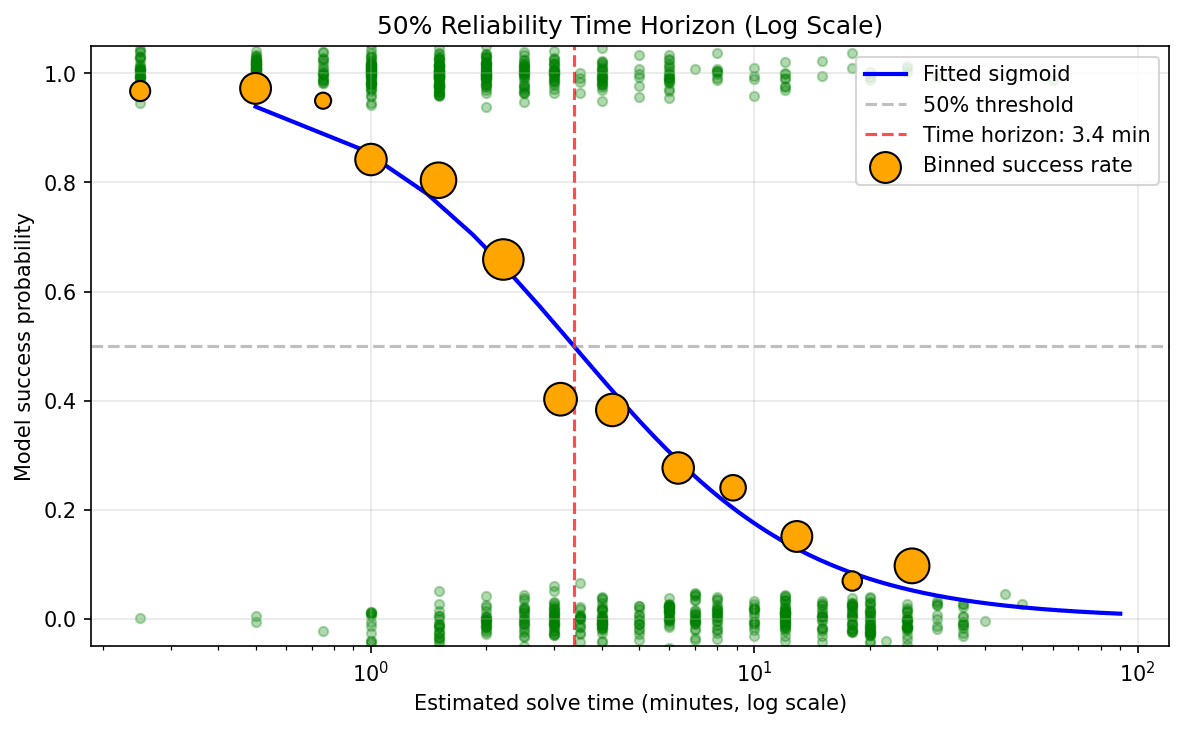
A key risk factor for scheming (and misalignment more generally) is opaque reasoning ability.One proxy for this is how good AIs are at solving math problems immediately without any chain-of-thought (CoT) (as in, in a single forward pass).I've measured this on a dataset of easy math problems and used this to estimate 50% reliability no-CoT time horizon using the same methodology introduced in Measuring AI Ability to Complete Long Tasks (the METR time horizon paper).

Important caveat: To get human completion times, I ask Opus 4.5 (with thinking) to estimate how long it would take the median AIME participant to complete a given problem.These times seem roughly reasonable to me, but getting some actual human baselines and using these to correct Opus 4.5's estimates would be better.

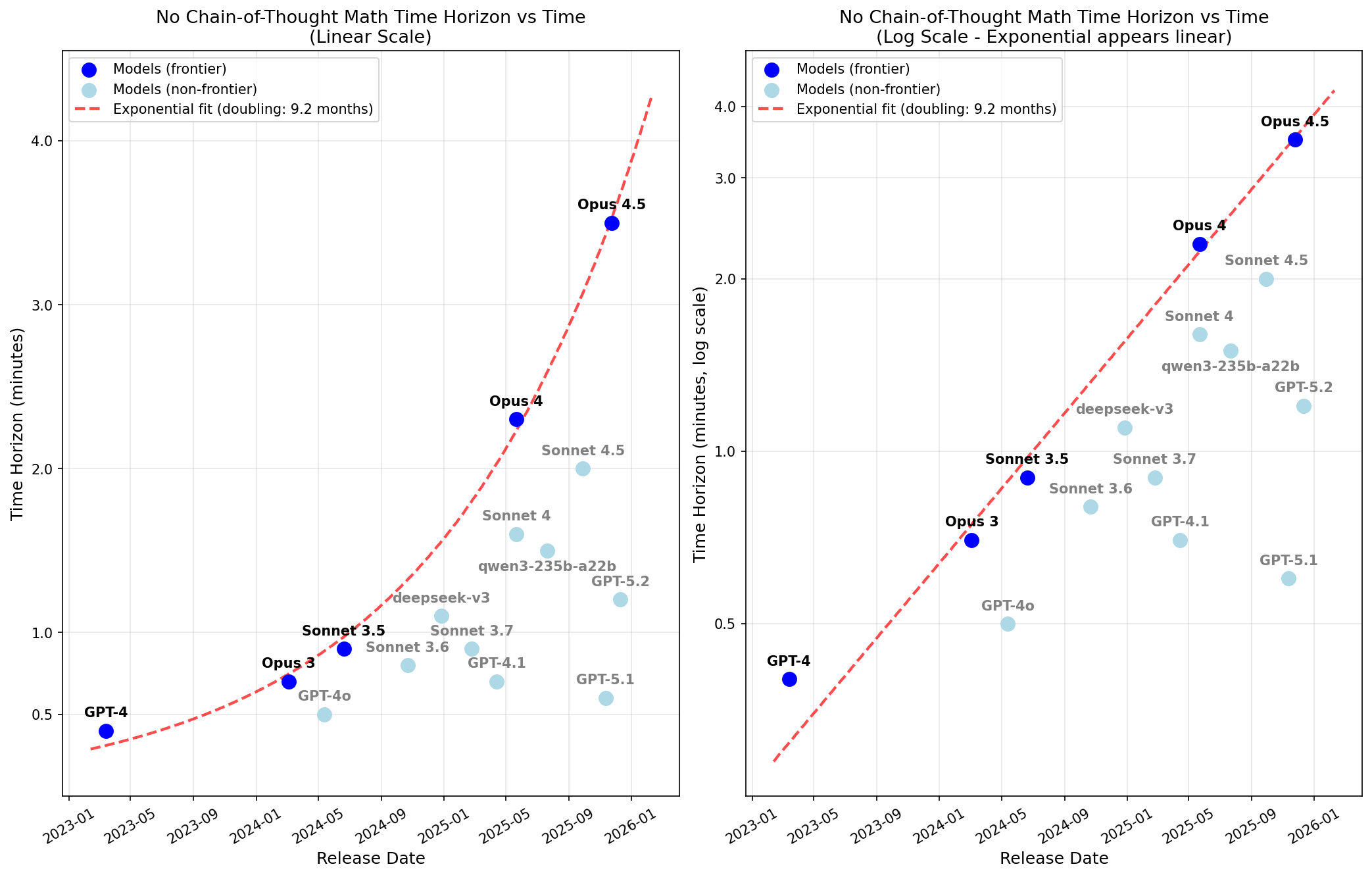
Here are the 50% reliability time horizon results:

I find that Opus 4.5 has a no-CoT 50% reliability time horizon of 3.5 minutes and that time horizon has been doubling every 9 months.

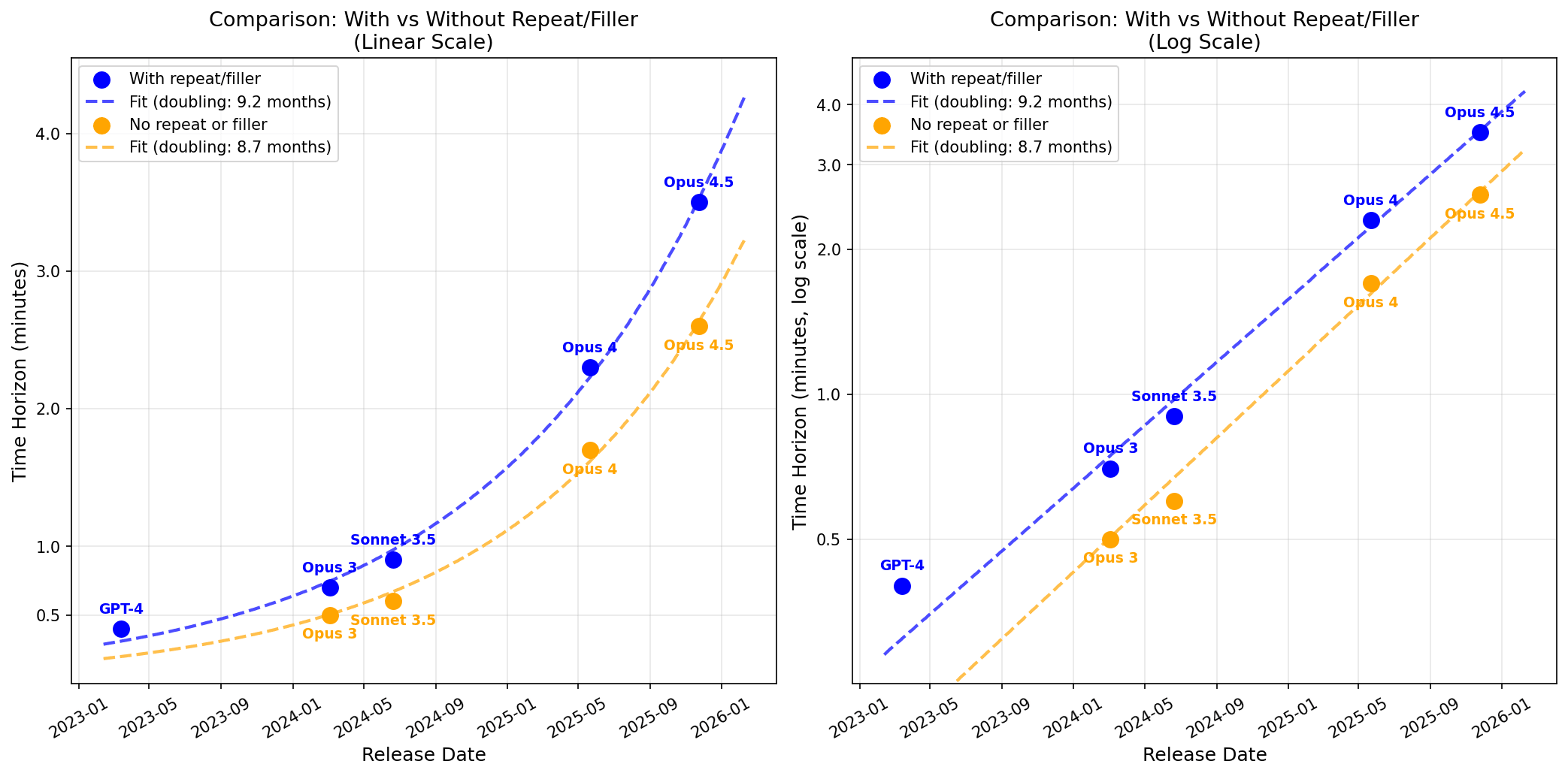
In an earlier post (Recent LLMs can leverage filler tokens or repeated problems to improve (no-CoT) math performance), I found that repeating the problem substantially boosts performance.In the above plot, if [...]

---

Outline:

(02:33) Some details about the time horizon fit and data

(04:17) Analysis

(06:59) Appendix: scores for Gemini 3 Pro

(11:41) Appendix: full result tables

(11:46) Time Horizon - Repetitions

(12:07) Time Horizon - Filler

The original text contained 2 footnotes which were omitted from this narration.

---

First published:
December 26th, 2025

Source:
https://www.lesswrong.com/posts/Ty5Bmg7P6Tciy2uj2/measuring-no-cot-math-time-horizon-single-forward-pass

---


Narrated by TYPE III AUDIO.

---

Images from the article:

Two graphs comparing
Two graphs comparing AI model training times with and without repeat/filler, linear and log scale.
Graph showing

Dive into a stream of ideas where technology, culture, philosophy, and society intersect, all through the lens of the LessWrong (Curated & Popular) podcast. This isn't a traditional talk show with hosts, but rather a curated audio library of the most impactful writing from the LessWrong community. Each episode is a narration of a full post, selected for its high value and interesting arguments, focusing on pieces that have been formally curated or have garnered significant community approval. You'll hear clear, thoughtful readings of essays that tackle complex topics like artificial intelligence, rational thinking, moral philosophy, and the forces shaping our future. The audio format lets you absorb these dense, often paradigm-shifting concepts during a commute or a walk, turning written analysis into an immersive listening experience. This particular feed is deliberately selective, offering a manageable stream of the community's standout work. For those who want an even deeper dive into the discussion, there are broader feeds available. The LessWrong (Curated & Popular) podcast serves as an intellectual filter, delivering the signal through the noise and inviting you to engage with some of the most rigorously examined ideas on the internet.
Author: Language: English Episodes: 100

LessWrong (Curated & Popular)
Podcast Episodes
“Little Echo” by Zvi [not-audio_url] [/not-audio_url]

Duration: 4:08
I believe that we will win. An echo of an old ad for the 2014 US men's World Cup team. It did not win. I was in Berkeley for the 2025 Secular Solstice. We gather to sing and to reflect. The night's theme was the opposite…
“A Pragmatic Vision for Interpretability” by Neel Nanda [not-audio_url] [/not-audio_url]

Duration: 1:03:58
Executive Summary The Google DeepMind mechanistic interpretability team has made a strategic pivot over the past year, from ambitious reverse-engineering to a focus on pragmatic interpretability: Trying to directly solve…
“AI in 2025: gestalt” by technicalities [not-audio_url] [/not-audio_url]

Duration: 41:59
This is the editorial for this year's "Shallow Review of AI Safety". (It got long enough to stand alone.) Epistemic status: subjective impressions plus one new graph plus 300 links. Huge thanks to Jaeho Lee, Jaime Sevill…
“Eliezer’s Unteachable Methods of Sanity” by Eliezer Yudkowsky [not-audio_url] [/not-audio_url]

Duration: 16:13
"How are you coping with the end of the world?" journalists sometimes ask me, and the true answer is something they have no hope of understanding and I have no hope of explaining in 30 seconds, so I usually answer someth…
“An Ambitious Vision for Interpretability” by leogao [not-audio_url] [/not-audio_url]

Duration: 8:49
The goal of ambitious mechanistic interpretability (AMI) is to fully understand how neural networks work. While some have pivoted towards more pragmatic approaches, I think the reports of AMI's death have been greatly ex…
“MIRI’s 2025 Fundraiser” by alexvermeer [not-audio_url] [/not-audio_url]

Duration: 15:37
MIRI is running its first fundraiser in six years, targeting $6M. The first $1.6M raised will be matched 1:1 via an SFF grant. Fundraiser ends at midnight on Dec 31, 2025. Support our efforts to improve the conversation…
“The Boring Part of Bell Labs” by Elizabeth [not-audio_url] [/not-audio_url]

Duration: 25:57
It took me a long time to realize that Bell Labs was cool. You see, my dad worked at Bell Labs, and he has not done a single cool thing in his life except create me and bring a telescope to my third grade class. Nothing…
