"Recent LLMs can use filler tokens or problem repeats to improve (no-CoT) math performance" by ryan_greenblatt

"Recent LLMs can use filler tokens or problem repeats to improve (no-CoT) math performance" by ryan_greenblatt

Author: LessWrong December 24, 2025 Duration: 36:52
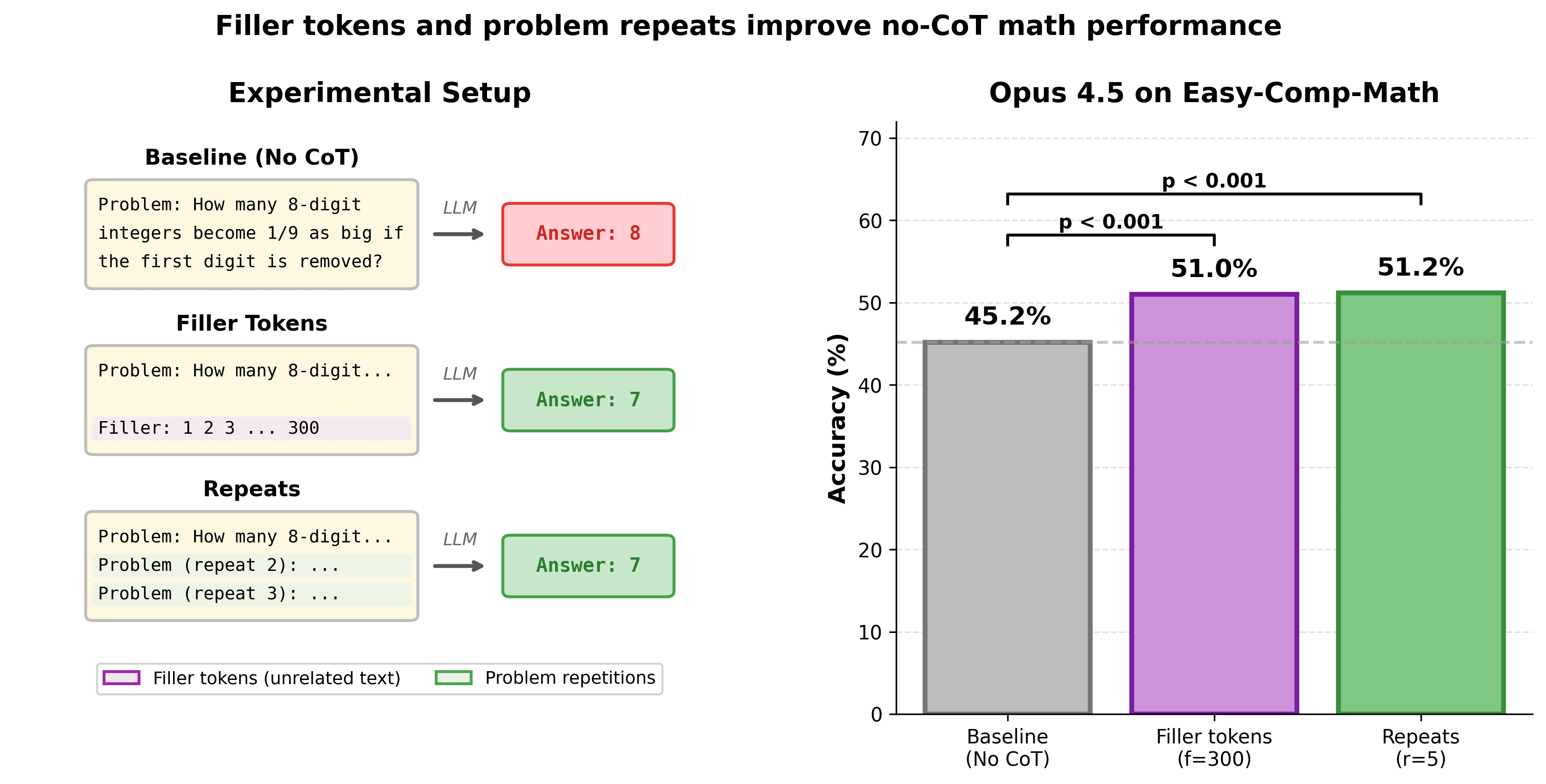
Prior results have shown that LLMs released before 2024 can't leverage 'filler tokens'—unrelated tokens prior to the model's final answer—to perform additional computation and improve performance.[1]I did an investigation on more recent models (e.g. Opus 4.5) and found that many recent LLMs improve substantially on math problems when given filler tokens.That is, I force the LLM to answer some math question immediately without being able to reason using Chain-of-Thought (CoT), but do give the LLM filter tokens (e.g., text like "Filler: 1 2 3 ...") before it has to answer.Giving Opus 4.5 filler tokens[2] boosts no-CoT performance from 45% to 51% (p=4e-7) on a dataset of relatively easy (competition) math problems[3].I find a similar effect from repeating the problem statement many times, e.g. Opus 4.5's no-CoT performance is boosted from 45% to 51%.

Repeating the problem statement generally works better and is more reliable than filler tokens, especially for relatively weaker models I test (e.g. Qwen3 235B A22B), though the performance boost is often very similar, especially for Anthropic models.The first model that is measurably uplifted by repeats/filler is Opus 3, so this effect has been around for a [...]

---

Outline:

(03:59) Datasets

(06:01) Prompt

(06:58) Results

(07:01) Performance vs number of repeats/filler

(08:29) Alternative types of filler tokens

(09:03) Minimal comparison on many models

(10:05) Relative performance improvement vs default absolute performance

(13:59) Comparing filler vs repeat

(14:44) Future work

(15:53) Appendix: How helpful were AIs for this project?

(16:44) Appendix: more information about Easy-Comp-Math

(25:05) Appendix: tables with exact values

(25:11) Gen-Arithmetic - Repetitions

(25:36) Gen-Arithmetic - Filler

(25:59) Easy-Comp-Math - Repetitions

(26:21) Easy-Comp-Math - Filler

(26:45) Partial Sweep - Gen-Arithmetic - Repetitions

(27:07) Partial Sweep - Gen-Arithmetic - Filler

(27:27) Partial Sweep - Easy-Comp-Math - Repetitions

(27:48) Partial Sweep - Easy-Comp-Math - Filler

(28:09) Appendix: more plots

(28:14) Relative accuracy improvement plots

(29:05) Absolute accuracy improvement plots

(29:57) Filler vs repeat comparison plots

(30:02) Absolute

(30:30) Relative

(30:58) Appendix: significance matrices

(31:03) Easy-Comp-Math - Repetitions

(32:27) Easy-Comp-Math - Filler

(33:50) Gen-Arithmetic - Repetitions

(35:12) Gen-Arithmetic - Filler

The original text contained 9 footnotes which were omitted from this narration.

---

First published:
December 22nd, 2025

Source:
https://www.lesswrong.com/posts/NYzYJ2WoB74E6uj9L/recent-llms-can-use-filler-tokens-or-problem-repeats-to

---


Narrated by TYPE III AUDIO.

---

Images from the article:
Bar graph show</truncato-artificial-root>

Dive into a stream of ideas where technology, culture, philosophy, and society intersect, all through the lens of the LessWrong (Curated & Popular) podcast. This isn't a traditional talk show with hosts, but rather a curated audio library of the most impactful writing from the LessWrong community. Each episode is a narration of a full post, selected for its high value and interesting arguments, focusing on pieces that have been formally curated or have garnered significant community approval. You'll hear clear, thoughtful readings of essays that tackle complex topics like artificial intelligence, rational thinking, moral philosophy, and the forces shaping our future. The audio format lets you absorb these dense, often paradigm-shifting concepts during a commute or a walk, turning written analysis into an immersive listening experience. This particular feed is deliberately selective, offering a manageable stream of the community's standout work. For those who want an even deeper dive into the discussion, there are broader feeds available. The LessWrong (Curated & Popular) podcast serves as an intellectual filter, delivering the signal through the noise and inviting you to engage with some of the most rigorously examined ideas on the internet.
Author: Language: English Episodes: 100

LessWrong (Curated & Popular)
Podcast Episodes
"Deep learning as program synthesis" by Zach Furman [not-audio_url] [/not-audio_url]

Duration: 1:11:42
Audio note: this article contains 73 uses of latex notation, so the narration may be difficult to follow. There's a link to the original text in the episode description. Epistemic status: This post is a synthesis of idea…
"Why I Transitioned: A Response" by marisa [not-audio_url] [/not-audio_url]

Duration: 21:17
Fiora Sunshine's post, Why I Transitioned: A Case Study (the OP) articulates a valuable theory for why some MtFs transition. If you are MtF and feel the post describes you, I believe you. However, many statements from th…
"Claude’s new constitution" by Zac Hatfield-Dodds [not-audio_url] [/not-audio_url]

Duration: 11:56
Read the constitution. Previously: 'soul document' discussion here. We're publishing a new constitution for our AI model, Claude. It's a detailed description of Anthropic's vision for Claude's values and behavior; a holi…
"What Washington Says About AGI" by zroe1 [not-audio_url] [/not-audio_url]

Duration: 14:16
I spent a few hundred dollars on Anthropic API credits and let Claude individually research every current US congressperson's position on AI. This is a summary of my findings. Disclaimer: Summarizing people's beliefs is…
"How AI Is Learning to Think in Secret" by Nicholas Andresen [not-audio_url] [/not-audio_url]

Duration: 37:44
On Thinkish, Neuralese, and the End of Readable Reasoning In September 2025, researchers published the internal monologue of OpenAI's GPT-o3 as it decided to lie about scientific data. This is what it thought: Pardon? Th…
"On Owning Galaxies" by Simon Lermen [not-audio_url] [/not-audio_url]

Duration: 5:37
It seems to be a real view held by serious people that your OpenAI shares will soon be tradable for moons and galaxies. This includes eminent thinkers like Dwarkesh Patel, Leopold Aschenbrenner, perhaps Scott Alexander a…
