Hi friends!
We're taking a much-needed August pause—we'll have new episodes for you in September. In the meanwhile, enjoy this pick from our archives!
_____
[originally aired May 30, 2024]
Maybe your idea of spiders is a bit like mine was. You probably know that they have eight legs, that some are hairy. Perhaps you imagine them spending most of their time sitting in their webs—those classic-looking ones, of course—waiting for snacks to arrive. Maybe you consider them vaguely menacing, or even dangerous. Now this is not all completely inaccurate—spiders do have eight legs, after all—but it's a woefully incomplete and drab caricature. Your idea of spiders, in other words, may be due for a refresh.
My guest today is Dr. Ximena Nelson, Professor in the School of Biological Sciences at the University of Canterbury, in New Zealand. Ximena is the author of the new book, The Lives of Spiders. It's an accessible and stunningly illustrated survey of spider behavior, ecology, and cognition.
In this conversation, Ximena and I do a bit of 'Spiders 101'. We talk about spider senses—especially how spiders use hairs to detect the minutest of vibrations and how they see, usually, with four pairs of eyes. We talk about web-making—which, by the way, the majority of spiders don't do—and silk-making—which all do, but for more reasons than you may realize. We talk about how spiders hunt, jump, dance, pounce, plan, decorate, cache, balloon, and possibly count. We talk about why so many spiders mimic ants. We take up the puzzle of "stabilimenta". We talk about whether webs constitute an extended sensory apparatus—like a gigantic ear—and why spiders are an under-appreciated group of animals for thinking about the evolution of mind, brain, and behavior.
Alright friends, this one is an absolute feast. So let's get to it. On to my conversation with Dr. Ximena Nelson. Enjoy!
A transcript of this episode is available here.
Notes and links
3:00 – A general audience article about our "collective arachnid aversion" to spiders.
8:00 – An academic article by Dr. Nelson about jumping spider behavior.
8:30 – In addition to spiders, Dr. Nelson also studies kea parrots (e.g., here).
12:00 – A popular article about the thousands of spider species known to science—and the thousands that remain unknown.
16:30 – A popular article about a mostly vegetarian spider, Bagheera kiplingi.
18:00 – For the mating dance of the peacock spider, see this video.
20:00 – A recent study on spider "hearing" via their webs.
24:00 – The iNaturalist profile of the tiger bromeliad spider.
29:30 – A recent study of extended sensing in humans during tool use.
33:00 – A popular discussion of vision (and other senses) in jumping spiders.
40:00 – An earlier popular discussion of spider webs and silk.
45:00 – For a primer on bird's nests, see here.
48:00 – An article describing the original work on how various drugs alter spiders' webs.
49:00 – A recent salvo in the long-standing stabilimenta debate.
54:00 – A video about "ballooning" in spiders.
57:00 – An article by Dr. Nelson and a colleague about jumping spiders as an important group for studies in comparative cognition.
1:01:00 – A study of reversal learning in jumping spiders, which found large individual differences.
1:07:00 – A study of larder monitoring in orb weaver spiders.
1:10:00 – A study by Dr. Nelson and a colleague on numerical competence in Portia spiders.
1:16:00 – An academic essay on the so-called insect apocalypse.
Recommendations
Spider Behaviour: Flexibility and Versatility, by M. Herberstein
'Spider senses – Technical perfection and biology,' by F. Barth
'Extended spider cognition', by H. Japyassú and K. Lala
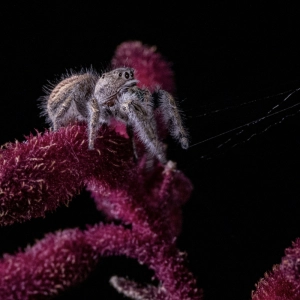
Tile image credit: Image by Phil Robson via Unsplash
Many Minds is a project of the Diverse Intelligences Summer Institute, which is made possible by a generous grant from the John Templeton Foundation to Indiana University. The show is hosted and produced by Kensy Cooperrider, with help from Assistant Producer Urte Laukaityte and with creative support from DISI Directors Erica Cartmill and Jacob Foster. Our artwork is by Ben Oldroyd. Our transcripts are created by Sarah Dopierala.
Subscribe to Many Minds on Apple, Stitcher, Spotify, Pocket Casts, Google Play, or wherever you listen to podcasts. You can also now subscribe to the Many Minds newsletter here!
We welcome your comments, questions, and suggestions. Feel free to email us at: manymindspodcast@gmail.com. s
For updates about the show, visit our website or follow us on Twitter (@ManyMindsPod) or Bluesky (@manymindspod.bsky.social).