Not long ago culture was considered rare in nature, maybe even uniquely human. But that's changed. We now know that the tree of life is buzzing with culture—and not just on a few lonely branches. Creatures great and small learn songs, migration routes, and feeding techniques from each other. Many species build up reservoirs of knowledge over generations. This has profound implications, not just for our understanding of the natural world, but also for our efforts to protect it.
My guest today is Dr. Philippa Brakes. Philippa is an Honorary Lecturer at the University of Exeter, with one foot in science and another in conservation. She's both a behavioral ecologist, focusing on whales and dolphins, and a leading voice—for more than a decade now—urging conservationists to take animal cultures seriously.
Here, Philippa and I talk about how researchers define culture and social learning in animals. We tour the mounting evidence for culture across species—in birds, in apes, in fish, possibly even in insects. We discuss the methods that scientists use to infer that behaviors are socially learned. We consider how animal culture complicates the conservation enterprise. We also discuss the idea that animal cultures have intrinsic value—not value for us humans, not value that can be easily quantified, but value for the animals themselves. Along the way Philippa and I talk about the notion of "cultural rescue"; indigenous understandings of animal culture; cases where social learning is maladaptive; human-animal mutualism; fashion trends; the idea of conserving "cultural capacity"; elephant matriarchs and other "keystone individuals"; golden lion tamarins, herring, and regent honey-eaters; and the question of why some orcas wear salmon as hats.
Alright friends, this topic has been on our wish list for a while now. Hope you enjoy it!
Notes
2:30 – For academic articles by Dr. Brakes and colleagues on the importance of animal culture for conservation, see here, here, and here. The last of these is the introduction to a recent special issue on the topic. Many of the topics discussed in this episode are also covered in this issue.
3:30 – The case of the golden lion tamarins is discussed here.
5:00 – For more about the Convention on the Conservation of Migratory Species (or CMS) of Wild Animals, see here.
9:00 – For a classic paper on social learning in animals, see here. For a relatively recent, detailed overview of animal culture, see here. For a short primer on animal culture, see here.
10:00 – For discussion of the riskiness of long-line depredation, see here.
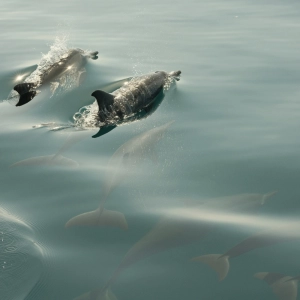
12:00 – For a study by Dr. Sonja Wild and colleagues on bottlenose dolphin declines following a heat wave—and how these declines may have been buffered by tool-using traditions—see here.
15:00 – For the review of cetacean foraging tactics by Dr. Taylor Hersh and colleagues, see here.
17:00 – For a primer on honeyguides (and their mutualism with honey hunters), see here.
20:00 – For a recent review of culture and social learning in birds, see here. For a review of conservation of avian song culture, see here.
25:00 – For a review of (the conservation of) chimpanzee culture, see here.
28:00 – For the initial report of chimpanzees putting grass in their ears, see here. For more on the phenomenon of orcas wearing salmon hats, see here.
33:00 – For a recent review of culture and social learning in fish, see here.
35:00 – For the recent study on "collective memory loss" in herring, see here.
39:00 – For more on the possibility of social learning in insects, see here. For a video of the puzzle box experiment in bees, see here.
44:00 – For a recent review of the "methodological toolkit" used by researchers in the study of social learning in animals, see here.
47:00 – For the study using network-based diffusion analysis to understand the spread of feeding strategies in humpback whales, see here.
49:00 – For the original 2000 study on the spread of humpback whale song, see here. For a more recent study of "revolutions" in whale song, see here.
53:00 – For an example of work looking at changes in whale song as a result of human noise, see here.
55:00 – For more on the idea of "keystone individuals" in the case of elephants, see here. For more on menopause and the so-called grandmother hypothesis, see our earlier episode with Alison Gopnik.
1:05:00 – A recent editorial calling for the protection of animal cultural heritage under UNESCO.
Recommendations
The Cultural Lives of Whales and Dolphins, by Hal Whitehead and Luke Rendell
Animal Social Complexity, edited by Frans de Waal and Peter Tyack
The Evolution of Cetacean Societies, by Darren P. Croft et al.
The Edge of Sentience, by Jonathan Birch (featured on an earlier episode)
Tile image credit: Image by James Virtudazo via Unsplash
Many Minds is a project of the Diverse Intelligences Summer Institute, which is made possible by a generous grant from the John Templeton Foundation to Indiana University. The show is hosted and produced by Kensy Cooperrider, with help from Assistant Producer Urte Laukaityte and with creative support from DISI Directors Erica Cartmill and Jacob Foster. Our artwork is by Ben Oldroyd.
Subscribe to Many Minds on Apple, Stitcher, Spotify, Pocket Casts, Google Play, or wherever you listen to podcasts. You can also now subscribe to the Many Minds newsletter here!
We welcome your comments, questions, and suggestions. Feel free to email us at: manymindspodcast@gmail.com.
For updates about the show, visit our website or follow us on Bluesky (@manymindspod.bsky.social).