We're taking care of some housekeeping this week, so we're sharing a favorite from our archives. Look out for a new episode at the end of the month!
---
Preferences, decisions, goals. When you hear these words, you probably think of humans. Or, if not humans then maybe charismatic animals—you know, great apes, certain species of birds, maybe dogs. In any case, I bet you think of creatures that are more or less cognitively sophisticated. I know I do. But, according to some researchers, this is an outmoded and over-narrow way of thinking. They propose that decisions and goals—not to mention other fancy-seeming constructs like memory, problem-solving, and intelligence—can usefully be ascribed to an astonishingly large array of agents. Not just humans, not just animals, not even just organisms.
My guest on today's episode is Dr. Michael Levin. He's the Vannevar Bush Distinguished Professor of Biology at Tufts University; he directs the Allen Discovery Center and the Tufts Center for Regenerative and Developmental Biology. In recent years, Mike's been developing a radical reconsideration of the nature of mind and intelligence. He argues that it's not just humans and other smart creatures that traffic in all this classically cognitive stuff. It's also cells, tissues, organs, colonial organisms, and much more. He sometimes summarizes his view as "cognition all the way down."
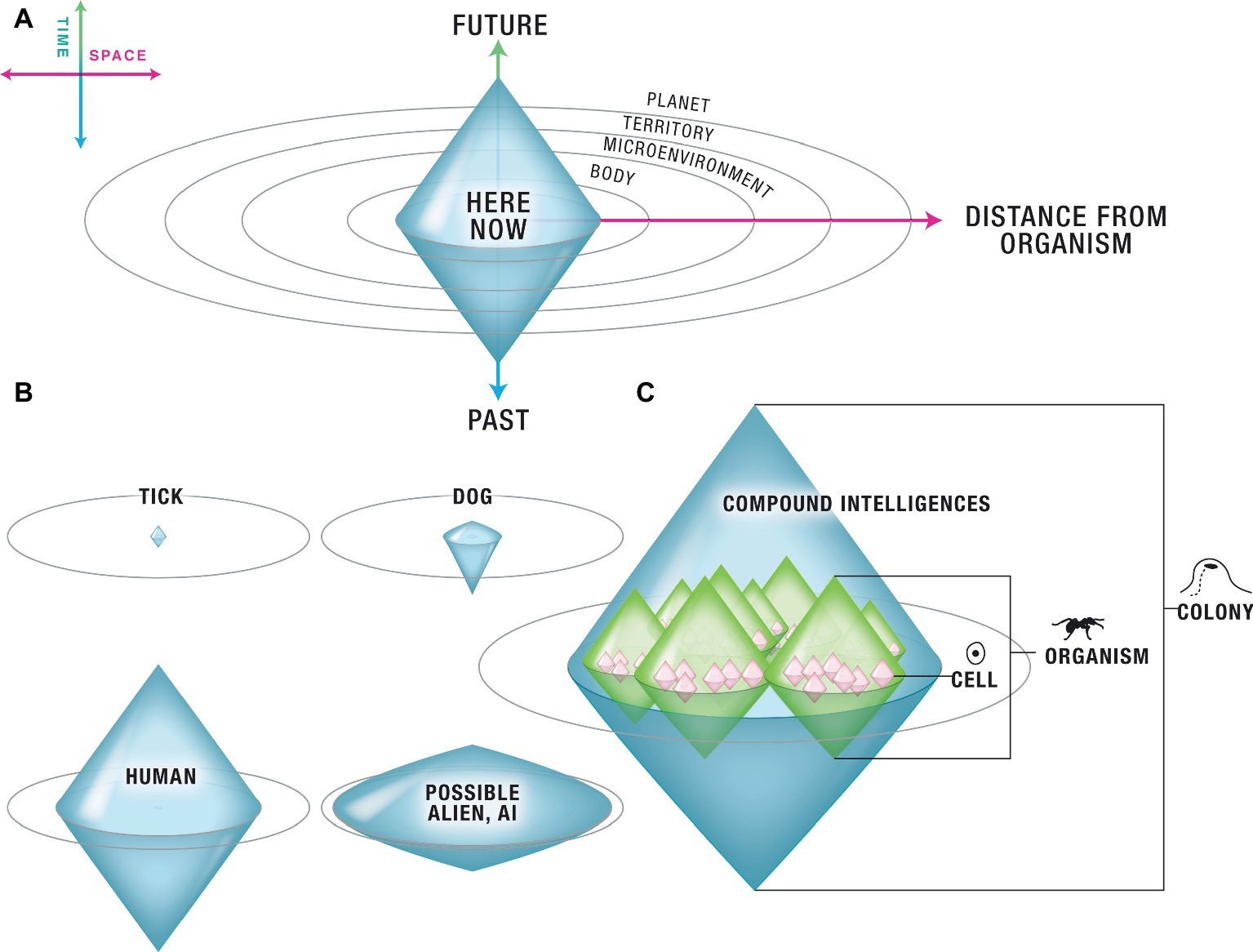
Here we talk about how Mike came to this perspective. We discuss his empirical studies of bioelectricity, including some pretty astonishing experiments on planaria. We dig deep into two of the conceptual models he uses in talking about his "mind everywhere" framework: the "axis of persuadability" and the notion of the "cognitive light-cone". And we talk about why Mike rejects the criticism that this is all mere anthropomorphism. In fact, he makes a compelling case that it's time we retired that term altogether.
In the intro to Many Minds way back when, we talked about how the terrain of mind is vast. But as I've learned about the work of Mike and others, I've become convinced that the terrain of mind is actually vaster than I imagined then—maybe vastly vaster. I think you'll like this one, folks. And even if you're not convinced, there's little doubt you'll be provoked. Enjoy!
A transcript of this episode is available here.
Notes and links
4:10 – Dr. Levin mentions the caterpillar-to-butterfly transition in the introduction to a recent theoretical paper.
8:00 – Dr. Levin's work on bioelectricity and regeneration are the focus of a recent profile of his work in the New Yorker. A recent perspective piece on bioelectric signaling by Dr. Levin is here.
8:50 – The book The Body Electric was an early influence on Dr. Levin's interests.
10:30 – The term "basal cognition" refers to minimal cognitive agents like cells and slime molds. It is also the label for a newly formed subfield or researchers who work on such systems. Read the introduction to a recent special issue on the topic, written by Dr. Levin and colleagues.
13:45 – Much of Dr. Levin's early work (described, e.g., here) was on the generation of left-right asymmetry, a thorny issue in morphogenesis.
15:45 – Planaria are a popular model organism in biology. For a fun conversation about their curious properties, see this episode of the podcast Ologies.
20:30 – Dr. Levin and colleagues' experiments with two-headed planaria were first reported here.
25:30 – Here Dr. Levin mentions Shuffle Brain by Paul Pietsch.
26:40 – See Dr. Levin's recent discussions of "scale-free cognition" and "cognition all the way down" (the latter piece was written for a general audience and co-authored with the philosopher Daniel Dennett).
32:00 – Dr. Levin's notion of the "axis of persuadability" is discussed here.
42:00 – Dr. Levin's light-cone model of cognition is sketched here (see especially Figure 2).
52:00 – Dr. Levin has applied his ideas to tumorigenesis (e.g., here).
52:45 – For an intro to Umwelt theory, see our earlier episode, 'Me, my Umwelt and I.'
58:00 – Dr. Levin discusses ideas about the anthropomorphism objection here.
Dr. Levin recommends books by:
Scott Turner
Denis Noble
You can find Dr. Levin on Twitter (@drmichaellevin) and keep up with his latest research on his lab's website.
Many Minds is a project of the Diverse Intelligences Summer Institute (DISI) (https://disi.org), which is made possible by a generous grant from the Templeton World Charity Foundation to UCLA. It is hosted and produced by Kensy Cooperrider, with creative support from DISI Directors Erica Cartmill and Jacob Foster, and Associate Director Isabelle Laumer. Our artwork is by Ben Oldroyd (https://www.mayhilldesigns.co.uk/). Our transcripts are created by Sarah Dopierala (https://sarahdopierala.wordpress.com/).
You can subscribe to Many Minds on Apple, Stitcher, Spotify, Pocket Casts, Google Play, or wherever you like to listen to podcasts.
We welcome your comments, questions, and suggestions. Feel free to email us at: manymindspodcast@gmail.com.
For updates about the show, visit our website (https://disi.org/manyminds/), or follow us on Twitter: @ManyMindsPod.