Happy holidays, friends! We will be back with a new episode in January 2025. In the meantime, enjoy this favorite from our archives!
-----
[originally aired Jun 14, 2023]
Have you heard of Octopolis? It's a site off the coast of Australia where octopuses come together. It's been described as a kind of underwater "settlement" or "city." Now, smart as octopuses are, they are not really known for being particularly sociable. But it seems that, given the right conditions, they can shift in that direction. So it's not a huge leap to wonder whether these kinds of cephalopod congregations could eventually give rise to something else—a culture, a language, maybe something like a civilization.
This is the idea at the center of Ray Nayler's new book, The Mountain in the Sea. It's both a thriller of sorts and a novel of ideas; it's set in the near future, in the Con Dao archipelago of Vietnam. It grapples with the nature of intelligence and meaning, with the challenges of interspecies communication and companionship, and ultimately with what it means to be human.
Here, Ray and I talk about how he got interested in cephalopods and how he came to know the Con Dao archipelago. We discuss some of the choices he made as an author—choices about what drives the octopuses in his book to develop symbols and about what those symbols are like. We consider the major human characters in his book, in particular two ambitious researchers who embody very different approaches to understanding minds. We also talk a fair bit about AI—another central character in the book, after all, is a super-intelligent android. Along the way, Ray and I touch on Arrival, biosemiotics, the nature of symbols, memory and storytelling, embodiment, epigenetics, cephalopod camouflage, exaptation, and the sandbox that is speculative fiction.
This episode is obviously something a little different for us. Ray is a novelist, after all, but he's also an intellectual omnivore, and this conversation, maybe more than any other we've had on the show, spans three major branches of mind—human, animal, and machine. If you enjoy this episode, note that The Mountain in the Sea just came out in paperback, with a jaw-droppingly cool cover, I'll add. I highly recommend that you check it out.
One more thing, while I have you: If you're enjoying Many Minds, we would be most grateful for your help in getting the word out. You might consider sharing the show with a friend or a colleague, writing us a review on Apple Podcasts, or leaving us a rating on Spotify or Apple. All this would really help us grow our audience.
Alright friends, on to my conversation with Ray Nayler. Enjoy!
A transcript of this episode is available here.
Notes and links
8:30 – For the review of The Mountain in the Sea in question, see here.
14:00 – Con Dao is a national park in Vietnam.
17:00 – For our previous episode about cephalopods, see here.
19:00 – For a book-length introduction to biosemiotics, see here.
24:00 – A video of Japanese macaques washing sweet potatoes.
26:30 – For discussion of the human case, in which environmental pressures of some kind may have propelled cooperation, see our episode with Michael Tomasello.
29:00 – A popular article about RNA editing in cephalopods.
35:00 – A video of the "passing cloud" phenomenon in cuttlefish. A brief article about the phenomenon. A video showing other forms of camouflage in octopuses.
41:00 – An experimental exploration of the movement from "iconic" to "symbolic" communication in humans.
44:00 – A popular article about the communication system used in the movie Arrival.
49:00 – One source of inspiration for Ray's book was Eduardo Kohn's How Forests Think.
1:00:00 – An article on the idea of "architects" and "gardeners" among writers.
1:05:00 – Ray's story 'The Disintegration Loops' is available here.
1:11:00 – Ray's story 'The Summer Castle' is available here.
1:13:00 – A popular article about the phenomenon of highly superior autobiographical memory. An essay about the idea that faulty memory is a feature rather than a bug.
1:18:00 – Ray's story 'Muallim' is available here.
Recommendations
Ways of Being, by James Bridle
Living in Data, by Jer Thorp
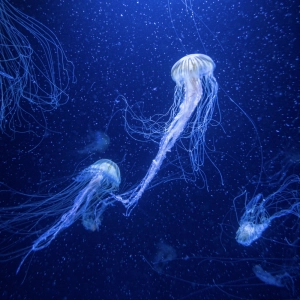
Tile image credit: Image by Sigmund via Unsplash
Many Minds is a project of the Diverse Intelligences Summer Institute, which is made possible by a generous grant from the Templeton World Charity Foundation to UCLA. It is hosted and produced by Kensy Cooperrider, with help from Assistant Producer Urte Laukaityte and with creative support from DISI Directors Erica Cartmill and Jacob Foster. Our artwork is by Ben Oldroyd. Our transcripts are created by Sarah Dopierala.
Subscribe to Many Minds on Apple, Stitcher, Spotify, Pocket Casts, Google Play, or wherever you listen to podcasts. You can also now subscribe to the Many Minds newsletter here!
We welcome your comments, questions, and suggestions. Feel free to email us at: manymindspodcast@gmail.com.
For updates about the show, visit our website or follow us on Twitter: @ManyMindsPod.