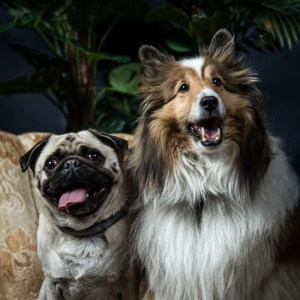
It's hard to say exactly when, but some tens of thousands of years ago, our best friends were born. I'm referring, of course, to dogs. This didn't happen overnight—it was a long process. And it not only changed how those canids behaved and what they looked like, it also changed their brains. As wolves gave way to proto-dogs, and proto-dogs gave way to dingoes and dalmatians and Dobermanns and all the rest, their brains have continued to change. What can we learn from this singular saga? What does it tell us about dogs, about domestication, and about brains?
My guest today is Dr. Erin Hecht. Erin is an Assistant Professor in the Department of Human Evolutionary Biology at Harvard, where she directs the Canine Brains Project.
Here Erin and I talk about how dogs are the most anatomically diverse species on the planet—and how their brains are no exception. We sketch the different waves in the dog domestication saga and discuss scenarios for how that saga got underway. We talk about how brains change as they get bigger and about how they change during domestication. We discuss a recent study by Erin and colleagues comparing the brains of modern dogs with the brains of pre-modern dogs like village dogs and New Guinea singing dogs. We also talk about a new study from Erin's lab finding that domestic dogs share with humans a key language-related structure. Along the way we talk about the Russian Farm Fox experiment, the stereotype of the gentle giant, the left lateralization of language, the respiratory condition known as BOAS, the dog personality inventory known as C-BARQ, the limitations of the idea of a "domestication syndrome," and the puppy kidnapping hypothesis.
Longtime listeners will recall that we had Erin on the show to talk about her work on fermentation and brain evolution. Given how much fun we had with that one, it was only a matter of time before we had her back to talk about her main line of research on dog brains. So here you go friends—hope you enjoy it!
Notes
4:30 – For one recent study of the early domestication of dogs, see here. For a review of leading hypotheses about what drove the wolf-to-dog transition, see here.
13:00 – For Dr. Hecht's initial 2019 study of brain variation across domestic dog breeds, see here.
20:00 – For a classic paper on the neurodevelopmental scaling by Dr. Barbara Finlay and colleagues, see here.
23:00 – For more of Dr. Hecht's work on neurodevelopmental scaling laws as they apply to dogs, see here. For a study reporting correlations between body size and personality in dogs, see here.
29:00 – See Dr. Hecht and colleagues' recent paper on the evolutionary neuroscience of domestication.
31:00 – See Dr. Hecht and colleagues' recent paper on brain changes seen in the Russian farm-fox experiment.
37:00 – For more on the idea of "domestication syndrome," see our recent episode with Dr. Kevin Lala and this critical discussion. For a classic treatment of the idea that domestication involves reduction in brain size, see here.
41:00 – For the recent study by Dr. Hecht and colleagues comparing the brains of modern and pre-modern dog breeds, see here.
43:00 – For video of a New Guinea Singing Dog singing, see here.
47:00 – For more about the dog personality inventory known as the C-BARQ, see here.
51:00 – For Dr. Hecht and colleagues' recent study on an analog to the "arcuate fasciculus" in dogs, see here.
58:00 – For Dr. Hecht and colleagues' study on arcuate fasciculus in chimpanzees (and its relationship to communicative behavior), see here. For more discussion of the hemispheric lateralization of language, see our recent interview with Dr. Ev Federenko.
1:04:00 – The website of the Functional Dog Collaborative.
Recommendations
Dogs: A New Understanding of Canine Origin, Behavior and Evolution, Raymond & Lorna Coppinger
Evolving Brains, John Allman
Tile image credit: Image by Paula Morin via Unsplash
Many Minds is a project of the Diverse Intelligences Summer Institute, which is made possible by a generous grant from the John Templeton Foundation to Indiana University. The show is hosted and produced by Kensy Cooperrider, with help from Assistant Producer Urte Laukaityte and with creative support from DISI Directors Erica Cartmill and Jacob Foster. Our artwork is by Ben Oldroyd.
Subscribe to Many Minds on Apple, Stitcher, Spotify, Pocket Casts, Google Play, or wherever you listen to podcasts. You can also now subscribe to the Many Minds newsletter here!
We welcome your comments, questions, and suggestions. Feel free to email us at: manymindspodcast@gmail.com.
For updates about the show, visit our website or follow us on Bluesky (@manymindspod.bsky.social).