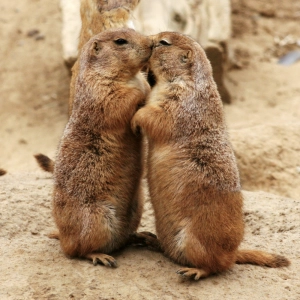
Humans do some pretty weird things. Some of us will sit in searingly hot rooms or jump into icy ponds. Others risk their lives trying to climb to new heights or dive to new depths. And every once in a while, two otherwise normal-seeming humans will lean in close to each other, open mouths, lock lips, and swap a hearty helping of microbes. You may even know people who've done this. But why? Are we the only animals who kiss? What could be the deeper origins of this truly bizarre behavior?
My guest today is Dr. Matilda Brindle. Matilda is an Evolutionary Biologist at the University of Oxford. She's interested in understanding the origins of behaviors and traits across the animal kingdom. But it's not just any traits she's interested in—she tends to favor those that are a bit risque.
Here, Matilda and I talk about the puzzle at the heart of human kissing behavior. We discuss the possible adaptive functions of kissing—and of romantic kissing in particular. We walk through her recent paper in which—drawing on observations across primates species—she and her colleagues reconstructed the phylogeny of kissing behavior. They found that kissing is present in almost all the Great Apes—and also in several species of monkeys—and that it may go back around 20 million years. We sketch different proposals for how kissing may have evolved, such as the idea that it originally grew out of "premastication"—the practice of chewing up food for infants and transferring that food by mouth. And, of course, we consider the cultural side of kissing—and how to make sense of the fact that, despite these ancient roots in the primate lineage, romantic kissing is by no means universal to all human groups.
Hope you enjoy this one, friends—offered in spirit of Valentine's Day, of course. Kissing may seem like a light-hearted or frivolous topic, but—as I hope you'll appreciate—it opens up some big, thorny, compelling questions. And, in fact, it's finally attracting serious attention from scholars of all kinds interested in the different dimensions of social behavior.
Without further ado, here's my interview with Dr. Matilda Brindle.
Notes
3:00 – Dr. Brindle's paper, 'A comparative approach to the phylogeny of kissing,' coauthored with Dr. Catherine Talbot and Dr. Stuart West.
10:00 – An academic review of "postcopulatory sexual selection."
15:45 – The study examining the convergence of oral microbiota in kissing couples. The same study quantified the amount of microbial transfer during kissing.
18:00 – For more on the "grass-in-ear" phenomenon among chimpanzees and other such arbitrary-seeming animal behaviors, see our earlier episode about animal cultures. For the more recent "grass-in-bum" phenomenon, see here.
21:30 – For Dr. Brindle's work on the adaptive functions of masturbation in primates, see here.
32:00 – For popular coverage of Dr. Brindle's work, highlighting the likelihood that humans and Neanderthals kissed, see here.
39:00 – The book, Biological Exuberance, by Bruce Bagemihl.
43:00 – For the study on the presence of romantic kissing across cultures, see here.
47:00 – For indirect (linguistic) evidence for the prevalence of "smell-kissing" across Southeast Asia, see here. For more on this style of greeting, see Kensy's post here.
50:00 – For the proposal that kissing is rooted in "oral grooming," see here.
58:00 – For the larger special issue on the origins of kissing, of which Dr. Brindle's paper is part, see here.
1:00:30 – For Dr. Brindle's work on "bacula" (aka "penis bones"), see here.
Recommendations
The Handshake, by Ella Al-Shamahi
Eve, by Cat Bohannon
Primate Sexuality, by Alan Dixson
Tile image credit: Image by Brocken Inaglory via Wikimieda Commons (CC BY-SA 3.0)
Many Minds is a project of the Diverse Intelligences Summer Institute, which is made possible by a generous grant from the John Templeton Foundation to Indiana University. The show is hosted and produced by Kensy Cooperrider, with help from Assistant Producer Urte Laukaityte and with creative support from DISI Directors Erica Cartmill and Jacob Foster. Our artwork is by Ben Oldroyd.
Subscribe to Many Minds on Apple, Stitcher, Spotify, Pocket Casts, Google Play, or wherever you listen to podcasts. You can also now subscribe to the Many Minds newsletter here!
We welcome your comments, questions, and suggestions. Feel free to email us at: manymindspodcast@gmail.com.
For updates about the show, visit our website or follow us on Bluesky (@manymindspod.bsky.social).