Thousands of languages are used around the world today, and this linguistic diversity is a precious part of our human heritage. But it's also more than that. Linguistic diversity provides clues—a vast crazy quilt of clues—about how language works, about how history has unfolded, about the dynamics of culture, and about the nature of the human mind.
My guest today is Dr. Damián Blasi. Damián is an ICREA Research Professor based at the Center for Brain & Cognition at the Pompeu Fabra University in Barcelona. Over the last decade or so, Damián's emerged as one of the most innovative researchers in the study of language and linguistic diversity. He's been widely recognized for this work, and most recently was awarded the 2026 FABSS Early Career Impact Award from the Cognitive Science Society.
In this conversation, Damián and I talk about why scientists should care about linguistic diversity. We do a bit of linguistic diversity 101—how many languages there are, how we can enumerate them, how they vary. We discuss a recent paper in which Damián and his colleagues reconstructed the explosive rise and precipitous fall of human linguistic diversity over the last 12,000 years. We talk about the factors that drive language change. And we discuss how cognitive science relies too much on English and English speakers—and how this may be holding the field back.
Along the way, Damián and I touch on the Tower of Babel, a golden age of linguistic diversity, the human bite configuration, scientific aesthetics, whether children shape language, polygenetic theories of language evolution, the pace of language change, schooling, linguistic inequality and behemoth languages, and why Damián thinks that the possibility space of human language might be bigger and wilder than we currently imagine.
This is a special episode of the Many Minds podcast. As I mentioned, Damián is this year's winner of an award from the Cognitive Science Society, in recognition of his outstanding early-career contributions to the field. He recently gave a keynote at the society's annual conference in Rio de Janeiro, and we've partnered with the Cognitive Science Society to feature this conversation about his work. I'll also mention that this wasn't my first time chatting with Damián—he's an alumnus of the Diverse Intelligences Summer Institute (DISI), the sponsor & incubator of this podcast. We met there a couple years ago, and so it was all the more fun to reconnect with him here.
Alright friends, without further ado, on to my conversation with Dr. Damián Blasi. Enjoy!
Notes
10:00 – The UNESCO page on multilingualism and linguistic diversity.
17:00 – The Ethnologue database.
20:00 – For examples of Dr. Blasi's work on "behemoth languages" and on how languages are not represented equally in terms of technological and development investment, see here and here.
26:00 - For the paper in which Dr. Blasi and colleagues introduced Grambank, see here. For the database itself, see here.
29:00 – For Dr. Blasi's earlier work on sound-meaning associations across languages, see here.
33:00 – For discussion of Darwin's views on monogenesis vs polygenesis and race, see our recent episode.
36:00 – For more about pronouns—and how they do and do not vary across the world's languages—see several chapters in the World Atlas of Language Structures.
39:00 – The paper—'Babies aren't persons'—by David Lancy.
41:00 - For Dr. Blasi and colleagues' recent Science paper on the rise and fall of human linguistic diversity, see here.
59:00 – For a recent study of linguistic diversification, including discussion of so-called schismogenesis, see here. For an example of Cristina Moya's work on ethnic identity in the Andes region, see here.
1:00:00 – For an example of Dr. Blasi's work on how ecology shapes language—a topic not discussed in this conversation—see here.
1:01:00 – For the study by Dr. Blasi and colleagues about changes in the human bite configuration and how these changes have shaped sound systems, see here.
1:14:00 – For the recent paper by Dr. Blasi and colleagues about the (non-)role of children in language change, see here.
1:22:00 – The paper by Dr. Blasi and colleagues about the over-reliance on English in the cognitive sciences (and how it hinders the field).
1:24:00 – See here for work by Aitor Egurtzegi, in collaboration with Dr. Blasi and others, on ergativity and gaze patterns across languages.
1:27:00 – For the preprint—'Which humans?'—led by Mohammad Atari (and including Dr. Blasi and others), see here.
1:30:00 – For a recent argument that psychology needs to overcome its "ahistorical" bent, see here.
Recommendations
A Myriad of Tongues, Caleb Everett
The Secret of Our Success, Joseph Henrich
Linguistic Diversity in Space and Time, Johanna Nichols
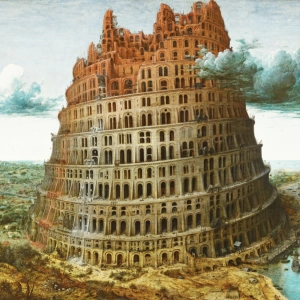
Tile art credit: Painting by Pieter Bruegel the Elder (detail)
Many Minds is a project of the Diverse Intelligences Summer Institute, which is made possible by a generous grant from the John Templeton Foundation to Indiana University. The show is hosted and produced by Kensy Cooperrider, with help from Assistant Producer Urte Laukaityte and with creative support from DISI Directors Erica Cartmill and Jacob Foster. Our artwork is by Ben Oldroyd.
Subscribe to Many Minds on Apple, Stitcher, Spotify, Pocket Casts, Google Play, or wherever you listen to podcasts. You can also now subscribe to the Many Minds newsletter here!
We welcome your comments, questions, and suggestions. Feel free to email us at: manymindspodcast@gmail.com.
For updates about the show, visit our website or follow us on Bluesky (@manymindspod.bsky.social).