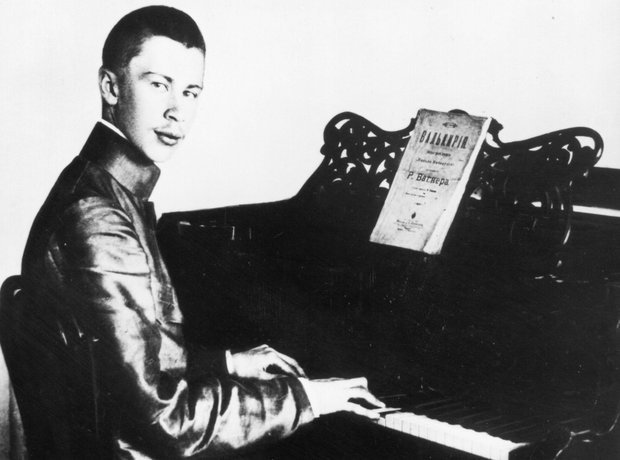
We mark the premiere on September 5, 1913 – 109 years ago today – of Sergei Prokofiev’s Piano Concerto No. 2. Prokofiev (1891-1953) composed the piece while still a student at the Saint Petersburg Conservatory; it was completed in April of 1913. (For our information, Prokofiev still had another year to go at the Conservatory; he didn’t graduate until May of 1914.)
The concerto received its premiere – 109 years ago today – at the Vauxhall at Pavlovsk, Pavlovsk being a sprawling Imperial palace, park, garden, and summertime concert venue some 19 miles south of St. Petersburg. The orchestra was conducted by Alexander Aslanov, who for many years led the summer concert series there at Pavlovsk. The piano solo – with its spectacularly difficult piano part – was performed by the then 22-year-old Prokofiev himself.
That premiere performance provoked quite an uproar from the audience. That uproar will be discussed at length in tomorrow’s Dr. Bob Prescribes post, which will be built around Prokofiev’s Piano Concerto no. 2.
For now, we are going to talk about what happened to the actual score of Prokofiev’s Second Piano Concerto. But first, some historical background without which there would be no context for the fire that is, along with Prokofiev’s Piano Concerto No. 2, the subject of today’s post.
Petrograd/Saint Petersburg on March 8, 1917: the Russian Revolution begins
Petrograd/St. Petersburg in 1917
For the residents of what was then the capital city of the Russian Empire, Petrograd (better known as “St. Petersburg”), the year 1917 was a dangerous, passionate, heady, exhilarating, and ultimately tragic year.
In was in March of 1917 that the horrific and ongoing sins of the Russian government under Tzar Nicholas II finally and forever came home to roost. At war since July 1914, the Tsarist government had shown itself to be utterly inept and corrupt, incapable of supplying adequate arms and food to its soldiers who died by the millions, often forcing peasant conscripts into battle against the Austrian/German enemy without rifles. On March 8, 1917, food riots broke out in Petrograd. Troops were called out, but they refused to fire on the rioters. Instead, by the hundreds, they themselves mutinied and joined the rioters.
It was anarchy.
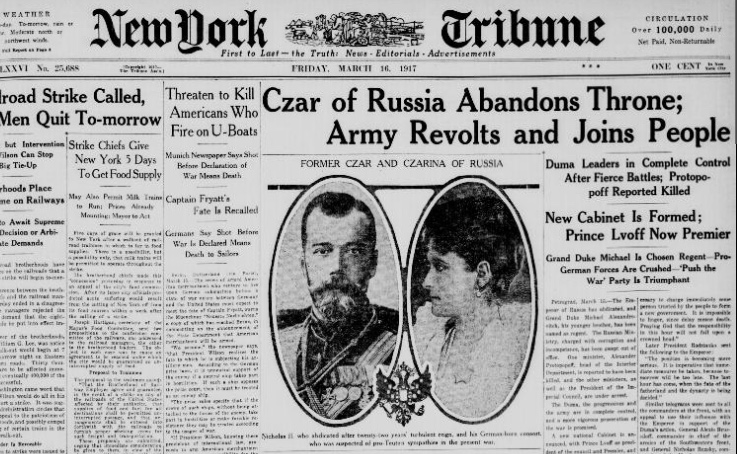
Seven days later – on March 15, 1917 – Tsar Nicholas abdicated his throne, bringing to an end 304 years of Romanov family rule.
The New York Times, March 16, 1917
On March 17, 1917, two days after Nicholas’ abdication, Russia became a republic ruled by a temporary, or “Provisional” Government. Sadly (and not for the last time), Russia’s brief flirtation with a republican government was not to last. The Provisional Government was, from day one, fatally flawed: it was far too moderate and far too closely associated with the Tsarist regime to be taken seriously by such far-left Marxist Socialist parties as the Bolsheviks, the Mensheviks, and the Social Revolutionists.
On April 16, 1917, Vladimir Lenin (born Vladimir Ilyich Ulyanov, 1870-1924) and his Bolshevik homies rode into town. Lenin had been in “exile” in Zurich, Switzerland. In what turned out to be a foreign policy triumph, the German government facilitated Lenin’s return to Russia, believing that his presence in Saint Petersburg (then the capital of the Russian Empire) would further destabilize Russia and help bring the war in the East to its conclusion. Which is exactly what happened.
Promising the soldiers, peasants, and workers “peace, land, and bread” the Bolsheviks quietly consolidated their power.
On the night of November 6-7, 1917, Lenin and his Bolsheviks made their move: they took over the telephone switchboards, the railway stations, and electric plants in Petrograd. The cruiser Aurora trained its guns on the Winter Palace, headquarters of the Provisional Government. A quickly assembled “Congress of Soviets” declared the Provisional Government dead as dial up and created in its place a “Council of People’s Commissars”, with Vladimir Lenin at its head. Leon Trotsky (1879-1940) was named commissar of foreign affairs, and the 38-year-old Joseph Stalin (1878-1953) became the commissar for nationalities.
All of these events were witnessed by an increasingly agitated (perhaps even an increasingly freaked-out?) Sergei Prokofiev.…
Every week, Music History Monday arrives with the kind of curiosity that turns dates on a calendar into doorways. Hosted by composer and historian Robert Greenberg, this podcast digs into the stories that happened *around* the music, finding the human moments-sometimes profound, sometimes scandalous, always fascinating-tied to a specific Monday. Greenberg approaches his subjects not as distant icons but as the complicated, brilliant, and often messy people they were, which makes each episode feel like a conversation rather than a lecture. You’ll hear about pivotal premieres, bitter rivalries, unexpected inspirations, and the sheer luck or misfortune that shaped the pieces we know today. The tone is erudite but never dry, packed with context and delivered with a wit that respects the art without putting it on a sterile pedestal. It’s for anyone who loves a good story and suspects that the history behind a symphony or a sonata is just as compelling as the notes themselves. Tune in each Monday with Robert Greenberg to connect the dots between a day in history and the soundtrack it inspired.
Author: Robert Greenberg
Language: en-us
Episodes: 100
Frontispiece to the Harmonice musices odhecaton A, published on May 15, 1501 On May 15, 1501 – 522 years ago today – the first polyphonic (that is, multi-part) music printed using moveable type was released to the public…