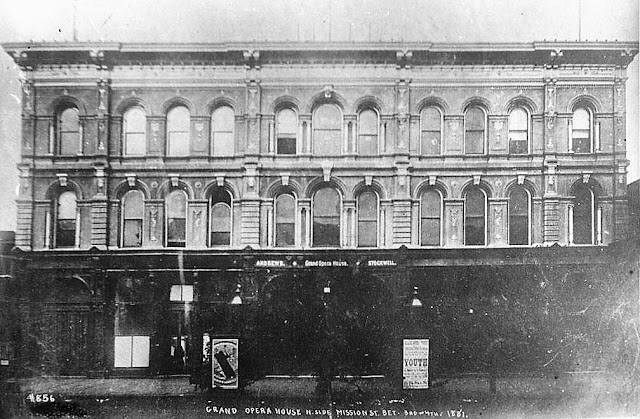
Grand Opera House (originally “Wade’s Opera House”), San Francisco, in 1881
We mark the final San Francisco performance – on the evening of Tuesday, April 17, 1906, 117 years ago today – of the great Italian tenor Enrico Caruso (1874-1921). That performance at the no longer extant Grand Opera House at No. 2 Mission Street (between 2nd and 3rd Streets) was not intended to have been Caruso’s last local appearance, but circumstances beyond his control assured that it was!
Enrico Caruso (1874-1921)
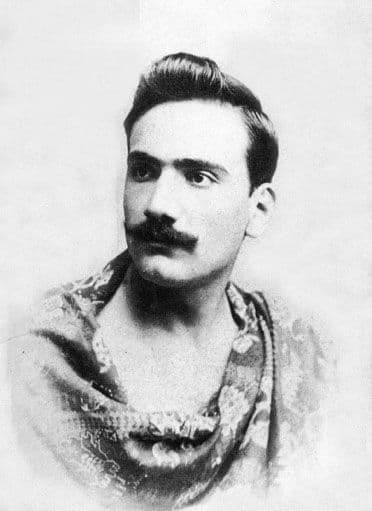
Enrico Caruso in one of his first publicity photos, taken in Sicily 1896 at the age of 24; he is wearing a bedspread draped like a toga since his only dress shirt was at the laundry
Caruso was born into a poor family in Naples, Italy, on February 24th, 1874. He was the third of seven children (and not the nineteenth of twenty-one, as Caruso himself often claimed!). Following in the professional footsteps of his father, Marcellino Caruso, who was a mechanic, young Enrico was apprenticed to a mechanical engineer at the age of 11. He “discovered” his voice singing in a church choir, and as a teenager he made a few extra dinero singing on the streets and in the cafes of Naples.
At the age of 18, Caruso had something of a revelation, when he used money he had earned as a singer to buy his first new pair of shoes. Realizing his real professional potential, he began taking voice lessons, and his progress was rapid.
The 21-year-old Caruso made his professional debut as an opera singer on March 15, 1895, when he sang in a now-forgotten opera (entitled L’Amico Francesco by Mario Morelli) at Naples’ Teatro Nuovo. He proceeded to pay his dues, singing a wide variety of roles in various provincial opera houses while continuing his vocal studies. He made his La Scala debut at the age of 26 on December 26, 1900, singing Rodolfo in Giacomo Puccini’s La bohème under the baton of Arturo Toscanini.
Caruso quickly became a fan favorite throughout Italy, but it was technology – a brand-new technology – that made him world famous.
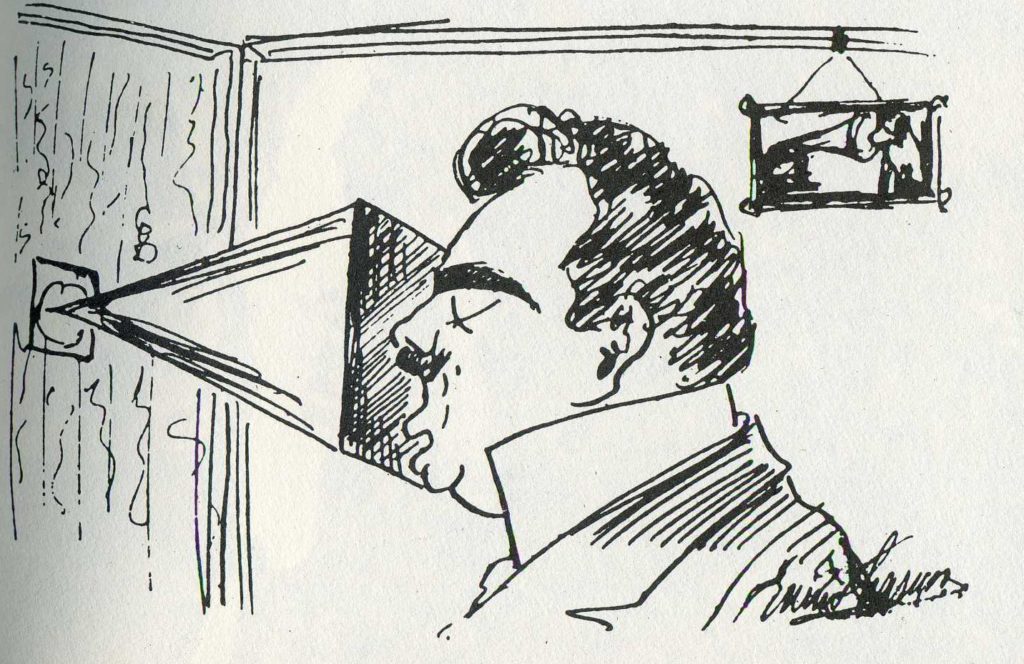
Self-caricature by Caruso himself, making his first records in a hotel room in Milan in April 1902; note the drawing of Nipper the dog listening to “his master’s voice” at the upper right, originally the logo of Emile Berliner’s The Gramophone Company
On April 11, 1902, Caruso walked into a hotel room in Milan which had been outfitted as a makeshift recording studio. On that day, for a fee of 100 pounds sterling, Caruso recorded 10 discs, becoming in the process the first opera singer to make a flat disc, 78 rpm record.
(For our information, those records were made for Emile Berliner’s The Gramophone Company. Founded in London in 1898, The Gramophone Company was the parent company of the record label His Master’s Voice (HMV), which was the American affiliate of the Victor Talking Machine Company. The Victor Talking Machine Company was acquired by RCA in 1929 and the new label was initially known as RCA Victor. In London, in a separate transaction, His Master’s Voice merged with the Columbia Gramophone Company in 1931 to create Electric and Musical Industries Limited, better known as the classical labels EMI and Angel.)
The records Caruso recorded in that Milanese hotel room made him an overnight sensation. Just weeks after they were released, Caruso was signed to sing at London’s Covent Garden. He made his Metropolitan Opera debut in a new production of Giuseppe Verdi’s Rigoletto on November 23, 1903, and from that day forward became the Met’s most popular tenor.
It was as a member of the Metropolitan Opera Company that Enrico Caruso came to perform in San Francisco, California, on April 17, 1906.…
Every week, Music History Monday arrives with the kind of curiosity that turns dates on a calendar into doorways. Hosted by composer and historian Robert Greenberg, this podcast digs into the stories that happened *around* the music, finding the human moments-sometimes profound, sometimes scandalous, always fascinating-tied to a specific Monday. Greenberg approaches his subjects not as distant icons but as the complicated, brilliant, and often messy people they were, which makes each episode feel like a conversation rather than a lecture. You’ll hear about pivotal premieres, bitter rivalries, unexpected inspirations, and the sheer luck or misfortune that shaped the pieces we know today. The tone is erudite but never dry, packed with context and delivered with a wit that respects the art without putting it on a sterile pedestal. It’s for anyone who loves a good story and suspects that the history behind a symphony or a sonata is just as compelling as the notes themselves. Tune in each Monday with Robert Greenberg to connect the dots between a day in history and the soundtrack it inspired.
Author: Robert Greenberg
Language: en-us
Episodes: 100
Claude Debussy (1862-1918) in 1902 We celebrate the birth on August 22, 1862 – 160 years ago today – of the French composer and pianist Claude Debussy. Born in the Paris suburb of St. Germain-en-Laye, he died in Paris on…