A quick comment in reference to the title of today’s post, “Papa’s Last Appearance.” Not that you really need me to tell you, but by “Papa” we are not referring to Papa John Schnatter, who founded “Papa John’s Pizza” in 1984. Neither are we referring to the stand-up comedian Tom Papa, the sportscaster Greg Papa, the American rock band Papa Roach, nor the American Paul Karason (1950-2013), also-known-as “Papa Smurf,” whose skin turned to a purplish-blue color as a result of ingesting a home-made brew of silver chloride colloid.
Papa Smurf (Paul Karason; 1950-2013)
By “Papa,” we are referring to Franz Joseph Haydn (1732-1809) who was once-and-forever nicknamed “papa” while still in his thirties by the grateful musicians who worked for him!
We mark what turned out to be the final public appearance of “Papa” Joseph Haydn on March 27, 1808 – 215 years ago today – at a concert held in honor of his upcoming 76th birthday. The gala concert, held at Vienna’s University Hall, featured a performance of Haydn’s oratorio The Creation, which had been completed ten years before, in 1798. The concert was what we would call today a “star-studded event”: everyone who was anyone in Vienna’s musical world was there, including Ludwig van Beethoven, Antonio Salieri, and Johann Nepomuk Hummel.
Background
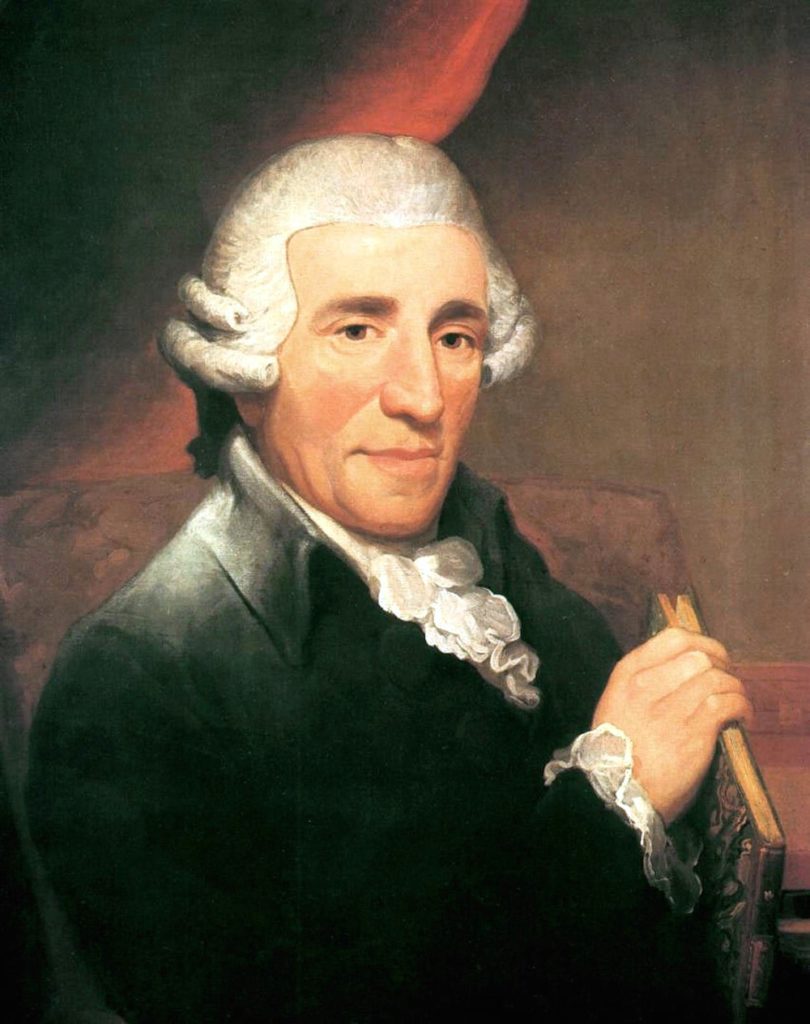
Joseph Haydn (1732-1809) in 1791, at the age of 59
Haydn was born on March 31, 1732, in the Austrian village of Rohrau, which at the time was just a hop-and-a-skip from the border with Hungary. He was a small, wiry, energetic, and genial boy, and he grew up to be a small, wiry, energetic, and genial man.
At a time when the average European life expectancy was just 33.3 years, Haydn remained a remarkably healthy man well into what was then considered to be old age. Having never travelled outside the immediate vicinity of his birth, Haydn undertook the arduous journey to England in 1791 at the age of 59, and then again in 1794, at the age of 62. Still composing masterworks into his 69th year (he completed his oratorio The Seasons in 1801), Haydn was considered an ageless wonder by everyone around him.
Unfortunately, no one of us is in fact “ageless,” and time caught up with Haydn when he was in his late sixties. Though he lived until May of 1809, his last years were marred by increasingly bad health. His symptoms – swollen legs, exhaustion, failing memory – point to a general case of arteriosclerosis, or “hardening of the arteries.” While symptoms of the disease first became apparent in 1799, Haydn’s health declined precipitously after 1805, by which time, at the age of 73, he was for all intents and purposes an invalid.
However, Haydn had the rare pleasure of knowing that in his old age he had not been forgotten. His ongoing popularity was astonishing, and from every corner of Europe, medals, awards, honors, and proclamations poured into his home in the Viennese suburbs. …
Every week, Music History Monday arrives with the kind of curiosity that turns dates on a calendar into doorways. Hosted by composer and historian Robert Greenberg, this podcast digs into the stories that happened *around* the music, finding the human moments-sometimes profound, sometimes scandalous, always fascinating-tied to a specific Monday. Greenberg approaches his subjects not as distant icons but as the complicated, brilliant, and often messy people they were, which makes each episode feel like a conversation rather than a lecture. You’ll hear about pivotal premieres, bitter rivalries, unexpected inspirations, and the sheer luck or misfortune that shaped the pieces we know today. The tone is erudite but never dry, packed with context and delivered with a wit that respects the art without putting it on a sterile pedestal. It’s for anyone who loves a good story and suspects that the history behind a symphony or a sonata is just as compelling as the notes themselves. Tune in each Monday with Robert Greenberg to connect the dots between a day in history and the soundtrack it inspired.
Author: Robert Greenberg
Language: en-us
Episodes: 100